Generalization and Maintenance: Programming for Success and Passing Related BCBA® Questions
By BCBA Mock Exam
Introduction
Generalization and maintenance are where real behavior change either succeeds or quietly falls apart.
For the BCBA® exam, you’re not just expected to define these terms—you’re expected to:
-
Recognize when a program has failed to promote generalization or maintenance
-
Choose strategies that increase the chances skills will last and transfer
-
Decode vignettes where a client performs well in sessions but not in the “real world”
In this article, we’ll walk through:
-
What generalization and maintenance mean in ABA
-
How to program for both from the start (not as an afterthought)
-
Common BCBA® question patterns and traps
-
Mini exam-style questions with explanations so you can test your understanding.
1. What Are Generalization and Maintenance in ABA?
Before you can master exam questions, you need clear, working definitions.
Generalization
-
Generalization means behavior change extends beyond the training context.
-
In practice, that looks like behavior occurring:
-
With new people (parents, teachers, peers)
-
In new settings (home, school, community)
-
With new materials or stimuli (different worksheets, toys, prompts)
-
Or in new response forms that still serve the same function (response generalization)
-
Maintenance
-
Maintenance means a behavior continues to occur over time after intervention has changed or been faded.
-
The skill doesn’t disappear the moment prompts, tokens, or dense reinforcement schedules are removed.
Exam tip:
-
Generalization = where/with whom/under what conditions the behavior occurs.
-
Maintenance = whether it persists over time after training or supports are changed.
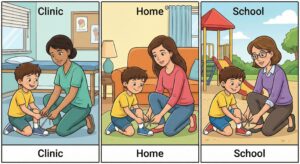
A visual example of generalization: The skill of tying shoes is demonstrated in the clinic with a therapist, at home with a parent, and at school with a teacher.
2. Types of Generalization You Need to Recognize
On the BCBA® exam, generalization can show up in slightly different flavors. You should be able to spot each one in a vignette.
Setting (environmental) generalization
-
Behavior occurs in places other than the original training setting.
-
Example: A client uses a visual schedule independently at home and at school.
People (mediator) generalization
-
Behavior occurs with various people, not just the therapist who trained it.
-
Example: A child greets peers, teachers, and family members after learning greetings with an RBT.
Stimulus generalization
-
The same response occurs in the presence of different but similar stimuli.
-
Example: Saying “dog” when seeing multiple breeds and pictures.
Response generalization
-
Different responses appear that serve the same function.
-
Example: A learner is taught to say “Help” and later also says “Can you help me?” or “I need help,” even though those extra phrases weren’t directly trained.
Exam tip:
-
Many questions won’t label the type—they’ll just describe a scenario and ask what’s missing or what to add to promote generalization.
3. Why Generalization and Maintenance Matter for the Exam (and Real Life)
From a practical standpoint:
-
A beautifully graphed skill that only happens at the therapy table is not a successful outcome.
-
Skills that disappear when reinforcement thins or staff change are also failures in real-world terms.
On the BCBA® exam, generalization and maintenance are embedded in questions about:
-
Treatment planning (how to design for real-world success)
-
Evaluating effectiveness (why progress doesn’t show up at home or school)
-
Ethical practice (are we producing meaningful, durable behavior change?)
If a question describes strong performance only in training sessions and poor performance elsewhere, your brain should immediately flag: 🛑 Generalization and/or maintenance issues.
4. Programming for Generalization: Don’t Wait Until the End
One of the biggest exam themes: program generalization from the start, not as an afterthought.
Common strategies to promote generalization:
Multiple exemplar training
-
Teach the skill using many examples of stimuli and situations.
-
Example: When teaching “big vs small,” use different objects, pictures, and contexts instead of just one set of blocks.
Train across people, settings, and materials
-
Rotate therapists, caregivers, rooms, and materials during training.
-
Example: Practice manding for break with the BCBA, RBT, teacher, and parent.
Program common stimuli
-
Include stimuli that will exist in the natural environment within training.
-
Example: Use the same picture schedule in the clinic that will later be used in the classroom.
Teach loosely
-
Vary noncritical elements (tone of voice, seating, wording of instructions) to prevent overly rigid stimulus control.
Mediating generalization
-
Teach self-instructions, rules, or self-management strategies that the learner can carry across contexts.
-
Example: Teaching a rule like “If I don’t know what to do, I ask for help.”
Exam tip:
-
When a stem asks, “What is the BEST way to promote generalization?” the strongest answers usually:
-
Add multiple exemplars, and/or
-
Add people/settings/materials, and/or
-
Incorporate common stimuli.
-
5. Programming for Maintenance: Fading, Natural Reinforcement, and Schedules
Maintenance doesn’t happen by accident—you have to plan for it.
Key strategies:
1. Thin reinforcement schedules gradually
-
Move from dense, artificial schedules (e.g., FR1 tokens) to:
-
Intermittent schedules (e.g., VR, VI)
-
Naturally occurring reinforcement (praise, access to real-life outcomes)
-
2. Shift from contrived to natural reinforcers
-
Start with tokens, edibles, or special toys if needed.
-
Gradually fade toward reinforcers that naturally follow the behavior (peer approval, success on tasks, independence).
3. Build in self-management
-
Teach the learner to monitor and reinforce their own behavior (with adult oversight initially).
-
Example: Checklists, self-recording, self-delivered rewards.
4. Schedule maintenance probes
-
Plan for periodic probe sessions after formal teaching ends to verify the skill is still present.
-
Example: Probing safety skills once a month.
Exam tip:
-
When items ask how to ensure behavior continues after services decrease, look for:
-
Intermittent reinforcement,
-
Natural reinforcement, and/or
-
Caregiver/teacher implementation and self-management.
-
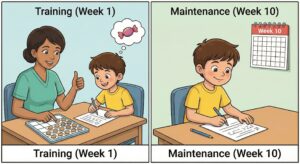
A visual example of maintenance: A skill is initially taught with dense reinforcement (tokens) and an instructor. Weeks later, the skill is maintained independently with no instructor and natural reinforcement.
6. Data Collection for Generalization and Maintenance
The exam won’t expect complex statistics, but it will expect conceptual clarity.
Generalization data
-
Collect data in non-training contexts:
-
Different people (parent vs therapist)
-
Different settings (home vs clinic)
-
Different materials (new worksheets, toys, environments)
-
-
Use probe sessions to see if the behavior occurs without prompting or dense reinforcement.
Maintenance data
-
Measure the behavior at planned intervals after formal teaching or intensive intervention has ended.
-
You may see wording like “maintenance probes at 2 weeks, 1 month, 3 months.”
Exam tip:
-
If the stem describes data only from training sessions, and asks how to tell if behavior generalized or maintained, the correct answer usually involves:
-
Collecting data in other settings/with other people, or
-
Conducting follow-up maintenance probes.
-
7. How Generalization and Maintenance Show Up on the BCBA® Exam
Expect these common patterns:
1️⃣ Scenario where the skill is “mastered” in session but not at home
-
Likely a generalization issue.
-
Best answer: add programming across caregivers/settings, common stimuli, multiple exemplars.
2️⃣ Scenario where skill disappears after services fade
-
Maintenance problem.
-
Best answer: schedule intermittent reinforcement, use natural consequences, train caregivers, or add self-management.
3️⃣ Dimension of ABA questions
-
Generalization and maintenance relate to the dimension of Generality (Baer, Wolf, & Risley).
-
If asked which dimension is missing when behavior only occurs in the clinic, the answer is usually “Generality.”
4️⃣ Intervention selection
-
Choosing strategies that explicitly promote generalization or ensure maintenance when modifying a plan.
5️⃣ Error analysis
-
Identifying that a BCBA declared a skill mastered too early—before checking for generalization or maintenance.
8. Common BCBA® Exam Traps with Generalization and Maintenance
Trap 1 – Assuming generalization because one setting shows improvement
-
Improvement in the clinic alone does not equal generalization.
Trap 2 – Calling it maintenance when the skill was never really mastered
-
Maintenance refers to behavior after it has been acquired under stable conditions.
Trap 3 – Using only caregiver report to claim generalization
-
On exam questions, the best practice is to obtain objective data, not just subjective reports.
Trap 4 – Over-relying on prompts
-
If prompts are not faded, behavior may not maintain or generalize when prompts are absent.
Trap 5 – Forgetting to consider reinforcement
-
If the environment outside of sessions does not reinforce the new behavior, generalization and maintenance are unlikely.
-
The exam often rewards answers that consider whether natural reinforcement is present.
9. Mini BCBA® Exam–Style Questions (With Explanations)
Question 1 – Generalization vs Maintenance A student learns to independently use a checklist to complete a 5-step morning routine in the resource room. Two months later, without additional teaching, the student continues to use the checklist successfully in the same room. However, at home the parent reports the student does not use any checklist.
What statement is MOST accurate? A. The skill has generalized but not maintained B. The skill has maintained in the training setting but has not generalized to the home setting C. The skill has generalized but not maintained D. The skill has neither generalized nor maintained
Correct Answer: B Explanation: The skill continues over time in the resource room (maintenance), but it does not occur at home (lack of generalization).
Question 2 – Programming for Generalization A BCBA wants a child to use a functional communication response (FCR) to request a break instead of engaging in tantrums. The child currently uses the FCR only with the RBT in the clinic. Which change would BEST promote generalization?
A. Increase the amount of edibles given for using the FCR in clinic B. Train parents and teachers to prompt and reinforce the FCR in home and school settings C. Add a punishment procedure when tantrums occur in the clinic D. Delay reinforcement for the FCR to make it more effortful
Correct Answer: B Explanation: Training multiple mediators (parents, teachers) and reinforcing the FCR in new settings directly promotes generalization.
Question 3 – Maintenance Strategy A learner has mastered independently tying their shoes in a clinic setting. The BCBA wants to ensure this skill maintains after direct services have faded. Which strategy is MOST appropriate?
A. Continue daily massed practice with continuous reinforcement indefinitely B. Transition to intermittent reinforcement and have caregivers naturally praise and rely on the skill during daily routines C. Eliminate all reinforcement to see if the behavior maintains on its own D. Only collect data during intensive teaching sessions
Correct Answer: B Explanation: Moving to intermittent reinforcement and relying on natural reinforcement in daily life supports maintenance.
Question 4 – Identifying a Generalization Problem A client performs a safety routine correctly with their BCBA in the clinic but fails to perform it during community outings with parents. Data show high accuracy in clinic sessions and near-zero accuracy in the community.
What is the MOST reasonable conclusion? A. The skill was never actually acquired B. The skill has generalized but not maintained C. The skill has not generalized to relevant real-world settings D. The BCBA should immediately abandon the safety goal
Correct Answer: C Explanation: The skill is present in one context but not another, indicating a generalization problem.
10. Key Takeaways
-
Generalization: Behavior occurs in new settings, with new people, or under new conditions.
-
Maintenance: Behavior continues over time after formal teaching and dense reinforcement are reduced.
-
Effective programming includes:
-
Multiple exemplars
-
Training across people, settings, and materials
-
Common stimuli and teaching loosely
-
Gradual thinning of reinforcement and reliance on natural consequences
-
Self-management and caregiver involvement
-
On the BCBA® exam, whenever you see “it works in session but not at home” or “it stopped after services ended,” think: 🤔 “Is this a generalization issue, a maintenance issue, or both—and what strategy best addresses it?”
Once you internalize that question, generalization and maintenance items become much more straightforward, both on the test and in real practice.
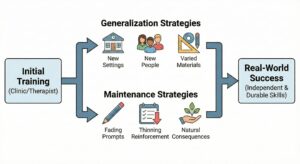
A visual summary of how generalization and maintenance strategies lead to real-world success.