Functional Analysis vs Descriptive Assessment: When to Use What and How to Read Exam Scenarios
By BCBA Mock Exam
Introduction
Functional assessment is at the heart of applied behavior analysis—and the BCBA® exam expects you to clearly distinguish between functional analysis (FA) and descriptive assessment.
On test day, you’ll see questions that ask you to:
-
Decide whether FA or descriptive methods are most appropriate in a scenario
-
Interpret results from both types of assessment
-
Recognize limitations and common errors
In this article, we’ll walk through:
-
What functional analysis is and how it works
-
What descriptive assessment is and what it can (and cannot) tell you
-
When to choose each method
-
How BCBA® exam questions typically frame FA vs descriptive assessment
-
Common exam traps, plus mini exam-style questions with explanations.
1. Big Picture: Why Functional Analysis vs Descriptive Assessment Matters
Both FA and descriptive assessment aim to identify the function of problem behavior—but they do so in very different ways.
At a high level:
-
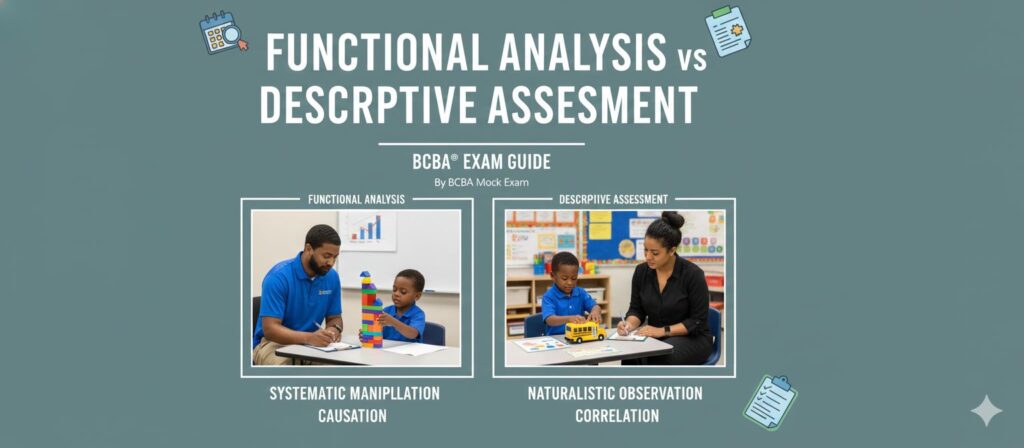
Functional analysis (FA): You systematically manipulate antecedents and consequences to see what actually causes behavior to change.
-
Descriptive assessment: You observe and record behavior and environmental events as they occur naturally, without manipulating them.
On the BCBA® exam, you need to know:
-
Which methods provide experimental (causal) information
-
Which methods give correlational information
-
Practical and ethical considerations for choosing one over the other.
2. What Is Functional Analysis (FA)?
A functional analysis (FA) is an experimental procedure in which you systematically test hypotheses about the function of problem behavior by arranging specific antecedents and consequences.
Key features:
-
You manipulate environmental variables (antecedents and consequences).
-
You compare rates of behavior across different test conditions and a control condition.
-
You draw causal conclusions: When we arrange X, behavior increases; when we don’t, it decreases.
Why it matters:
-
FA is considered the gold standard for identifying function because it demonstrates functional relations, not just correlations.
Typical functions tested:
-
Attention
-
Escape
-
Tangible (access to items/activities)
-
Automatic (sensory)
Exam tip: If the stem describes systematic manipulation of consequences across different conditions, you are looking at a functional analysis (or variant), not a descriptive assessment.
3. Standard Functional Analysis Conditions (Iwata-style)
Many BCBA® exam questions are based on the classic Iwata et al. FA format.
Typical conditions:
Attention condition
-
Antecedent: Therapist is “busy” and withholds attention.
-
Consequence: Problem behavior produces brief attention (e.g., reprimands, concern).
-
Function tested: Social positive reinforcement (attention).
Escape (demand) condition
-
Antecedent: Presentation of task demands.
-
Consequence: Problem behavior results in brief escape (removal of task).
-
Function tested: Social negative reinforcement (escape).
Alone/Ignore condition
-
Antecedent: Minimal stimulation; no programmed consequences.
-
Consequence: Problem behavior produces no social consequences.
-
Function tested: Automatic reinforcement (if behavior persists without social consequences).
Play (control) condition
-
Antecedent: Noncontingent attention, access to preferred items, no demands.
-
Consequence: Problem behavior does not produce specific consequences.
-
Purpose: Provides a low-rate baseline for comparison.
Sometimes a tangible condition is added:
-
Consequence: Problem behavior produces access to preferred items.
-
Function tested: Tangibles as reinforcers.
Exam tip: Many questions ask which condition to include or add based on a suspected function (e.g., add a tangible condition if caregivers report behavior occurs when denied toys).
4. Variations of Functional Analysis
The BCBA® exam may also reference FA variations designed to increase feasibility and safety:
Brief FA
-
Shorter sessions, fewer repetitions.
-
Useful in applied settings with time constraints.
Trial-based FA
-
FA components embedded into ongoing activities (e.g., classroom routines).
-
Test and control segments conducted in short trials.
Latency-based FA
-
Measure latency to first response instead of rate.
-
Useful when behavior is low in frequency but dangerous.
Synthesized or IISCA-type analyses (conceptual awareness only)
-
Combine multiple contingencies (e.g., attention + escape + tangibles) into test conditions.
-
Focus on ecologically valid response–reinforcer relations.
Exam tip: You do not need deep procedural details, but you should recognize that FA can be adapted to fit context, safety, and practicality.
5. What Is Descriptive Assessment?
Descriptive assessment involves observing behavior in natural environments and recording events that occur before and after behavior, without systematically manipulating them.
Key point:
-
Descriptive methods identify correlations, not causal relations.
Why we use descriptive assessment:
-
To generate hypotheses about function before conducting an FA.
-
When FA is not feasible or temporarily contraindicated (e.g., severe risk, limited resources).
-
To understand real-world patterns and inform treatment.
On the BCBA® exam, descriptive assessment is often contrasted with FA around the theme: “Correlation vs causation.”
6. Types of Descriptive Assessment
Common descriptive methods you need to recognize:
ABC (antecedent–behavior–consequence) data
-
Record what happens before behavior (A), the behavior itself (B), and what happens after (C).
-
Can be narrative (open-ended) or structured (checklist, partial interval, etc.).
Scatterplot data
-
Record time-of-day or activity-based patterns of behavior.
-
Helps identify when behavior is more or less likely to occur.
Continuous or narrative recording
-
Detailed descriptions of ongoing events, often used to detect patterns.
Indirect assessment (related but not descriptive observation)
-
Interviews, rating scales, questionnaires (e.g., FAST, QABF).
-
Rely on report rather than direct observation.
Exam tip: Descriptive assessment = direct observation in natural contexts. Indirect assessment = reports from others; often paired with descriptive or experimental methods.
7. Functional Analysis vs Descriptive Assessment: Pros, Cons, and When to Use Which
Functional Analysis (FA)
Pros:
-
Demonstrates causal relations between variables and behavior.
-
Provides strong basis for function-based interventions.
Cons:
-
Requires time, expertise, and controlled conditions.
-
May temporarily evoke problem behavior intentionally.
-
May not always be feasible for very dangerous or low-frequency behaviors.
Descriptive Assessment
Pros:
-
Easier to implement in natural settings.
-
Can be done with fewer resources.
-
Useful for hypothesis generation and understanding context.
Cons:
-
Only reveals correlations.
-
Can be misleading (e.g., attention often follows problem behavior regardless of function).
-
Not sufficient alone for strong causal conclusions.
When to consider FA (exam perspective):
-
When you need clear functional relations to design treatment.
-
When behavior can be safely and ethically tested.
-
When descriptive and indirect assessments are inconclusive or conflicting.
When to rely more on descriptive/indirect methods:
-
When FA poses significant risk (e.g., severe self-injury, dangerous aggression) and you cannot safely proceed.
-
When resources are limited and you’re in an early hypothesis-generating phase.
-
When behavior is very low frequency, making FA difficult to conduct.
Exam tip: The exam often favors FA when feasible and safe, but expects you to recognize when descriptive methods are more appropriate initially.
8. How Functional Analysis vs Descriptive Assessment Shows Up on the BCBA® Exam
Common patterns:
1. Identify the method
-
Is the scenario describing an experimental FA or just descriptive observation?
2. Choose the next step
-
After indirect and descriptive assessments yield mixed results, what is the most appropriate next assessment? (Often FA.)
3. Interpret outcomes
-
Given data from an FA (e.g., higher rates in attention and escape conditions), identify the maintaining function(s).
-
Given descriptive data (e.g., attention follows behavior 80% of the time), recognize that this suggests—but does not prove—an attention function.
4. Ethical and practical decisions
-
Deciding when an FA is contraindicated or needs modification.
5. Error analysis
-
Spotting situations where someone draws causal conclusions from descriptive data or mislabels an informal observation as “functional analysis.”
9. Common BCBA® Exam Traps with FA vs Descriptive Assessment
Trap 1 – Treating descriptive data as proof of function
-
Just because attention often follows behavior does not prove attention is the maintaining reinforcer.
Trap 2 – Calling any observation a “functional analysis”
-
FA requires systematic manipulation of variables. Watching and taking notes is descriptive, not FA.
Trap 3 – Ignoring safety and ethics
-
If an FA as described would clearly place a client at unreasonable risk, your best answer may involve modifying or delaying FA, using alternative strategies first.
Trap 4 – Overusing FA when descriptive methods would be sufficient for minor behavior
-
The exam sometimes expects you to recognize that very minor, low-risk behavior might not warrant a full FA.
Trap 5 – Confusing indirect, descriptive, and experimental levels
-
Indirect: interviews, rating scales.
-
Descriptive: direct observation without manipulation.
-
FA: systematic manipulation. The exam expects you to keep these levels straight.
10. Mini BCBA® Exam–Style Questions (With Explanations)
Question 1 – Identifying the Method
A BCBA observes a student in the classroom for several days, recording the antecedents and consequences surrounding instances of disruptive behavior. No conditions are manipulated; the BCBA simply watches and records what happens.
This is an example of: A. Functional analysis B. Descriptive assessment C. Indirect assessment D. Latency-based functional analysis
Correct Answer: B – Descriptive assessment
Explanation: The BCBA is directly observing and recording behavior and environmental events without manipulating variables.
Question 2 – When to Use FA
After interviews and ABC data collection, a BCBA has conflicting hypotheses: teachers think the behavior is escape-maintained, while parents think it is attention-maintained. The behavior is frequent but not dangerous.
What is the MOST appropriate next step? A. Immediately implement an escape extinction procedure B. Conduct a functional analysis to clarify the function C. Discontinue assessment and focus on academic goals D. Use only teacher report to design treatment
Correct Answer: B – Conduct a functional analysis
Explanation: With conflicting hypotheses and non-dangerous behavior, an FA is appropriate to determine the maintaining variables.
Question 3 – Descriptive Data Limitations
A BCBA’s ABC data show that attention from staff follows aggression in 90% of observed episodes. However, no FA has been conducted.
Which conclusion is MOST appropriate? A. Aggression is conclusively attention-maintained B. Attention is correlated with aggression, but further assessment is needed to confirm function C. Aggression must be automatically reinforced D. The BCBA should immediately begin time-out without more data
Correct Answer: B
Explanation: Descriptive data reveal correlations, not causal relations. An FA or further assessment is needed to confirm the function.
Question 4 – Safety and FA
A client engages in severe self-injury that has led to multiple hospitalizations. The team suspects escape-maintained behavior. The BCBA considers an FA but is concerned that deliberate evocation of self-injury in test conditions may pose excessive risk.
What is the BEST course of action? A. Conduct a standard multi-condition FA with long sessions B. Avoid any assessment and choose treatment randomly C. Consider modified assessment strategies (e.g., brief or latency-based FA, additional descriptive data) and prioritize safety D. Rely solely on staff opinion and skip all data collection
Correct Answer: C
Explanation: When standard FA poses high risk, the BCBA should consider modified or alternative strategies that prioritize safety while still attempting to identify function.
11. Key Takeaways
-
Functional analysis (FA) involves experimental manipulation of variables to identify causal functions of behavior.
-
Descriptive assessment involves direct observation of behavior and its natural antecedents and consequences, yielding correlational data.
-
FA is the strongest method for identifying function but must be balanced with ethical and safety considerations.
-
Descriptive methods are useful for hypothesis generation and for contexts where FA is difficult or risky.
-
On the BCBA® exam, always ask:
-
Are variables being manipulated (FA) or only observed (descriptive)?
-
Is the conclusion about function warranted by the level of assessment?
-
What is the safest, most effective next step in assessment or treatment?
-
Keeping these distinctions clear will help you navigate tricky exam scenarios and design better assessments in real-world practice.