Accurate measurement forms the foundation of effective applied behavior analysis. Two fundamental measurement procedures—frequency and duration data—serve distinct purposes in capturing different dimensions of behavior. Understanding when to use each method is crucial for both clinical practice and exam success.
Table of Contents
- Defining Frequency and Duration Data: The Core Distinction
- Applied Examples: From ABC to Data Collection
- BCBA Exam Focus: Traps, Tips, and Practice
- Quick-Reference Checklist for Practitioners
- Final Summary and Next Steps
This guide breaks down the core distinctions, provides practical examples, and offers strategies for making the right measurement choice in any situation.
Defining Frequency and Duration Data: The Core Distinction
Before collecting data, you must determine which dimension of behavior matters most. The choice between frequency and duration recording depends entirely on your clinical question.
What is Frequency (Count) Data?
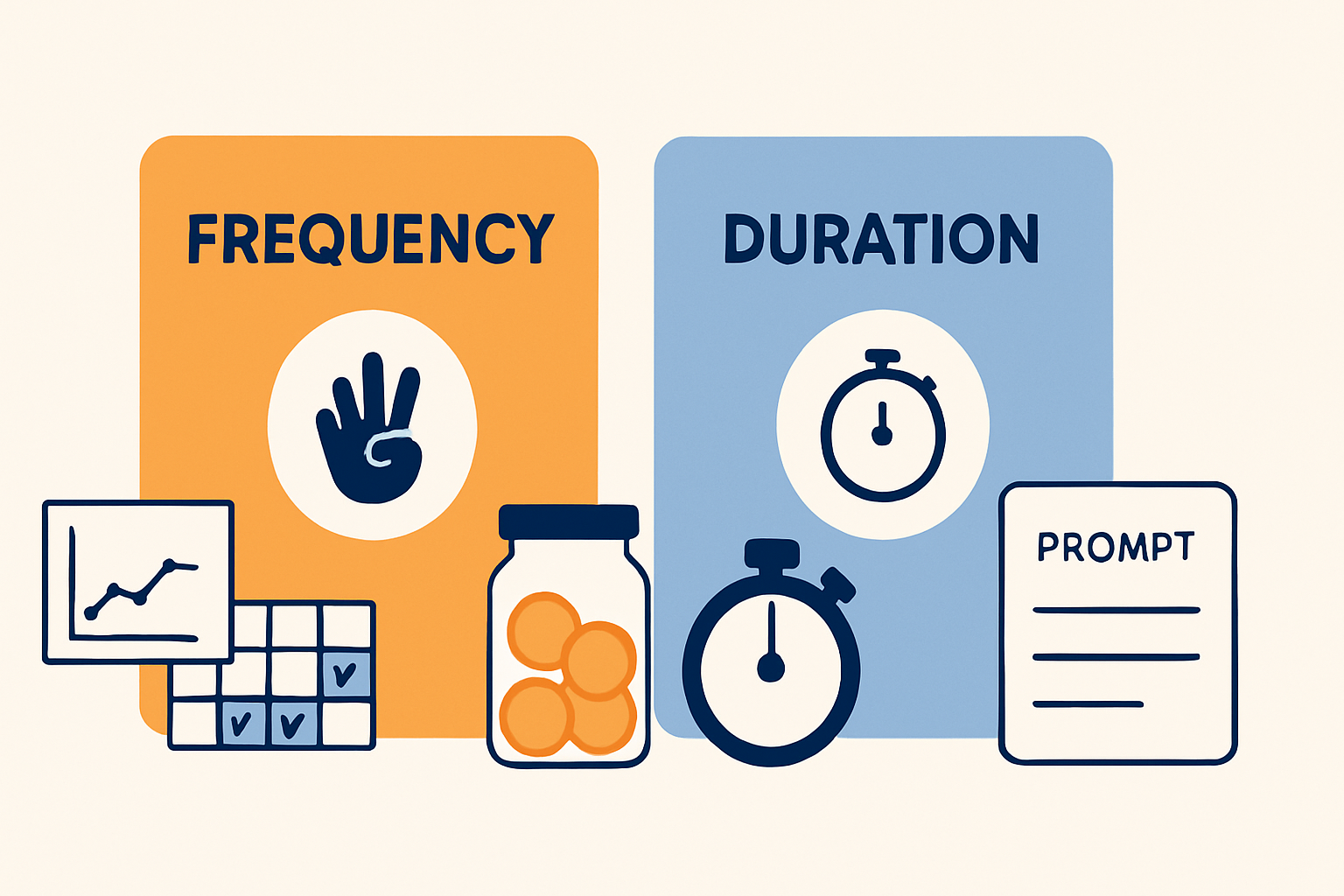
Frequency data, also called event recording, involves counting how many times a behavior occurs during an observation period. This method works best for discrete behaviors with clear beginnings and endings.
For more meaningful analysis, practitioners often convert raw counts to rate by dividing the count by observation time. This allows fair comparisons across sessions of different lengths.
What is Duration Data?
Duration data measures how long a behavior lasts from start to finish. This method captures the temporal dimension of behavior when the length of occurrence is clinically relevant.
Related concepts include total duration (sum of all behavioral episodes) and latency (time from antecedent to behavior onset). Both fall under the broader category of temporal measurement.
The Key Question: Count or Time?
Ask yourself: “Do I care about how many times this happens, or how long it lasts?” The answer determines your measurement approach.
This decision must align with your operational definition. A poorly matched measurement method will produce misleading data, regardless of collection accuracy.
Applied Examples: From ABC to Data Collection
Let’s examine practical scenarios demonstrating proper application of each measurement method. Each example includes antecedent-behavior-consequence analysis and hypothesized function.
Example 1: Frequency Data for Hand Raising
Scenario: Elementary classroom during group instruction. Antecedent: Teacher asks a question to the whole class. Behavior: Student raises hand. Consequence: Teacher calls on student. Function: Access to adult attention and opportunity to answer.
Data Plan: Use tally marks to count each hand raise during the 30-minute lesson. Calculate rate per minute by dividing total count by 30. This frequency recording captures participation attempts effectively.
Example 2: Duration Data for Tantrum Behavior
Scenario: Home setting after denied access. Antecedent: Parent says “no” to preferred snack. Behavior: Crying, flopping to floor, screaming. Consequence: Parent provides snack after 5 minutes. Function: Access to tangibles.
Data Plan: Start stopwatch when tantrum begins (meets operational definition criteria). Stop when behavior ends (meets cessation criteria). Record total duration of each episode. This captures the behavior’s impact on daily routines.
Example 3: Choosing the Wrong Measure (Common Mistake)
Scenario: Measuring “off-task behavior” defined as “looking away from work materials.” Using frequency would be misleading—ten brief glances versus one long stare both count as 10 occurrences.
Better Approach: Use duration recording or momentary time sampling to capture time spent off-task. This better reflects the behavior’s actual impact on work completion.
BCBA Exam Focus: Traps, Tips, and Practice
Exam questions often test your ability to select appropriate measurement procedures based on behavioral definitions and clinical goals.
Common Exam Traps and Misconceptions
- Confusing frequency with rate: Frequency is raw count; rate is count divided by time
- Using frequency for non-discrete behaviors: Continuous behaviors like humming or rocking don’t have clear start/stop points
- Forgetting duration variations: Duration data can be reported as total duration, percentage of session, or average duration
- Ignoring the operational definition: Always match your measurement to the definition provided in the vignette
- Overlooking measurement practicality: Some behaviors occur too frequently for accurate frequency counting
Sample Exam-Style Practice Prompts
Prompt 1: “A teacher wants to reduce interruptions during lectures. The behavior is defined as ‘calling out without raising hand.’ Which measurement is most appropriate?”
Answer: Frequency/rate recording. The behavior is discrete, and the number of occurrences matters most.
Prompt 2: “A parent wants to decrease time spent playing video games. The behavior is ‘engaged with gaming console.’ Which measurement?”
Answer: Duration recording. The length of engagement is the primary concern.
Prompt 3: “A therapist wants to measure how quickly a child responds to instructions. The behavior is ‘initiating the requested task.’ Which measurement?”
Answer: Latency recording (a type of temporal measurement). This requires timing from instruction to response initiation.
Quick-Reference Checklist for Practitioners
Use this clinical decision guide to select the right measurement method for any behavior.
When to Choose Frequency (Count) Recording
- Behavior has clear start and end points (discrete)
- The number of occurrences is the primary clinical concern
- Behavior doesn’t occur at excessively high rates that make counting impossible
- You need to calculate rate for fair session comparisons
- Examples: hand raising, aggression instances, correct responses, interruptions
When to Choose Duration Recording
- The length of time the behavior lasts is clinically significant
- Behavior occurs at variable durations (tantrums, social engagement)
- Behavior represents a state rather than a brief event (on-task, stereotypy)
- You need to measure total time or percentage of session
- Examples: time on task, duration of social play, length of crying episodes
Final Summary and Next Steps
Mastering frequency versus duration data selection requires understanding both the behavioral dimension you’re measuring and your clinical question. Frequency captures how many times, while duration captures how long.
For comprehensive measurement guidance, explore our guide on data collection methods in ABA. Understanding functional behavior assessment will also help you select appropriate measurement procedures based on behavioral function.
Remember that proper measurement is the first step toward effective intervention. The BACB’s Task List emphasizes measurement as a foundational skill, and research by Cooper, Heron, and Heward (2020) confirms that measurement decisions directly impact intervention effectiveness.