
What Are Fine Motor Skills?
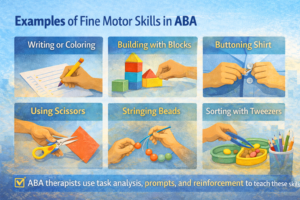
Fine motor skills refer to the small, precise movements of the hands, fingers, wrists, and sometimes toes, needed to perform tasks like writing, buttoning a shirt, using scissors, or picking up small items.
These skills involve coordination between the brain and the muscles, especially in the fingers and hands. They are crucial for school readiness, self-care, and functional independence.
Fine Motor vs Gross Motor Skills
Understanding the difference is key:
-
Fine motor skills involve small muscles: fingers, wrists, hands
-
Gross motor skills involve large muscles: arms, legs, torso
Examples of fine motor tasks:
-
Holding a pencil
-
Using utensils
-
Stringing beads
-
Tying shoelaces
-
Zipping a jacket
-
Picking up coins
Examples of gross motor tasks:
-
Running, jumping
-
Climbing stairs
-
Throwing a ball
-
Riding a bike
How Fine Motor Skills Develop
Fine motor development follows a general progression from gross to fine. Young children start with broad arm movements and gradually refine control to the fingertips.
Typical development pathway:
-
6–12 months: reaches, grasps, transfers objects
-
12–24 months: stacks blocks, starts using a spoon
-
2–3 years: scribbles, turns pages, builds simple towers
-
4–5 years: draws shapes, cuts paper, starts writing letters
-
6+ years: writes legibly, ties shoes, buttons with ease
Development may be delayed or uneven in children with:
-
Autism Spectrum Disorder (ASD)
-
Developmental delays
-
Neurological disorders
-
ADHD
-
Sensory processing differences
Why Fine Motor Skills Matter in ABA
In ABA programs, fine motor goals are often integrated into:
-
Instructional programs (e.g., imitation, copying, pre-academics)
-
Daily living skills (e.g., self-help, dressing, feeding)
-
Play and leisure routines
-
School readiness programs
Fine motor deficits can interfere with:
-
Writing and classroom participation
-
Independent eating and hygiene
-
Participation in peer play
-
Tolerance for fine motor tasks (e.g., puzzles, crafts)
Teaching Fine Motor Skills in ABA
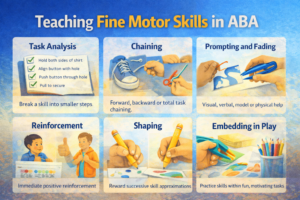
Applied Behavior Analysis (ABA) offers many evidence-based strategies for teaching fine motor skills. These include:
1. Task Analysis
Break the skill into smaller steps. For example, buttoning a shirt may include:
-
Hold both sides of shirt
-
Align button with hole
-
Push button through hole
-
Pull to secure
Teach each step using prompts and reinforcement.
2. Chaining
Use forward, backward, or total task chaining to teach complex fine motor routines step-by-step.
Example: Toothbrushing, shoe tying, or cutting.
3. Prompting and Fading
Use visual, verbal, model, or physical prompts to support initial learning. Gradually fade as independence increases.
4. Reinforcement
Provide positive reinforcement immediately after each successful attempt or independent step.
Example: A child earns praise or tokens after zipping their jacket.
5. Shaping
Reinforce approximations of the skill as the child improves.
Example: Reward holding a crayon with a fist grip, then gradually shape toward a tripod grasp.
6. Embedding in Play
Incorporate fine motor goals into naturally reinforcing play tasks:
-
Stringing beads to make a necklace
-
Building with small blocks
-
Using tweezers to sort items
-
Painting with a brush
This supports generalization and motivation.
Tools and Activities to Support Fine Motor Development
Many ABA therapists and educators use the following materials during fine motor sessions:
-
Pegboards and lacing cards
-
Playdough and modeling clay
-
Beads and string
-
Scissors and construction paper
-
Clothespins, tweezers, tongs
-
Finger paints and crayons
-
Button boards and dressing vests
For preschool and early elementary learners, these tools support both motor and academic readiness.
Measuring Fine Motor Progress
ABA professionals may assess fine motor development using:
-
VB-MAPP Milestones & Barriers Assessment
-
ABLLS-R® (Assessment of Basic Language and Learning Skills – Revised)
-
AFLS® (Assessment of Functional Living Skills)
-
Occupational therapy evaluations (collaboration with OTs)
Always record:
-
Independence level (e.g., 0–100%)
-
Prompt level required
-
Frequency and duration of practice
-
Changes over time
These data support individualized programming and treatment planning.
Tips for BCBA or RBT Exam Prep
While fine motor skills are not labeled as a “task list item” in the BCBA exam, they may appear in applied scenarios about skill acquisition, prompting, generalization, and task analysis.
Key points to remember:
-
Fine motor skills are functional, not just academic
-
Use chaining and shaping to build complex routines
-
Embed teaching in naturalistic and play-based contexts
-
Measure progress with consistent data collection
For RBTs: you may be asked to implement fine motor programs written by your supervisor, collect data, and provide session notes that reflect client progress.
Additional Resources
-
BACB Task List (5th Edition):
https://www.bacb.com/task-lists/ -
ABLLS-R Guide:
https://www.stephen-edelson.com/aba/ablls.html -
VB-MAPP Overview:
https://www.vbmappapp.com/vbmapp-guide/ -
Fine Motor Activities from OT Toolbox:
https://www.theottoolbox.com/fine-motor-skills/
Final Thoughts
Fine motor skills are foundational to independence, communication, and academic success. In ABA, we teach these skills not only to increase function, but to improve quality of life. Through structured teaching and positive reinforcement, children and learners of all abilities can develop the skills they need to succeed.


