
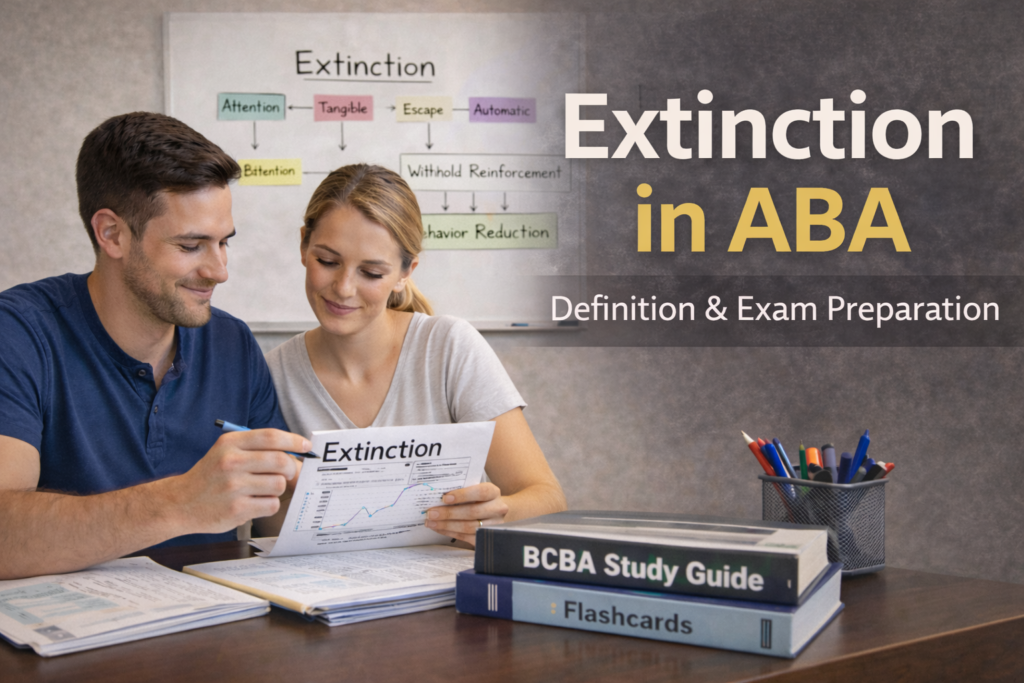
Extinction in ABA: Definition, Examples, and Key Concepts
Extinction is a fundamental concept in applied behavior analysis (ABA) and one of the most frequently tested behavior-reduction procedures on the BCBA® exam.
Many ABA students and BCBA candidates know that this procedure involves discontinuing reinforcement, but struggle to explain how it works, why behavior may worsen at first, or how it differs from punishment or simply ignoring behavior.

This article explains extinction in clear, practical terms. You will learn the definition, review real-world examples, understand key concepts such as extinction bursts, and see how this procedure is applied in ABA programs and assessed on the BCBA exam.
What Is Extinction in ABA?
Definition of Extinction (Task-List Style)
Extinction is a behavior-reduction procedure in which reinforcement that previously maintained a behavior is withheld, leading to a gradual decrease in that behavior over time.
In simpler terms:
-
The behavior no longer produces its maintaining outcome
-
Without reinforcement, responding decreases
This procedure does not involve adding aversive stimuli. Instead, it focuses on removing access to reinforcement.
How Extinction Works When Reinforcement Is Withheld
From a behavioral perspective, behavior decreases when the functional relationship between a response and its consequence is disrupted.
If a behavior no longer produces the outcome that maintained it, the response loses effectiveness. Over time, the individual is less likely to engage in that behavior because it no longer “works.”
Before using any behavior-reduction procedure, the practitioner must first identify why the behavior occurs.
Function-Based Behavior Reduction Procedures
Effective behavior-reduction strategies are always matched to the function of behavior.
Examples include:
-
Attention-maintained behavior → attention is withheld
-
Escape-maintained behavior → escape is no longer provided
-
Tangible-maintained behavior → access to items is withheld
-
Automatically reinforced behavior → often more complex and resistant to change
If the maintaining consequence is misidentified, the intervention will not be effective.
Common Extinction Examples in ABA Practice
Attention-maintained behavior
A child screams to gain attention. Adults stop providing attention following screaming.
Escape-maintained behavior
A learner engages in problem behavior to avoid tasks. The task continues despite the behavior.
Tangible-maintained behavior
A child cries to obtain a toy. Access to the toy is no longer provided following crying.
In each case, the maintaining reinforcer is removed.
Extinction Burst
One important phenomenon associated with extinction is the extinction burst.
An extinction burst refers to a temporary increase in behavior when reinforcement is first withheld. This may include:
-
Increased frequency
-
Increased intensity
-
New forms of responding
Exam tip:
An initial increase in behavior does not indicate that the procedure is failing.
Response Variability
Another common effect is response variability.
When a behavior no longer produces reinforcement, individuals may try different responses to access the same outcome. Some of these responses may be inappropriate, while others may be more adaptive.
This variability can create opportunities to reinforce appropriate alternative behaviors.
Why This Is Not the Same as Ignoring Behavior
A common misconception is that extinction simply means ignoring behavior.
In reality:
-
Ignoring applies only to attention-maintained behavior
-
Some procedures require active follow-through (for example, continuing task demands)
-
Safety and ethics must always be considered
Ignoring behavior without understanding its function can be ineffective or unsafe.
Reinforcing Alternative Behavior
Behavior reduction is most effective when withholding reinforcement is paired with reinforcement of appropriate alternatives.
Examples include:
-
Teaching functional communication responses
-
Reinforcing task completion
-
Providing attention for appropriate behavior
This approach reduces problem behavior while building meaningful skills.
Ethical Considerations
Withholding reinforcement can raise ethical concerns, particularly when:
-
Behavior escalates
-
Safety is compromised
-
Implementation is inconsistent
Practitioners must consider:
-
Least restrictive alternatives
-
Client dignity
-
Ongoing data collection
All interventions should be ethical, data-driven, and individualized.
How Extinction Appears on the BCBA Exam
BCBA exam questions often assess whether candidates understand that:
-
Reinforcement is discontinued
-
Behavior may temporarily increase
-
Procedures are function-based
-
This approach differs from punishment

Look for phrases such as:
-
“No longer produces the previous consequence”
-
“Withholding reinforcement”
-
“Behavior initially increases”
Common Implementation Errors
ABA students often make these mistakes:
-
Using the procedure without identifying function
-
Expecting immediate behavior reduction
-
Inconsistent implementation
-
Failing to reinforce alternative behaviors
-
Confusing extinction with punishment
Consistency and planning are essential.
Quick Study Checklist
Before the exam or clinical use, make sure you can:
-
Define extinction clearly
-
Identify the maintaining reinforcer
-
Explain extinction bursts and response variability
-
Distinguish extinction from punishment
-
Apply the concept to real-world scenarios
Final Thoughts
Extinction is a powerful behavior-reduction procedure when implemented correctly and ethically.
By understanding how reinforcement maintains behavior—and what happens when that reinforcement is removed—practitioners can design effective, function-based interventions. For BCBA candidates, mastering this concept strengthens both exam performance and clinical decision-making.


