

What Are Emergent Relations in Behavior Analysis?
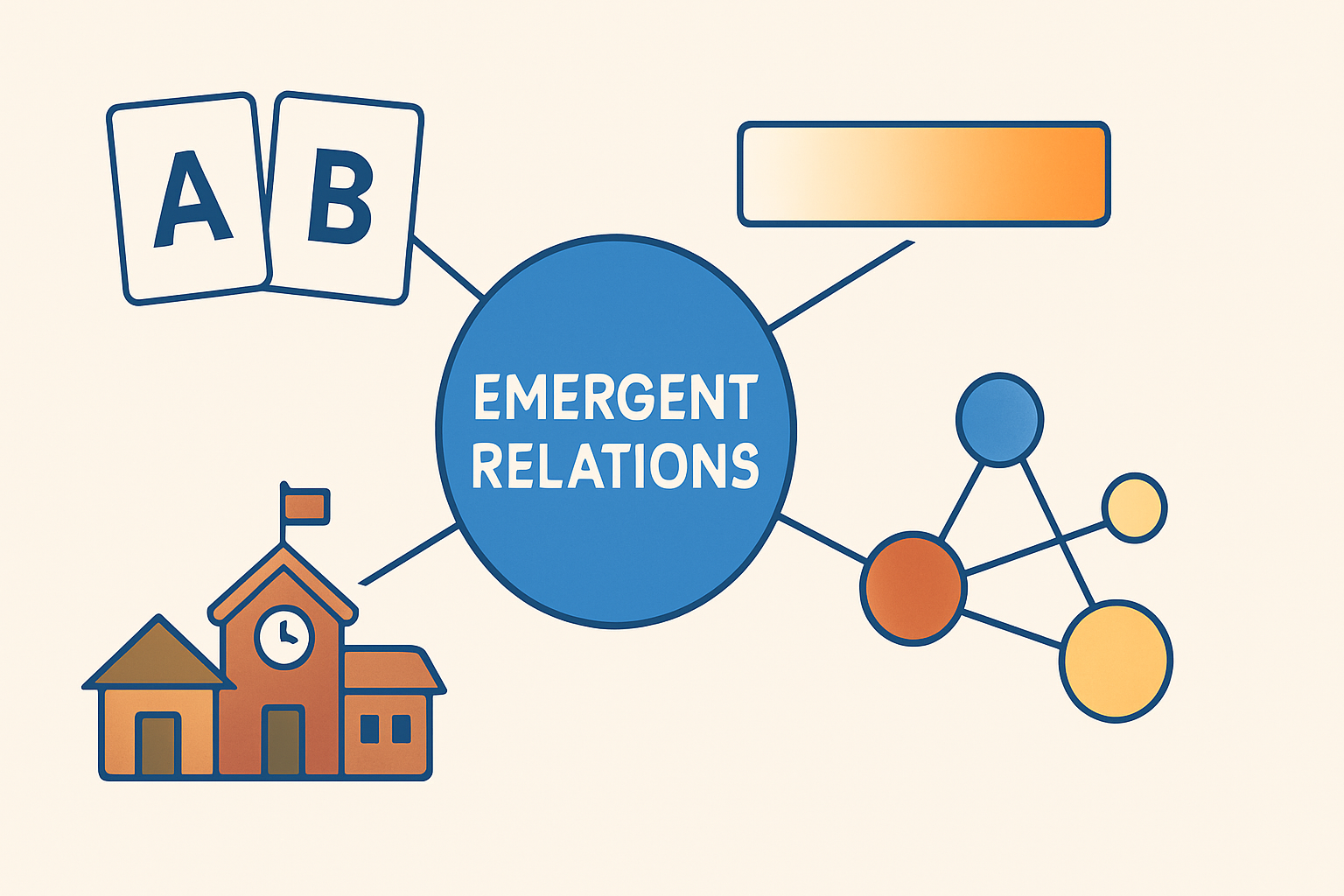
Emergent relations refer to behaviors that appear without direct training, emerging from established relationships between stimuli. These derived responses represent a sophisticated form of learning that goes beyond simple stimulus-response associations.
Table of Contents
- What Are Emergent Relations in Behavior Analysis?
- Stimulus Equivalence: The Three Must-Pass Tests
- Worked ABA Examples: From Training to Emergent Performance
- BCBA Exam Focus: Common Traps and How to Avoid Them
- Quick-Study Checklist for Emergent Relations
- Summary and Key Takeaways
In applied behavior analysis, understanding emergent relations is crucial for designing efficient teaching programs and explaining complex human behavior.
Core Definitions: Stimulus Equivalence and Derived Relational Responding
Stimulus equivalence is a specific type of emergent relation where stimuli become functionally interchangeable without direct training. This phenomenon demonstrates reflexivity, symmetry, and transitivity – three properties that define true equivalence classes.
Derived relational responding represents the broader category of behavior that emerges from trained relations. This concept extends beyond equivalence to include other relational frames like comparison, opposition, and distinction.
Why Emergent Relations Matter for Practitioners and the Exam
These concepts are essential for BCBA candidates because they explain how language develops and how complex skills emerge efficiently. In clinical practice, understanding emergent relations allows practitioners to design teaching programs that maximize skill generalization and minimize direct training time.
The topic appears frequently on the BCBA exam due to its importance in explaining symbolic behavior and its connection to verbal operants and language development.
Stimulus Equivalence: The Three Must-Pass Tests
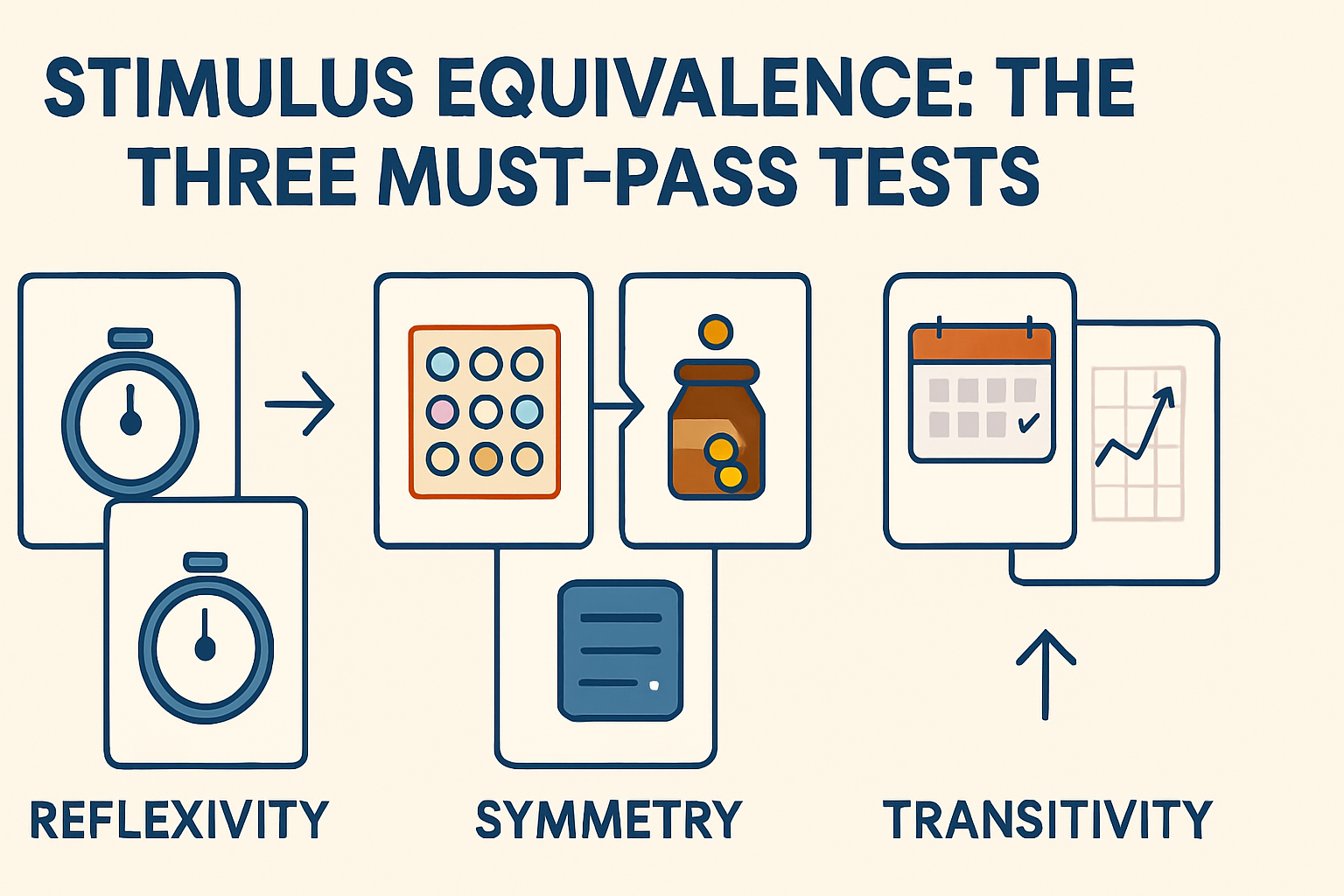
True stimulus equivalence requires demonstrating three properties through specific tests. Each property represents a different type of emergent relation that must be present for stimuli to be considered equivalent.
Reflexivity (Matching to Sample: A=A)
Reflexivity involves matching a stimulus to itself without reinforcement. This represents generalized identity matching where the learner demonstrates that A equals A across different contexts and presentation formats.
For example, after being taught to match a picture of a cat to an identical picture, the learner spontaneously matches different pictures of cats to each other without additional training.
Symmetry (If A→B, then B→A)
Symmetry demonstrates the reversibility of a trained conditional discrimination. If you teach “when you see A, select B,” symmetry emerges when the learner spontaneously selects A when shown B.
This property shows that the relationship between stimuli is bidirectional rather than unidirectional, which is essential for understanding bidirectional stimulus control in language.
Transitivity (If A→B and B→C, then A→C)
Transitivity represents the most complex emergent relation, where a relationship is derived between two stimuli never directly paired. This occurs when A is related to B, B is related to C, and the learner spontaneously relates A to C.
This property demonstrates true equivalence class formation and is the hallmark of symbolic relationships in language and conceptual learning.
Worked ABA Examples: From Training to Emergent Performance
Understanding these concepts requires seeing them in action. Here are practical examples showing how direct training leads to emergent relations in clinical settings.
Example 1: Teaching Safety Signs (Visual-Visual)
Direct training involves teaching matching between different representations of safety concepts:
- Match picture of stop sign (A1) to written word STOP (B1)
- Match picture of walk sign (A2) to written word WALK (B2)
Emergent tests reveal the derived relations:
- Symmetry: Point to A1 when shown B1 (without training)
- Transitivity: Match A1 to novel picture of person standing still (C1) if B1 was previously related to C1
The function of emergent correct responses is typically automatic reinforcement via stimulus equivalence class formation, where correct responding becomes reinforcing in itself.
Example 2: Expanding Tact and Listener Repertoires (Object-Word)
This example demonstrates how emergent relations connect different verbal operants:
- Tact training: See spoon (A), say “spoon” (B)
- Listener training: Hear “spoon” (B), touch spoon (A)
The emergent symmetry between tact and listener behavior allows for efficient skill expansion. Further transitivity emerges if “spoon” (B) is taught to match written word SPOON (C), resulting in seeing spoon (A) evoking selection of written word (C) without direct training.
This demonstrates how derived stimulus functions can expand language repertoires efficiently, connecting to concepts in stimulus equivalence.
BCBA Exam Focus: Common Traps and How to Avoid Them
This topic presents specific challenges on the BCBA exam. Understanding these common errors can help you avoid them.
Trap 1: Confusing Derived Relations with Simple Discrimination or Generalization
Emergent relations are not simple stimulus generalization across physical dimensions. They involve derived stimulus functions based on relational frames, not physical similarity. For example, matching different shades of red is generalization, while matching “red” to a stop sign after training is an emergent relation.
Trap 2: Misidentifying the Properties of Equivalence
Use this decision flow to identify properties correctly:
- Is it matching identical items? → Reflexivity
- Is it reversing a trained direction? → Symmetry
- Is it relating two items never directly paired, via a third? → Transitivity
Trap 3: Overlooking the Role in Verbal Behavior
Stimulus equivalence provides a behavioral account of symbolic meaning and is heavily tested in the Verbal Behavior section. Remember that emergent relations explain how words acquire meaning and how language develops beyond simple associations.
This connects to broader concepts in radical behaviorism that address complex human behavior.
Quick-Study Checklist for Emergent Relations
Use this checklist for last-minute review before your exam:
- Define stimulus equivalence and its three properties
- Distinguish between derived relations and simple generalization
- Identify examples of reflexivity, symmetry, and transitivity
- Explain how emergent relations contribute to language development
- Recognize common exam traps and how to avoid them
- Apply these concepts to clinical teaching scenarios
Summary and Key Takeaways
Emergent relations represent a sophisticated form of learning where behaviors appear without direct training. Stimulus equivalence, characterized by reflexivity, symmetry, and transitivity, demonstrates how stimuli become functionally interchangeable.
For BCBA candidates, mastering these concepts is essential for understanding language development, designing efficient teaching programs, and explaining complex human behavior. The clinical applications extend to teaching safety skills, expanding language repertoires, and promoting skill generalization.
Remember that emergent relations go beyond simple associations to explain how symbolic meaning develops and how complex skills emerge from limited training. For further study on related concepts, review the BACB Task List and research on relational frame theory.


