
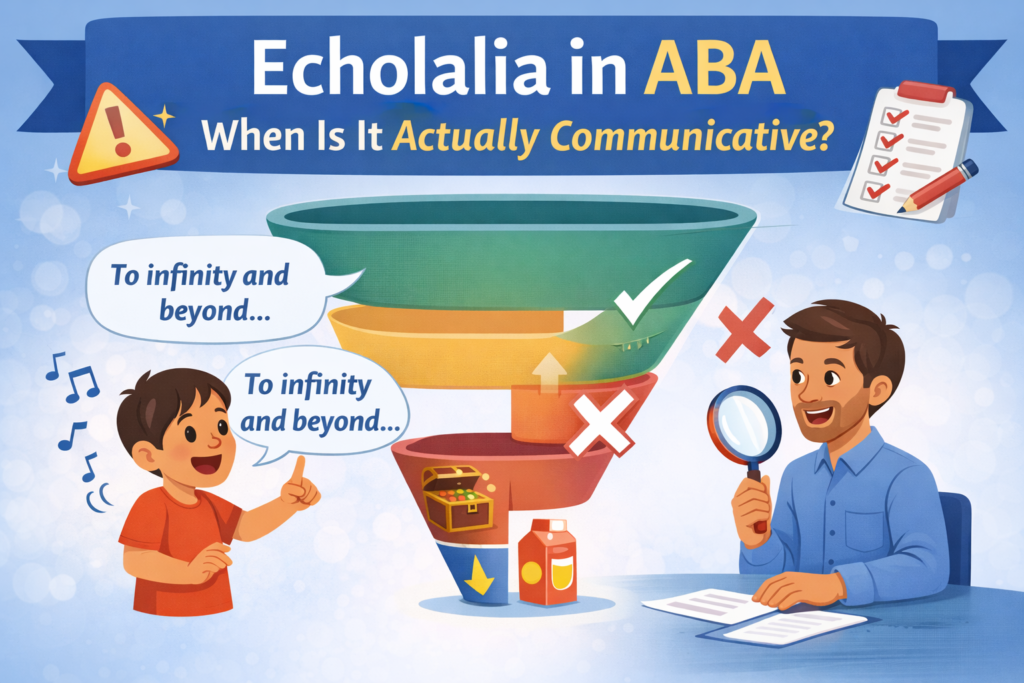
Echolalia in ABA: When Is It Actually Communicative?
Echolalia is one of those terms that many BCBA candidates think they understand — until it shows up in an exam question. Too often, echolalia is treated as meaningless repetition that should be reduced. In reality, this assumption leads to frequent misclassification errors on the BCBA® exam.
The key issue is not what echolalia sounds like, but what function it serves. This article focuses on a single exam-relevant question: when is echolalia actually communicative, and when is it not?
When Echolalia Is Communicative
From an ABA perspective, echolalia can be communicative if it functions to affect the behavior of a listener. The surface form — repeating words or phrases — is irrelevant without functional analysis.
Echolalia may be considered communicative when it:
-
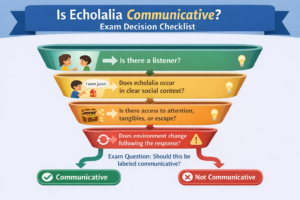
Occurs in a clear social context
-
Produces access to attention, tangibles, or escape
-
Is consistently followed by a meaningful change in the environment
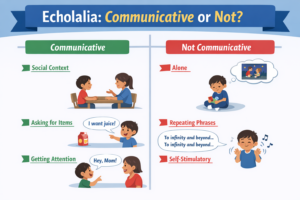
For example, a learner who repeats “Do you want juice?” and is then given juice is not simply echoing speech. Functionally, that response may be serving the same role as a mand, even if the form is unconventional.
On the BCBA exam, this distinction matters. Questions often describe echolalic responses that look nonfunctional but clearly contact social reinforcement. In those cases, the correct answer hinges on function, not topography.
When Echolalia Is Not Communicative
Not all echolalia serves a social purpose. In many cases, echolalic speech persists without influencing another person’s behavior.
Echolalia is more likely non-communicative when it:
-
Occurs in the absence of a listener
-
Persists regardless of environmental consequences
-
Appears to be automatically reinforced
For instance, delayed repetition of movie scripts spoken alone, without any observable social outcome, is unlikely to be communicative. These responses may be maintained by automatic reinforcement rather than by access to social consequences.
On exam questions, this is where candidates often overinterpret meaning. The presence of speech does not imply communication. If no listener behavior is affected, communicative function should not be assumed.
A Common BCBA Exam Trap
One of the most common traps on the BCBA® exam is confusing topography with function.
Echolalia is a form of verbal behavior, not a function. Two identical echolalic responses can have entirely different maintaining variables depending on context.
If a question stem emphasizes:
-
repetition alone
-
lack of environmental change
-
sensory or automatic reinforcement
then labeling the behavior as communicative is usually incorrect.
If the stem highlights:
-
consistent social outcomes
-
listener-mediated consequences
-
functional replacement for mands or tacts
then echolalia may be functioning communicatively, even if it appears atypical.
Key Terms to Review for This Topic
To answer echolalia-related questions accurately, BCBA candidates should be fluent in the following distinctions:
-
Verbal operant vs. verbal form
-
Social vs. automatic reinforcement
-
Mand, tact, and intraverbal functions
-
Functional assessment of verbal behavior
Most exam errors in this area come from failing to analyze function under exam pressure.
Why This Matters on the BCBA® Exam
The BCBA exam does not test whether you can define echolalia. It tests whether you can classify behavior based on function, even when the form is misleading.
When faced with echolalia in a question stem, pause before assuming it is nonfunctional. Ask instead: What consequence maintains this response? That single shift in thinking is often the difference between a correct and incorrect answer.


