Discriminative Stimulus ABA: Definition, Examples, and Exam-Style Questions
Introduction
If you’re preparing for the BCBA® exam, you must be solid on the idea of the discriminative stimulus in ABA (SD). The term shows up everywhere: in stimulus control questions, discrimination training, verbal behavior, and functional communication.
You’re expected to be able to:
-
Define discriminative stimulus ABA concepts clearly
-
Recognize SDs and SΔs in everyday and clinical examples
-
Understand how SDs relate to stimulus discrimination and stimulus generalization
-
Answer exam questions that mix SDs with MOs and functions of behavior
If you want a broader foundation before you dive in, you can review basic reinforcement concepts in our article on positive reinforcement in ABA:
https://bcbamockexam.com/positive-reinforcement-aba/
In this article, we’ll walk through:
-
A clear, exam-ready definition of discriminative stimulus in ABA
-
Everyday and clinical ABA examples
-
How discrimination training (SD vs SΔ) works
-
Common BCBA® exam traps
-
Mini exam-style practice questions with explanations
1. Psychology & ABA Definition: What Is a Discriminative Stimulus?
In psychology and ABA, stimulus discrimination means a person responds differently to different stimuli based on learning history. The discriminative stimulus (SD) is at the heart of that process.
More specifically in discriminative stimulus ABA terms:
-
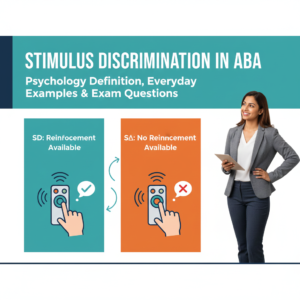
A discriminative stimulus (SD) is a stimulus in whose presence a particular response has been reinforced in the past.
-
An S-delta (SΔ) is a stimulus in whose presence that response has not been reinforced (or has been placed on extinction).
When a behavior is more likely in the presence of the SD and less likely in the presence of the SΔ because of differential reinforcement, we say stimulus discrimination has been established.
If you need a refresher on how reinforcement and non-reinforcement shape behavior, see our full guide to differential reinforcement in ABA:
https://bcbamockexam.com/differential-reinforcement-aba/
Exam shortcut:
-
Discrimination = responding in one situation but not another.
-
The SD is the “signal that it will work”; the SΔ is the “signal that it won’t.”
For official terminology and task list wording, you can also check the BACB® BCBA® handbook and task list here:
https://www.bacb.com/bcba/
2. Stimulus Discrimination vs Stimulus Generalization
The BCBA® exam often asks you to distinguish discriminative stimulus ABA examples (discrimination) from generalization.
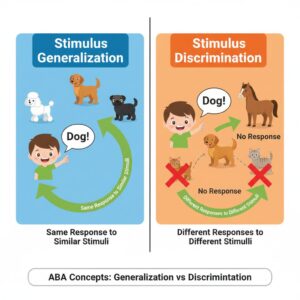
Stimulus generalization
-
The same response occurs in the presence of multiple similar stimuli that share common features.
-
Example: Saying “dog” to many different dogs.
Stimulus discrimination
-
The response occurs in the presence of some stimuli but not others.
-
Example: Saying “dog” to dogs, but not to cats or horses.
You can think of it as:
-
Generalization = “I respond the same way to things that are similar.”
-
Discrimination = “I respond differently when the stimulus changes.”
On the exam, SD-focused items often ask: Which stimulus is functioning as the discriminative stimulus (SD)?
3. Everyday Examples of Discriminative Stimulus and Discrimination
Here are non-clinical examples that mirror exam-style wording. In each one, ask: What is the SD?
Example 1 – Traffic lights
-
SD: Green light → you go.
-
SΔ: Red light → you stop.
-
Yellow light → you slow down or prepare to stop.
Different responses occur depending on which stimulus is present. The green light functions as a discriminative stimulus in ABA terms because “go” has been reinforced in its presence.
Example 2 – Unlocking your phone
-
SD: Your specific PIN or face ID → unlocks your phone.
-
SΔ: Any other random numbers or faces → no access.
Your behavior (entering the code) is under the stimulus control of the correct SD (your real PIN).
Example 3 – Social cues
-
With a close friend → you make jokes more freely.
-
With a supervisor → you use more formal language.
Different social contexts function as different discriminative stimuli because they have different reinforcement histories for your behavior.
4. ABA Program Examples: Discriminative Stimulus (SD) and SΔ
In ABA programs, we often intentionally design discriminative stimulus ABA conditions.
Example 1 – Receptive ID (“Touch dog”)
-
Stimuli: Pictures of a dog, cat, and car.
-
SD: Therapist says, “Touch dog” and reinforces touching the dog picture.
-
SΔ: Touching cat or car is not reinforced for that SD.
Over time, the learner discriminates and touches the SD-correlated picture when that verbal SD is given.
Example 2 – Functional communication
-
SD: Teacher says, “It’s time for work” while presenting a schedule.
-
Response: Student uses a break card to request a break.
-
Reinforcement: Break is given when the card is used appropriately during work time.
In other contexts (e.g., free play), the same response might not produce a break. The “time for work” cue functions as the discriminative stimulus for using the break card.
Example 3 – Safety responses
-
SD: Fire alarm sound → walk to the exit and line up.
-
SΔ: Normal school bell or music → no evacuation.
The alarm is the SD that sets the occasion for evacuation behavior, built through repeated drills and reinforcement.
If you’d like to see how extinction fits into these patterns of reinforcement and non-reinforcement, you can review our extinction in ABA article here:
https://bcbamockexam.com/extinction-aba/
5. How Discriminative Stimulus Control Develops: Discrimination Training
Stimulus discrimination doesn’t appear out of nowhere; it is shaped through discrimination training.
In discriminative stimulus ABA training, we typically:
-
Present an SD and reinforce a specific response in its presence.
-
Present an SΔ and withhold reinforcement for that same response in its presence.
Over repeated trials:
-
The response becomes stronger in the presence of the SD.
-
The response becomes weaker or absent in the presence of the SΔ.
Examples of discrimination training:
-
Simple discriminations: One SD vs one SΔ (e.g., “Touch red” with red vs blue card).
-
Conditional discriminations: Matching-to-sample tasks where the correct response depends on combinations of stimuli (sample + comparison).
Exam tip:
When you see wording like “the response was reinforced in the presence of X and not reinforced in the presence of Y,” you’re looking at discrimination training built around discriminative stimuli.
For a deeper dive into how basic schedules interact with stimulus conditions, see our guide on schedules of reinforcement in ABA:
https://bcbamockexam.com/schedules-of-reinforcement-aba/
6. Discriminative Stimulus, Stimulus Control, and Why It Matters
When discrimination training is successful, we say the behavior is under stimulus control of the SD.
Stimulus control means:
-
A behavior occurs more often in the presence of a specific antecedent stimulus (SD) than in its absence.
-
The SD “sets the occasion” for the response because reinforcement has been more likely in that context.
On the exam, discriminative stimulus ABA knowledge connects to many areas:
-
Verbal behavior (mands, tacts, intraverbals)
-
Matching, sorting, and receptive language programs
-
Functional communication and replacement behaviors
You may be asked:
-
Which stimulus is functioning as the SD?
-
Is this behavior under adequate stimulus control?
-
How can you tighten or broaden stimulus control?
If you want to test whether you can spot SDs inside longer vignettes, try our free full-length BCBA® mock exam:
https://bcbamockexam.com/free-bcba-mock-exam/
7. SD vs MO: The Classic BCBA® Exam Distinction
Both SDs and MOs are antecedent variables, but they do different things. This is a favorite exam theme.
Discriminative Stimulus (SD)
-
Signals that reinforcement is available for a specific behavior.
-
Answers: “Is this behavior likely to work right now?”
Motivating Operation (MO)
-
Changes how valuable a reinforcer is (EO/AO).
-
Answers: “How much do I want this thing right now?”
Example – Snack scenario
-
MO: The child hasn’t eaten in several hours → food becomes more valuable (EO).
-
SD: Parent opens the pantry and asks, “Do you want a snack?” → signals that asking can contact reinforcement.
On the exam:
-
If the stem emphasizes deprivation, satiation, pain, or temperature, think MO.
-
If it emphasizes a history of reinforcement in the presence of a specific cue, think discriminative stimulus in ABA.
For a full breakdown of motivating operations (UMOs vs CMOs), you can read our motivating operations ABA guide here:
https://bcbamockexam.com/motivating-operations-aba/
8. Common BCBA® Exam Traps with Discriminative Stimuli
Watch for these common pitfalls in discriminative stimulus ABA questions:
Trap 1 – Confusing discrimination with generalization
-
Generalization = same response across many stimuli.
-
Discrimination = responding differently depending on the stimulus (often SD vs SΔ).
Trap 2 – SD vs MO confusion
-
SD → availability signal.
-
MO → value changer.
A stimulus is not an SD just because it’s present; it’s an SD because reinforcement has been more likely when it is present.
Trap 3 – Calling any cue an SD
-
A poster on the wall is not automatically an SD.
-
It only functions as an SD if a specific behavior has consistently been reinforced in its presence.
Trap 4 – Ignoring the “no reinforcement” side
-
Without some condition where the response is not reinforced (SΔ), stimulus control will be weak.
-
Exam stems about discrimination training almost always include both: “reinforced in X” and “not reinforced in Y.”
Trap 5 – Over-focusing on labels instead of function
-
Remember: SD is a functional term.
-
First identify the behavior and reinforcer, THEN decide which antecedent qualifies as the SD.
If you’d like a more textbook-style treatment, you can also reference Cooper, Heron, and Heward’s Applied Behavior Analysis (see the publisher page here):
https://www.pearson.com/en-us/subject-catalog/p/applied-behavior-analysis/P200000008180
9. Mini BCBA® Exam–Style Questions (With Explanations)
Question 1 – Discrimination vs Generalization
A child learns to say “dog” when shown a picture of the family’s black lab. Later, the child also says “dog” when shown pictures of a golden retriever, a poodle, and a cartoon dog.
Which process is MOST strongly illustrated by this pattern?
A. Stimulus discrimination
B. Stimulus generalization
C. Response generalization
D. Extinction
Correct Answer: B – Stimulus generalization
Explanation: The same response (“dog”) occurs in the presence of different but similar stimuli. No clear SD/SΔ pattern is described, so this is not primarily about a discriminative stimulus in ABA terms.
Question 2 – Example of Stimulus Discrimination and SD
A learner is taught to respond “red” only when a red card is presented. When red, blue, and yellow cards are placed on the table and the teacher says, “Touch red,” only touches to the red card are reinforced. Touches to other colors are ignored. Over time, the learner reliably touches only the red card when asked.
This BEST illustrates:
A. Stimulus generalization
B. Stimulus discrimination
C. Response generalization
D. Spontaneous recovery
Correct Answer: B – Stimulus discrimination
Explanation: The learner responds differently to different stimuli based on differential reinforcement. The red card in the presence of the instruction functions as the discriminative stimulus (SD).
Question 3 – Identifying the Discriminative Stimulus
A student frequently raises their hand and answers questions correctly during math class because the teacher consistently calls on them and offers praise when they do so. In other classes, hand-raising rarely results in attention.
Which stimulus is MOST likely functioning as the SD for hand-raising?
A. The teacher’s presence in math class
B. The student’s motivation for attention
C. The school building
D. The student’s desk
Correct Answer: A – The teacher’s presence in math class
Explanation: In that specific context, hand-raising has a strong reinforcement history. The math teacher’s presence (in that setting) functions as the discriminative stimulus in ABA language.
Question 4 – SD vs MO
A child has not had access to their favorite snack all afternoon and is now very hungry. When the parent opens the pantry and says, “Do you want a snack?”, the child immediately asks for the snack and receives it.
Which option BEST identifies the MO and SD in this scenario?
A. MO = parent’s question; SD = hunger
B. MO = hunger; SD = parent’s question “Do you want a snack?”
C. MO = snack; SD = pantry
D. MO = asking for a snack; SD = receiving the snack
Correct Answer: B – MO = hunger; SD = parent’s question
Explanation: Hunger increases the value of food (MO), while the parent’s question signals availability of reinforcement for asking (SD). The question is the discriminative stimulus.
10. Key Takeaways
-
Discriminative stimulus in ABA (SD) = a stimulus that signals reinforcement is available for a specific behavior based on history.
-
Stimulus discrimination = responding differently in different stimulus conditions (SD vs SΔ) due to differential reinforcement.
-
Effective ABA programs build both good discrimination (tight stimulus control where needed) and healthy generalization.
-
For the BCBA® exam, always ask:
-
Which stimulus has a history of making reinforcement more likely? (That’s your SD.)
-
Are they describing “same response across many stimuli” (generalization) or “different responding based on the stimulus” (discrimination)?
-
Is this about availability (SD) or value (MO)?
-
Once you really understand discriminative stimulus ABA concepts, questions about stimulus control, discrimination training, verbal behavior, and functional communication become much more straightforward—both on the exam and in real clinical practice.