
What is Differential Reinforcement? The Core Principle
Differential reinforcement is a fundamental behavioral procedure that involves reinforcing one set of behaviors while simultaneously withholding reinforcement for another set of behaviors. This dual-component approach makes it distinct from simple reinforcement strategies. For BCBA exam candidates, understanding this core principle is essential for both theoretical knowledge and practical application questions.
The procedure’s effectiveness stems from its systematic approach to behavior change. By carefully selecting which behaviors receive reinforcement and which do not, practitioners can shape behavior in targeted directions. This method is widely used in applied behavior analysis settings, from clinical interventions to educational programming.
The Two-Part Process: Reinforcement and Extinction
The two-part process of differential reinforcement consists of reinforcement for desired behaviors and extinction for target problem behaviors. The reinforcement component strengthens appropriate alternatives, while the extinction component weakens the problematic behavior by removing its maintaining consequences.
Consider this simple analogy: Imagine a child who screams to get attention. In a differential reinforcement approach, you would provide attention when the child uses appropriate communication (reinforcement) while ignoring the screaming (extinction). This dual approach is more effective than either component alone because it teaches what to do while reducing what not to do.
The extinction component is crucial for exam understanding. Many candidates mistakenly focus only on the reinforcement aspect, but differential reinforcement requires both components working together. This procedural requirement distinguishes it from other behavioral interventions and appears frequently in exam scenarios.
The Five Differential Reinforcement Procedures
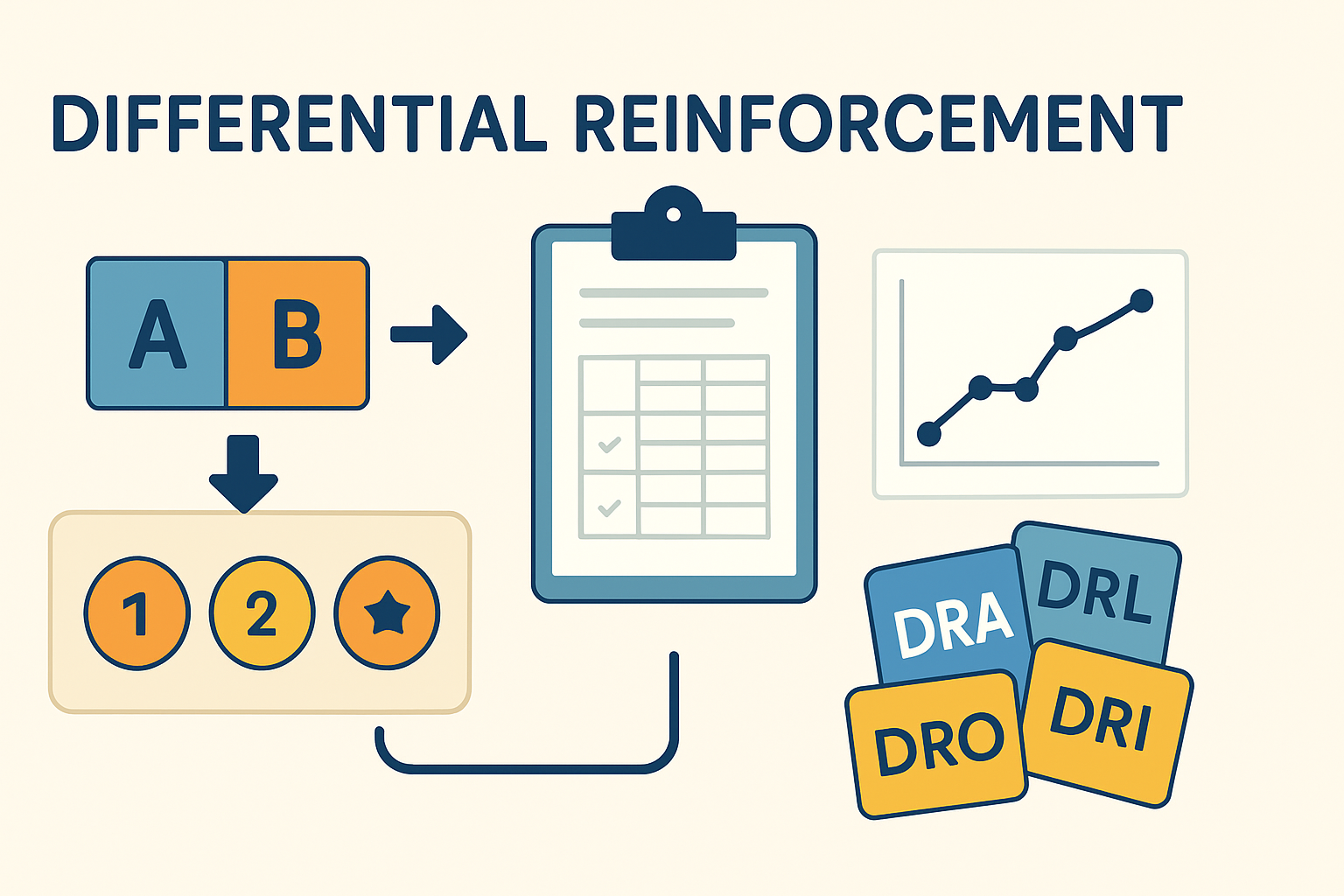
BCBA candidates must master five specific differential reinforcement procedures: DRA, DRO, DRI, DRL, and DRH. Each serves distinct purposes in behavior change programming. Understanding their unique characteristics and applications is critical for exam success and clinical practice.
These procedures fall into two main categories: those primarily used for behavior reduction (DRA, DRO, DRI) and those for rate modification (DRL, DRH). The selection depends on the target behavior’s function, the availability of alternative behaviors, and the specific goals of intervention.
DRA, DRO, and DRI: For Behavior Reduction
Differential Reinforcement of Alternative Behavior (DRA) reinforces a specific alternative behavior that serves the same function as the problem behavior. For example, if a student engages in disruptive behavior to escape difficult tasks, DRA would involve reinforcing task completion or asking for a break appropriately.
Differential Reinforcement of Other Behavior (DRO) provides reinforcement when the target behavior does not occur during a specified interval. This procedure is useful when no specific alternative behavior has been identified. For instance, if a child engages in hand-flapping for automatic reinforcement, DRO might involve providing reinforcement after 5 minutes without hand-flapping.
Differential Reinforcement of Incompatible Behavior (DRI) reinforces behaviors that cannot physically occur simultaneously with the target behavior. For example, reinforcing hands-on-desk behavior to reduce hand-flapping, since both cannot occur at the same time. The key distinction from DRA is that DRI requires physical incompatibility.
DRL and DRH: For Modifying Behavior Rates
Differential Reinforcement of Low Rates (DRL) targets reducing the frequency of a behavior while not eliminating it entirely. There are two main types: full-session DRL (reinforcement if behavior occurs at or below a criterion for the entire session) and spaced-responding DRL (reinforcement for responses separated by minimum time intervals).
Differential Reinforcement of High Rates (DRH) increases the rate of behavior that already occurs but at insufficient frequency. For example, increasing social initiations in a child with autism who initiates only once per hour. DRH requires setting a criterion for minimum responses within a time period.
The distinction between these rate modification procedures is crucial for exam questions. DRL decreases but maintains behavior, while DRH increases existing behavior. Both differ fundamentally from the reduction procedures, which aim to eliminate or substantially decrease problem behaviors.
Applying Differential Reinforcement on the BCBA® Exam
Exam questions on differential reinforcement require more than definitional knowledge. Candidates must analyze scenarios, select appropriate procedures based on behavioral functions, and anticipate implementation considerations. The exam tests both conceptual understanding and practical application skills.
Successful candidates develop a systematic approach to differential reinforcement questions. This involves identifying the target behavior’s function, determining intervention goals, and selecting the most appropriate procedure based on available alternatives and client characteristics. Practice with varied scenarios is essential for building this analytical skill.
Common Exam Traps and How to Avoid Them
One frequent exam trap involves confusing DRA with DRI. Remember that DRI requires physical incompatibility, while DRA requires functional equivalence. Another common error is selecting DRO when a specific alternative behavior exists and serves the same function—DRA is typically more appropriate in such cases.
Candidates often misidentify DRL scenarios, particularly confusing it with DRO. DRL maintains behavior at reduced rates, while DRO aims for zero occurrences. Also, many forget that all differential reinforcement procedures include an extinction component for the target behavior—this is a critical exam point.
Scenario-based questions may present multiple plausible answers. The key is to identify the primary goal (reduction vs. rate modification), the availability of alternatives, and whether behaviors are physically incompatible. Systematic elimination of incorrect options based on these criteria improves accuracy.
Your Differential Reinforcement Decision Checklist
Use this decision checklist when approaching exam questions:
- Step 1: Identify the target behavior’s function through functional assessment data
- Step 2: Determine the primary goal: behavior reduction or rate modification
- Step 3: Assess if a specific alternative behavior exists that serves the same function
- Step 4: Consider if the alternative behavior is physically incompatible with the target
- Step 5: Evaluate if the behavior should be maintained at reduced rates or eliminated
- Step 6: Select the appropriate procedure based on these determinations
This systematic approach helps avoid common errors and ensures selection of the most appropriate differential reinforcement procedure for each scenario. Practice applying this checklist to various case studies to build exam readiness.
Key Takeaways and Next Steps for Study
Mastering differential reinforcement requires understanding both the overarching principle and the specific procedures. Key distinctions include: DRA vs. DRI (functional equivalence vs. physical incompatibility), DRO applications (when no alternative exists), and DRL/DRH purposes (rate modification rather than elimination).
For effective study, create comparison charts that highlight the defining features of each procedure. Include columns for: target goal, reinforcement criteria, extinction component, and typical applications. Practice with scenario-based questions from reputable BCBA exam prep resources to build application skills.
Remember that differential reinforcement is evidence-based practice supported by extensive research. The Behavior Analyst Certification Board includes these procedures in the Task List, and understanding their proper application is essential for ethical practice. Continue studying related concepts like extinction procedures and reinforcement schedules to build comprehensive knowledge.
Final preparation should include reviewing the BACB Task List items related to differential reinforcement and practicing with mock exams that include these procedures. With systematic study and application practice, you can confidently approach differential reinforcement questions on the BCBA exam.


