Differential Reinforcement in ABA: DRA, DRO, DRI, DRL, DRH
Introduction to Differential Reinforcement ABA
If you’re preparing for the BCBA® exam, you’ll see differential reinforcement ABA concepts everywhere: task-list items, mock exam vignettes, and real clinical decision-making in applied behavior analysis (ABA).
But on test day, the challenge isn’t just remembering what DRA, DRO, DRI, DRL, and DRH stand for. The real challenge is:
-
Quickly spotting which differential reinforcement procedure is being described in a long scenario
-
Choosing the most appropriate reinforcement strategy for the target behavior and context
-
Avoiding common traps (like confusing DRO with extinction, or treating DRI as generic DRA)
In this guide, you’ll learn:
-
What “differential reinforcement” means in ABA (and why it works in operant conditioning)
-
Clear definitions and differential reinforcement examples for DRA, DRO, DRI, DRL, and DRH
-
How these procedures appear on the BCBA® exam
-
Common exam traps + mini practice questions with explanations
If you want more structured practice as you study, you can also explore our BCBA® exam study materials and try a free full-length BCBA® mock exam.
Big Picture: What Is Differential Reinforcement ABA?
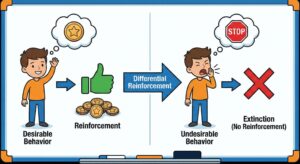
Differential reinforcement means you arrange reinforcement so that:
-
One response (or pattern of responding) contacts reinforcement, and
-
Another response contacts extinction or at least no reinforcement for the problem behavior
In simple terms: “This behavior gets reinforcement; that behavior doesn’t.”
Common examples:
-
Reinforce hand-raising, while not reinforcing calling out
-
Reinforce appropriate requests (a replacement behavior), while not reinforcing whining for the same outcome
On the BCBA® exam, differential reinforcement is often the backbone of:
-
Decreasing problem behavior
-
Increasing socially significant skills and adaptive behavior
-
Shaping the rate of responding (lower, higher, or specific patterns)
-
Teaching a functionally equivalent response (often through functional communication training (FCT))
All the procedures below—DRA, DRI, DRO, DRL, DRH—are specific ways to set up a differential reinforcement contingency.
For more on how reinforcement works in ABA, you can review our guide to positive reinforcement. These patterns explain why differential reinforcement ABA procedures are so powerful in real treatment and on the BCBA® exam.
Overview of Differential Reinforcement ABA Procedures (Quick Map)
Here’s a fast snapshot before we dive in:
-
DRA – Differential Reinforcement of Alternative Behavior
Reinforce a specific alternative response (often function-based) while placing the problem behavior on extinction. -
DRI – Differential Reinforcement of Incompatible Behavior
Reinforce an incompatible behavior that cannot occur at the same time as the problem behavior (a subtype of DRA). -
DRO – Differential Reinforcement of Other Behavior (Omission Training)
Reinforce the absence of the target behavior for a specified interval (whole-interval or momentary). -
DRL – Differential Reinforcement of Low Rates
Reinforce lower rates of a behavior you want less of (not zero). -
DRH – Differential Reinforcement of High Rates
Reinforce higher rates of a desirable behavior to build fluency/productivity.
Quick BCBA® Exam Tip
Start with one question:
Do they want the behavior eliminated, reduced, or increased?
That instantly narrows the answer set.
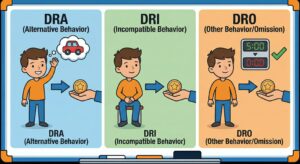
DRA: Differential Reinforcement of Alternative Behavior
Definition
DRA reinforces a specific alternative behavior (often a replacement behavior) while placing the problem behavior on extinction. The alternative behavior is typically functionally equivalent—it produces the same reinforcer but in a more appropriate way.
Examples
-
A learner hits others to get toys. Instead, you teach them to ask nicely, like saying, “Can I have a turn?” and do not reward hitting.
-
A student calls out for attention → you reinforce hand-raising for attention and stop responding to call-outs.
Key Features (What Exam Writers Want You to Notice)
-
The alternative behavior is clearly defined and observable.
-
The alternative often contacts the same reinforcer as the problem behavior.
-
The plan includes extinction (or at least no reinforcement) for the problem behavior.
Exam Cues
Look for phrases like:
-
“Teach a replacement behavior”
-
“Function-based alternative”
-
“Functional communication training (FCT)”
-
“Functionally equivalent response”
If you want a quick refresher on how reinforcement fits into treatment plans, you can also read our article on punishment in ABA and ethics to compare reinforcement-first vs. punishment-heavy approaches.
DRI: Differential Reinforcement of Incompatible Behavior
Definition
DRI reinforces a behavior that is incompatible with the problem behavior—both cannot happen at the same time. DRI is a type of DRA where incompatibility is the selection rule.
Examples
-
Reinforce sitting in a chair to reduce running (can’t sit and run simultaneously).
-
Reinforce hands in lap to reduce grabbing/hitting.
-
Reinforce writing with both hands on the desk to reduce throwing materials.
Exam Tip
-
If the vignette highlights “cannot co-occur”, it’s DRI.
-
If the alternative is appropriate and function-based but not physically incompatible, it’s more likely DRA.
DRO: Differential Reinforcement of Other Behavior (Omission)
Definition
DRO delivers reinforcement when the target behavior has not occurred for a specified interval (or at a specific check moment), regardless of what other behavior occurs. This is also called omission training.
Types You May See on the BCBA® Exam
-
Whole-interval DRO: Reinforce only if the target behavior did not occur at all during the entire interval.
-
Momentary DRO: Reinforce if the target behavior is not happening at the moment the interval ends.
Examples
-
Pencil tapping → deliver a token every 2 minutes if no tapping occurred (whole-interval).
-
Loud vocalizations → check every 5 minutes and reinforce if not occurring right then (momentary).
Caution (A Common Exam “Best Answer” Angle)
DRO does not specify what should happen instead. If you are not careful, you might accidentally encourage a behavior you don’t want during the “no target behavior” time.
That’s why exam questions often prefer function-based DRA/FCT when safety and skill-building matter.
Exam Cues
-
If reinforcement is for absence of behavior across time → DRO.
-
If reinforcement is for a specific replacement behavior → DRA/DRI, not DRO.
- Many scenario questions are really asking whether you understand how differential reinforcement ABA procedures change behavior over time.
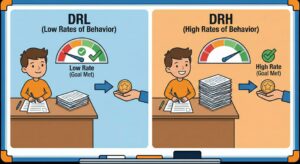
DRL: Differential Reinforcement of Low Rates
Definition
DRL reinforces lower rates of a behavior when the behavior is acceptable but happens too often. DRL targets the rate of responding, not the form of the behavior.
Common Forms
-
Full-session DRL: Reinforcement if total responses ≤ criterion.
-
Interval DRL: Reinforcement if responses per interval ≤ criterion.
-
Spaced-responding DRL: Reinforcement if a minimum time passes between responses.
Examples
-
Hand-raising is appropriate but too frequent → reinforce if there are ≤ 10 raises per lesson.
-
Rechecking a lock → reinforce if checks are at least 10 minutes apart (spaced-responding DRL).
Exam Tip
Choose DRL when the vignette says:
-
The behavior is “okay” or “appropriate,” but “too frequent,” and the goal is reduction, not elimination.
-
Avoid DRL for severe, dangerous behavior where the goal is “near zero.”
DRH: Differential Reinforcement of High Rates
Definition
DRH reinforces high rates of a desired behavior. It’s used to increase fluency, productivity, or participation—again targeting response rate.
Examples
-
Math practice → reinforce only if the learner completes ≥ 8 correct problems in 10 minutes.
-
Class participation → reinforce ≥ 3 appropriate contributions per activity.
-
AAC device use → reinforce ≥ 5 independent uses per hour.
Exam Tip
Look for: “only reinforced when more than X responses occur” or “must meet/exceed a response criterion.”
How the BCBA® Exam Tests Differential Reinforcement ABA
BCBA® exam questions rarely ask, “Which DR procedure is this?” directly. Instead, they describe a treatment plan and require you to infer the procedure by the reinforcement contingency.
Differential reinforcement commonly appears in:
-
Intervention selection (“most appropriate procedure”)
-
Treatment plan identification (DRA vs DRO vs DRL, etc.)
-
Ethics/treatment design (reinforcement-first approaches vs punishment)
-
Questions about extinction, schedule thinning, and implementation details
Fast Strategy for Differential Reinforcement ABA Vignettes
-
What’s the goal for the target behavior?
-
Eliminate? Reduce? Increase?
-
-
Is reinforcement contingent on:
-
A specific alternative behavior (DRA/DRI),
-
Absence of behavior (DRO), or
-
A rate criterion (DRL/DRH)?
-
For official exam updates and task list details, always cross-check with the BACB® website.
Common Differential Reinforcement ABA Exam Traps
-
Trap 1 – Calling replacement behavior plans “DRO.”
If reinforcement is for a specific replacement response, it’s DRA/DRI. -
Trap 2 – Confusing DRA and DRI.
DRI is a type of DRA, but requires incompatibility. -
Trap 3 – Choosing DRO when function-based DRA/FCT is safer.
Exam writers often prefer skill-building and function-based alternatives. -
Trap 4 – Using DRL for dangerous behavior.
DRL is for “too often,” not “unsafe.” -
Trap 5 – Forgetting extinction is usually part of DR.
If the problem behavior still contacts the reinforcer, it may not be true differential reinforcement.
Mini BCBA® Exam–Style Questions (With Explanations)
Question 1 – DRA or DRO?
A student earns tokens for raising their hand to ask for help. The teacher no longer responds to calling out. Calling out decreases and hand-raising increases.
A. DRO
B. DRA
C. DRL
D. DRH
Correct Answer: B – DRA.
A specific alternative response is reinforced; the problem behavior is placed on extinction.
Question 2 – DRI
A learner hits peers during circle time. The teacher delivers praise and tokens when students fold their hands in their laps for 2 minutes. Hitting decreases.
A. DRA
B. DRI
C. DRO
D. DRL
Correct Answer: B – DRI.
“Hands folded” is incompatible with hitting.
Question 3 – DRO
A timer is set for 3 minutes. A token is delivered if no vocal outbursts occurred during the entire interval.
A. DRA
B. DRO
C. DRL
D. DRH
Correct Answer: B – DRO.
Reinforcement is contingent on omission (absence) of the target behavior.
Question 4 – DRL
A student raises a hand constantly and blocks others. The student earns a preferred activity if they keep hand-raises under 5 during a 20-minute discussion.
A. DRH
B. DRL
C. DRO
D. DRA
Correct Answer: B – DRL.
The behavior is appropriate, but the goal is lower rates.
Question 5 – DRH
A learner uses a communication device about once per hour. They earn extra game time if they use it five or more times in an hour.
A. DRH
B. DRL
C. DRA
D. DRO
Correct Answer: A – DRH.
Reinforcement depends on a high rate of the desired response.
Differential Reinforcement ABA: Key Takeaways
Differential reinforcement is a core ABA toolkit: reinforce what you want, and withhold reinforcement (often via extinction) for what you don’t want.
-
DRA: Reinforce a function-based alternative / replacement behavior
-
DRI: Reinforce an incompatible behavior (a subtype of DRA)
-
DRO: Reinforce the absence of the target behavior (whole-interval or momentary)
-
DRL: Reinforce lower rates of an acceptable behavior
-
DRH: Reinforce higher rates of a desired behavior
On the BCBA® exam, focus on:
-
What happens to the target behavior (eliminate vs reduce vs increase)
-
What reinforcement is contingent on (alternative response vs absence vs response rate)
-
Avoiding traps like mislabeling DRA as DRO or using DRL for severe behavior
When you think of differential reinforcement as a family of strategies, it gets easier. Exam questions about DRA, DRO, DRI, DRL, and DRH will feel more straightforward—both on test day and in real ABA practice. When you can clearly identify and label differential reinforcement ABA procedures, BCBA® exam questions about DRA, DRO, DRI, DRL, and DRH feel much more manageable.
If you’re ready to test yourself under exam-style conditions, you can try our free BCBA® mock exam or explore more BCBA® exam prep resources.