Compound vs Simple Schedules of Reinforcement: How to Read Exam Questions Without Getting Lost
By BCBA Mock Exam
Introduction
If you’re preparing for the BCBA® exam, schedules of reinforcement can feel like alphabet soup: FR, VR, FI, VI, multiple, mixed, chained, tandem, concurrent, alternative, conjunctive…
The good news? Most exam questions aren’t asking you to memorize every definition in isolation. They are really testing whether you can:
-
Recognize simple (basic) vs compound schedules in realistic scenarios
-
Notice the critical details (SDs, components, different responses) in the stem
-
Avoid common traps that mix up similar-sounding schedules
In this article, we will:
-
Quickly review simple schedules (FR, VR, FI, VI)
-
Break down the most common compound schedules
-
Show you how exam questions “hide” schedule types in the details
-
Give you mini practice questions and reading strategies so you don’t get lost on test day.
1. Quick Review: Simple Schedules of Reinforcement
Simple schedules involve one basic rule for when reinforcement is delivered. On the exam, you need to be fluent with the four big ones:
-
Fixed Ratio (FR) – A fixed number of responses
-
Example: FR 10 = reinforcement after every 10th response
-
Pattern: High rate of responding, brief post-reinforcement pause
-
-
Variable Ratio (VR) – A varying number of responses around an average
-
Example: VR 5 = on average every 5th response, but unpredictable
-
Pattern: Steady, high rate, little or no pause (think slot machines)
-
-
Fixed Interval (FI) – The first response after a fixed amount of time
-
Example: FI 2 min = first response after 2 minutes gets reinforced
-
Pattern: Scallop (low responding right after reinforcement, accelerating as interval ends)
-
-
Variable Interval (VI) – The first response after varying intervals around an average
-
Example: VI 3 min = on average every 3 minutes, but unpredictable
-
Pattern: Stable, moderate response rate, little pause
-
Exam tip: Many compound schedules are built from these simple components. If you aren’t fluent with simple schedules, compound schedules will feel much harder. Practice reading descriptions and quickly labeling FR, VR, FI, or VI.
2. What Makes a Schedule ‘Compound’?
A compound schedule combines two or more simple schedules of reinforcement. They can be arranged:
-
Successively (one after another)
-
Simultaneously (available at the same time)
-
With different discriminative stimuli (SDs)
-
With the same SD or no SD at all
On the BCBA® exam, you are often asked to:
-
Recognize which type of compound schedule is described
-
Distinguish between look-alikes (multiple vs mixed, chained vs tandem, etc.)
-
Understand how the components affect behavior
The key to not getting lost: Always ask yourself:
-
How many components/schedules are there?
-
Are there distinct SDs signaling each component?
-
Is there a sequence of components, or are they available at the same time?
-
Is reinforcement delivered when ANY or ALL components are met?
3. Multiple vs Mixed Schedules: Same Components, Different SDs
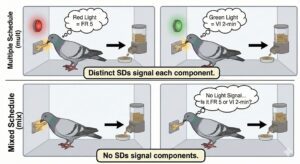
Multiple (mult) schedule
-
Two or more basic schedules
-
Presented successively, one after another
-
Each component has its own SD (e.g., different colors, sounds)
-
Reinforcement is delivered according to the schedule currently signaled by the SD
Example:
-
In the presence of a green light: VR 5 for lever pressing
-
In the presence of a red light: FI 30 s for lever pressing The organism alternates between green and red; each color signals a different schedule.
Mixed (mix) schedule
-
Same as multiple: two or more basic schedules
-
Presented successively, one after another
-
No SDs correlated with each component (they look the same)
-
The organism cannot “see” which schedule is currently in effect
Example:
-
Sometimes the lever is on VR 5, sometimes FI 30 s, but there are no different lights or cues.
Exam cues:
-
If the stem clearly describes different stimuli signaling each component → multiple
-
If the components alternate but there are no distinct SDs → mixed
Common trap: Confusing multiple with chained schedules. Remember: multiple schedules involve different SDs but do not require completing a sequence of different responses; chained schedules do.
4. Chained vs Tandem Schedules: Sequences With and Without SDs
Chained (chain) schedule
-
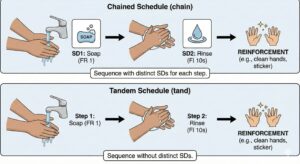
Two or more basic schedules presented in a specific sequence
-
Each component has its own SD
-
A particular response requirement must be met in each component before moving to the next
-
Reinforcement is delivered only after the final component is completed
Example:
-
SD1 (green card): FR 5 of sorting spoons → leads to SD2
-
SD2 (blue card): FI 1 min of wiping tables → then reinforcement The learner must complete spoons (FR 5) under SD1, then wiping (FI 1) under SD2, to access reinforcement.
Tandem (tand) schedule
-
Same idea: sequence of components, reinforcement after the final one
-
No distinct SDs for each component
-
The organism cannot tell exactly which part of the sequence it is in, but must complete them all
Example:
-
FR 5 followed by FI 1 min before reinforcement, but no different stimuli signaling when FR ends and FI begins.
Exam cues:
-
If there is a sequence of different components and each has its own SD → chained
-
If there is a sequence but no distinct SDs for components → tandem
Common trap: Seeing a scenario with multiple steps (task analysis) and assuming it’s automatically a chained schedule. On the exam, chained schedules are about different schedule components with different SDs, not just any multistep task.
5. Concurrent Schedules: Two (or More) Options at the Same Time
Concurrent (conc) schedules
-
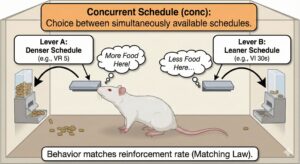
Two or more simple schedules are available simultaneously
-
Each schedule is associated with a different response option (e.g., lever A vs lever B, button 1 vs button 2)
-
The individual can choose which schedule to contact at any moment
Example:
-
Lever A: VR 5 for food
-
Lever B: VI 30 s for food Both levers are available; the organism distributes responding between them.
Why this matters for the exam:
-
Concurrent schedules underlie the matching law (allocation of responses matches relative rates of reinforcement).
-
Stems often describe choices between two tasks, adults, or activities with different reinforcement rates.
Exam cues:
-
Two or more response alternatives are available at the same time
-
Each alternative has its own schedule of reinforcement
-
The question may ask why behavior shifts toward one option (usually the one with denser reinforcement).
6. Alternative vs Conjunctive Schedules: Either/Or vs Both
Alternative (alt) schedule
-
Combines two or more simple schedules (often ratio and interval)
-
Reinforcement is delivered when either schedule requirement is met first
-
Think: “OR” logic
Example:
-
alt (FR 10, FI 2 min): the first time either 10 responses are emitted or 2 minutes pass (with at least one response), reinforcement is delivered.
Conjunctive (conj) schedule
-
Combines two or more simple schedules
-
Reinforcement is delivered only when all schedule requirements are met
-
Think: “AND” logic
Example:
-
conj (FR 10, FI 2 min): the organism must emit at least 10 responses and 2 minutes must have passed before reinforcement is available.
Exam cues:
-
If the stem describes reinforcement when one of several conditions is met → alternative
-
If the stem requires completing multiple conditions before reinforcement → conjunctive
These show up less often than multiple/chained/concurrent, but when they appear, the key is noticing whether the logic is OR (alt) or AND (conj).
7. How to Read Schedule Questions Without Getting Lost
When you see a schedule-of-reinforcement question on the BCBA® exam, slow down and systematically mark:
-
Number of components
-
Is there just one simple rule (FR, VR, FI, VI)? → Simple schedule
-
Are there two or more components? → Likely a compound schedule
-
-
Presence of discriminative stimuli (SDs)
-
Different colors, signals, people, or settings associated with different components?
-
If yes → think multiple or chained schedules.
-
If no → think mixed or tandem.
-
-
Sequence vs simultaneous availability
-
Do components happen one after another? → multiple, mixed, chained, tandem, alt, conj.
-
Are multiple options available at the same time? → concurrent.
-
-
Rule for reinforcement
-
One component at a time? → multiple/mixed/chained/tandem.
-
Reinforcement when any schedule is met? → alternative.
-
Reinforcement only after all schedules are met? → conjunctive.
-
-
Ignore extra story details
-
Exam stems often include names, settings, or emotional descriptions that do not change the type of schedule.
-
Keep returning to: components, SDs, sequence vs simultaneous, OR vs AND conditions.
-
8. Common BCBA® Exam Traps with Compound Schedules
Trap 1 – Confusing Multiple vs Chained
-
Multiple: different SDs, same response class, each schedule runs independently, reinforcement after each component.
-
Chained: different SDs, sequence of components, reinforcement only after final component.
Trap 2 – Ignoring SDs (Multiple vs Mixed; Chained vs Tandem)
-
If components are signaled by different stimuli → multiple or chained.
-
If components have no distinct stimuli → mixed or tandem.
Trap 3 – Forgetting Concurrent Means Choice
-
Concurrent schedules involve two or more responses available at the same time.
-
If there is only one response option, it’s probably not concurrent.
Trap 4 – Misreading Alt vs Conj
-
Alternative = OR (reinforce when any requirement is met).
-
Conjunctive = AND (reinforce when all requirements are met).
Trap 5 – Over-focusing on Time vs Responses
-
Candidates sometimes get stuck on whether a component is ratio vs interval.
-
For schedule-type questions, the more critical issue is how components are arranged (successive vs simultaneous, with vs without SDs, OR vs AND).
9. Mini BCBA® Exam–Style Questions (With Explanations)
Question 1 – Multiple or Mixed? A researcher alternates between FR 5 and VI 2-min schedules for a pigeon’s key pecking. When the key light is red, the FR 5 schedule is in effect. When the key light is yellow, the VI 2-min schedule is in effect.
Which type of schedule is being used? A. Multiple B. Mixed C. Chained D. Tandem
Correct Answer: A – Multiple Explanation: Two schedules (FR and VI) alternate, and each is correlated with its own SD (key color). That’s a multiple schedule.
Question 2 – Chained or Tandem? A client must complete 5 math problems and then work quietly for 2 minutes before earning a break. The therapist uses different visual cards to signal each component: a “pencil” card during the math-problem part and a “clock” card during the quiet-work part.
What schedule BEST describes this arrangement? A. Chained B. Tandem C. Alternative D. Conjunctive
Correct Answer: A – Chained Explanation: There is a sequence of components (FR then FI/interval) and each component has its own SD. Reinforcement is after the final component.
Question 3 – Concurrent or Multiple? In a classroom token system, the student can earn tokens in two ways: (1) by raising their hand to answer questions on a VR 4 schedule, and (2) by helping peers clean up materials on a VI 5-min schedule. Both options are available throughout the lesson, and the student chooses freely which behavior to engage in.
Which schedule arrangement is being used? A. Multiple B. Concurrent C. Chained D. Mixed
Correct Answer: B – Concurrent Explanation: Two schedules are available at the same time, associated with different response options (answering vs helping). That’s a concurrent schedule.
Question 4 – Alternative or Conjunctive? In a job-coaching program, a worker earns a bonus whenever they either complete 20 tasks or have worked for 60 minutes without leaving their station.
Which type of schedule best fits this description? A. Alternative B. Conjunctive C. Variable ratio D. Fixed interval
Correct Answer: A – Alternative Explanation: Reinforcement is delivered when either requirement is met first (OR logic), which is an alternative schedule.
10. Key Takeaways
-
Simple schedules (FR, VR, FI, VI) are the building blocks for compound schedules.
-
Compound schedules combine two or more schedules, and you can decode them by asking:
-
Are there multiple components?
-
Are there distinct SDs for each component?
-
Do components occur in sequence or simultaneously?
-
Is reinforcement delivered when any condition is met (alt) or only when all are met (conj)?
-
-
Multiple vs mixed and chained vs tandem are mainly distinguished by the presence or absence of SDs.
-
Concurrent schedules always involve choice between two or more response options.
-
On the BCBA® exam, ignore story details and focus on the structural features of the schedule. Once you train your eye for components, SDs, and OR vs AND logic, compound schedule questions become much easier to handle.