Behavior Skills Training (BST): The 4 Components and How It’s Tested on the BCBA® Exam
By BCBA Mock Exam
Introduction
Behavior Skills Training (BST) is one of the most practical, high-utility concepts you’ll see on the BCBA® exam—and in real life.
BST is frequently used to train:
-
Parents and caregivers
-
Teachers and classroom staff
-
RBTs and direct support professionals
-
Community members, peers, and even clients themselves (for self-management)
But on test day, it’s not enough to simply remember “instructions, modeling, rehearsal, feedback.” The exam wants you to:
-
Recognize when all four components are present (or missing) in a vignette
-
Choose the BEST next step when a BST sequence is not working
-
Differentiate BST from other staff training methods
In this article, we’ll walk through:
-
What BST is and why it matters
-
Clear descriptions of each of the 4 components
-
How BST is commonly tested on the BCBA® exam
-
Common exam traps
-
Mini exam-style questions with explanations so you can check your understanding.
1. What Is Behavior Skills Training (BST)?
Behavior Skills Training (BST) is a structured, evidence-based method for teaching new skills, especially to adults who will be implementing behavior-change procedures.
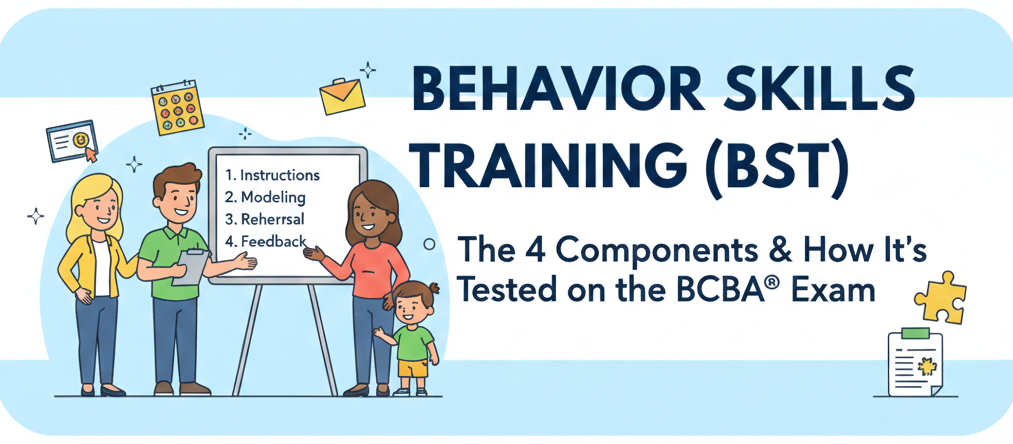
BST includes four core components:
-
Instructions – Describe the skill/behavior
-
Modeling – Show how to do it
-
Rehearsal – Trainee practices the skill
-
Feedback – Trainer provides praise and corrective feedback
BST is most often used to teach:
-
Implementation of behavior intervention plans (BIPs)
-
Data collection procedures
-
Safety skills and crisis responses
-
Teaching strategies (prompting, reinforcement, error correction)
On the BCBA® exam, BST appears in questions about staff training, caregiver training, social skills training, and intervention implementation.
2. The Four BST Components at a Glance
Before diving deeper, it helps to have a quick, exam-friendly snapshot of the four components:
-
Instructions
-
A clear description of the target skill and when it should be used.
-
-
Modeling
-
Demonstrating the skill correctly so the trainee can see what it looks like.
-
-
Rehearsal
-
The trainee practices the skill (role-play, in vivo practice) in relevant situations.
-
-
Feedback
-
Providing specific praise for correct performance and clear, constructive corrections for errors.
-
The BCBA® exam expects you to recognize all four components and identify which one is missing in a given scenario.
3. Component 1 – Instructions: Clear, Concise, and Behaviorally Specific
Instructions are the starting point of BST.
What they are:
-
A description of what to do, when to do it, and sometimes why it matters.
-
Delivered verbally, in writing, via slides, or through a combination of these.
Good BST instructions are:
-
Behaviorally specific – describe observable actions
-
Clear and concise – avoid jargon when possible
-
Linked to examples – often supported by scenarios or task analyses
Example in practice:
-
“When the client hits, block the hit, say ‘hands down,’ guide their hands to their lap, and then prompt the functional communication response.”
Exam tip:
-
If a vignette only includes a BCBA explaining a procedure to staff, with no modeling, rehearsal, or feedback, this is not full BST—it’s just the instructions component.
4. Component 2 – Modeling: Showing the Skill in Action
Modeling means demonstrating the correct performance of the skill.
What it looks like:
-
The trainer (or a video/peer model) shows the target behavior while the trainee observes.
-
Modeling can be live (in role-play) or via video-based training.
Effective modeling often includes:
-
Clear demonstration of each step in the skill
-
Examples of both typical and challenging situations
-
Opportunities for the trainee to ask questions
Examples:
-
The BCBA role-plays how to deliver differential reinforcement while another staff member pretends to be the client.
-
A video demonstrates how to safely implement a protective physical intervention.
Exam tip:
-
If a question describes staff reading a manual with no demonstration, modeling is missing.
-
BST requires that the skill is shown, not just described.
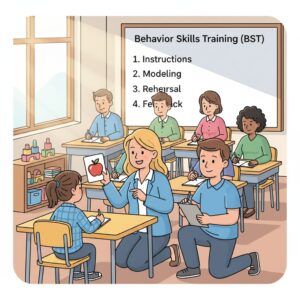
Here’s an image illustrating the concept of modeling in a training setting:
5. Component 3 – Rehearsal: Practice, Practice, Practice
Rehearsal is where the trainee gets to practice the skill.
What it involves:
-
The trainee performs the behavior in a structured context:
-
Role-play with the trainer
-
Practicing with a peer or confederate
-
In vivo practice with the actual client (when appropriate)
-
Why rehearsal matters:
-
It allows the trainer to see what the trainee can actually do—not just what they say they understand.
-
It creates opportunities to correct errors and build fluency.
Examples:
-
After seeing a model of how to run discrete-trial teaching (DTT), the RBT practices several trials while the BCBA observes.
-
A parent practices using a functional communication response (FCR) with the BCBA acting as the child.
Exam tip:
-
If staff or caregivers never practice the skill during training, you are not looking at complete BST.
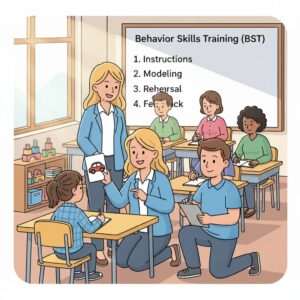
This image depicts a scenario where a trainee is rehearsing skills under supervision:
6. Component 4 – Feedback: Reinforcing and Refining Performance
Feedback is the component that shapes the trainee’s performance.
What effective feedback looks like:
-
Immediate or very timely after rehearsal
-
Behavior-specific praise for what was done correctly
-
Clear, respectful correction for errors, with guidance on how to improve
Examples:
-
“You did a great job waiting 3 seconds before giving the prompt. Next time, remember to give the praise statement right after the correct response.”
-
“I like how you blocked the hit calmly. Let’s also remember to prompt the FCR right after you block.”
Feedback can be:
-
Verbal (most common)
-
Written (checklists, performance notes)
-
Combined with performance goals or follow-up coaching
Exam tip:
-
If the vignette ends after rehearsal with no mention of praise or corrections, feedback is missing, and the training is incomplete as BST.
7. Putting It Together: A Full BST Sequence
A typical BST session might look like this:
-
Instructions
-
The BCBA explains the target skill: “Today I’ll show you how to implement the token economy during math centers…”
-
-
Modeling
-
The BCBA demonstrates the procedure with a confederate student while the teacher watches.
-
-
Rehearsal
-
The teacher practices running the token system in role-play, then with students.
-
-
Feedback
-
The BCBA gives specific praise and corrective feedback, then allows additional practice.
-
This sequence may repeat several times, with performance criteria (e.g., “Implement with 90% accuracy across 3 consecutive sessions”).
On the BCBA® exam, you may be asked to identify which step comes next, or which component is missing in a described training sequence.
8. How BST Is Tested on the BCBA® Exam
BST can appear in exam questions about:
-
Staff and caregiver training
-
Teaching parents to use FCT, DRA, or token systems
-
Training RBTs to collect data, implement prompting, or run programs
-
-
Treatment integrity
-
Using BST to improve implementation fidelity when staff are making consistent errors
-
-
Social skills and safety skills training
-
Teaching clients to respond to lures, cross the street safely, or handle bullying
-
-
Performance management and supervision
-
As part of competency-based training for supervisees
-
Typical exam tasks:
-
Identify which part of BST is being used or missing
-
Choose the best next step to correct performance issues
-
Decide whether a staff training plan truly uses BST or is just “telling people what to do”
Strategy:
-
Whenever you see a vignette about training adults or teaching complex skills, mentally check for: instructions, modeling, rehearsal, feedback.
9. Common BCBA® Exam Traps with BST
Trap 1 – Calling a lecture or manual read-through “BST”
-
If there is no modeling, rehearsal, and feedback, it’s not full BST.
Trap 2 – Forgetting rehearsal
-
Staff must practice the skill. Observing the BCBA or watching videos alone is not enough.
Trap 3 – Feedback that is vague or absent
-
“Good job” with no specifics does not count as effective BST feedback.
Trap 4 – Confusing BST with in-the-moment coaching only
-
Live coaching can be part of BST but should still include the four elements over time.
Trap 5 – Ignoring performance measurement
-
High-quality BST is often paired with competency checks or performance data. The exam may ask you how to verify that BST was effective.
10. Mini BCBA® Exam–Style Questions (With Explanations)
Question 1 – Is This BST? A BCBA provides a 1-hour lecture to teachers on how to use a token economy. The teachers receive a printed manual but do not practice the skills during the training, and no feedback is given on their performance.
This training MOST clearly: A. Implements all components of BST B. Includes instructions only, not full BST C. Includes modeling and rehearsal, but not feedback D. Includes feedback and rehearsal only
Correct Answer: B – Includes instructions only, not full BST Explanation: The scenario only describes instructions (lecture/manual). There is no modeling, rehearsal, or feedback.
Question 2 – Missing Component A BCBA explains a new prompting procedure to an RBT, demonstrates it several times with a confederate, and then asks the RBT to practice. The RBT implements the procedure three times while the BCBA silently records data. The session ends without any comments from the BCBA.
Which component of BST is MOST clearly missing? A. Instructions B. Modeling C. Rehearsal D. Feedback
Correct Answer: D – Feedback Explanation: Instructions, modeling, and rehearsal are present. The BCBA never provides specific praise or correction, so feedback is missing.
Question 3 – Choosing the Next Step A parent has received instructions and watched several models of how to implement a planned ignoring procedure for attention-maintained whining. They report that they understand the plan but still struggle to apply it consistently at home.
What is the BEST next step for the BCBA? A. Provide additional written instructions B. Have the parent rehearse the procedure through role-play and provide feedback C. Increase the complexity of the procedure D. Discontinue parent training and work only with the child
Correct Answer: B Explanation: The parent needs rehearsal and feedback, which are core components of BST and often missing when people “understand” a plan but cannot implement it fluently.
Question 4 – BST and Treatment Integrity A school team is inconsistently implementing a behavior intervention plan. The BCBA wants to improve treatment integrity. Which approach BEST represents using BST?
A. Email the plan again and ask staff to reread it B. Give a group lecture about the plan during a staff meeting C. Provide instructions, model correct implementation, have staff rehearse the procedures, and give performance-based feedback D. Add a response cost procedure for staff who do not follow the plan
Correct Answer: C Explanation: Option C includes all four BST components and directly addresses performance through practice and feedback.
11. Key Takeaways
-
Behavior Skills Training (BST) is a four-component training package: instructions, modeling, rehearsal, and feedback.
-
BST is widely used for staff, caregiver, and client training, and is commonly tested on the BCBA® exam.
-
When analyzing vignettes, always ask:
-
Did the trainer explain the skill? (Instructions)
-
Did someone demonstrate it? (Modeling)
-
Did the trainee practice it? (Rehearsal)
-
Did the trainer provide behavior-specific praise and corrections? (Feedback)
-
If any piece is missing, it’s not full BST.
Once you see BST as a structured sequence rather than just a list of words, exam questions about staff training and performance become much easier to decode—and your real-world supervision and coaching become more effective as well.