
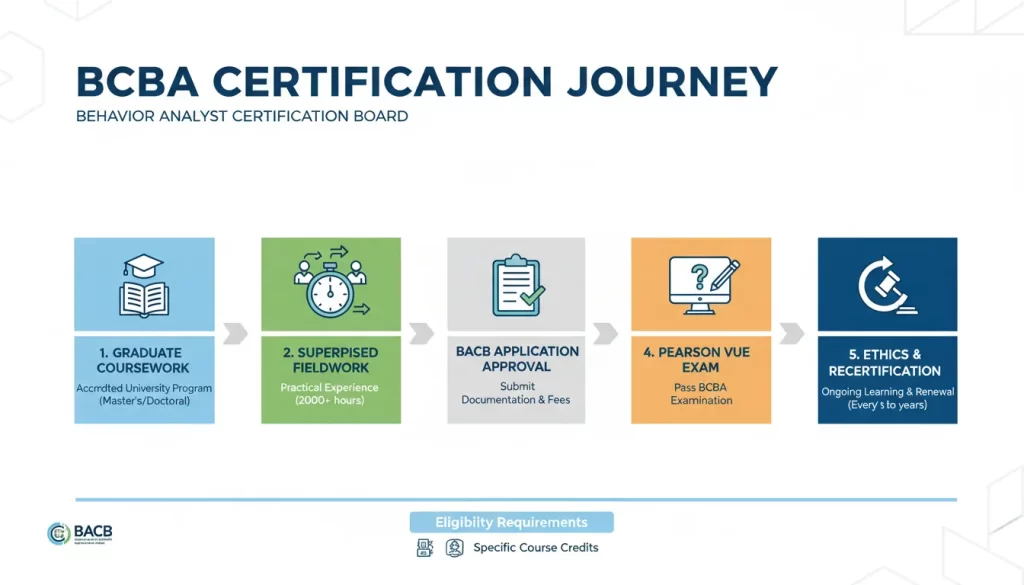
If you’ve ever typed behavior analyst certification board into a search bar at midnight, you’re not alone. I’ve worked with candidates who are juggling full-time caseloads, supervision hours, and a growing stack of notes—yet still feel unsure about what the BACB actually does and what steps matter most. The good news: once you understand how the behavior analyst certification board process fits together (eligibility → fieldwork → application → exam → ethics), your plan gets simpler and your study time becomes more effective.
In this guide, you’ll learn what the behavior analyst certification board is, what it controls (and what it doesn’t), how the BCBA exam is scheduled, and how to prep efficiently using realistic practice.

What Is the Behavior Analyst Certification Board (BACB)?
The Behavior Analyst Certification Board (BACB) is the credentialing organization best known for setting standards for behavior analyst credentials such as BCBA. In plain language, the behavior analyst certification board defines eligibility requirements, publishes key policies, and oversees certification-related compliance (including ethics expectations). It’s not a training company and it doesn’t provide your university coursework or your job site supervision—those come from schools and supervisors—but the BACB sets the rules they must align with.
If you want the official source for updates, standards, and policy changes, start at the BACB official website. I also recommend watching the BACB’s own explanations when rules feel confusing; their resources can clarify details like fieldwork structure and documentation.
What the BACB Controls vs. What Pearson VUE Controls
A common point of stress is assuming the BACB manages your test appointment. In reality, the certification and the exam delivery are split between two parties, which is why candidates get conflicting assumptions in study groups.
-
BACB (behavior analyst certification board) typically governs:
- Eligibility requirements and application review
- Exam content outline alignment (what topics can be tested)
- Ethics and professional conduct expectations
- Certification status and maintenance rules
-
Pearson VUE typically governs:
- Test center availability and appointment scheduling
- Rescheduling/cancellation timelines and fees
- Day-of testing rules at the center
For scheduling logistics and fees, review the Pearson VUE BACB exam page. If something is wrong in your authorization information, follow the instructions to contact the BACB promptly.
| Task | BACB (Behavior Analyst Certification Board) | Pearson VUE |
|---|---|---|
| Eligibility decision | Reviews application and determines exam eligibility | Confirms only that an eligible authorization exists for scheduling |
| Exam appointment scheduling | Provides authorization window/ID to test; sets exam authorization rules | Manages test-center/online scheduling, available dates/times, and appointment confirmation |
| Accommodations communication | Reviews and approves accommodation requests; issues accommodation authorization details | Implements approved accommodations at the test center/online appointment based on BACB authorization |
| Rescheduling fees | Sets related policy constraints (e.g., authorization window limits) | Charges and processes rescheduling/cancellation fees per Pearson VUE rules and timelines |
| Exam day check-in rules | Defines candidate conduct expectations tied to exam security policies | Enforces check-in procedures (ID requirements, arrival time, security screening, test-center/online proctoring rules) |
| Certification issuance | Determines pass/fail status reporting, issues certification, maintains registrant records | Delivers the exam administration and sends score results to BACB (no certification issuance) |
The BCBA Certification Pathway (High-Level Steps)
Most candidates do better when they stop treating the certification path like one giant task and start treating it like a sequence with checkpoints. Here’s the typical flow that aligns with how the behavior analyst certification board approach is structured.
- Complete required graduate coursework aligned to current standards.
- Accrue supervised fieldwork hours with correct supervision structure and documentation.
- Apply for the exam through the BACB and receive authorization to test.
- Schedule the exam through Pearson VUE and sit for the test.
- Maintain certification and ethics compliance once certified.
I’ve found that candidates who build a timeline (with buffer weeks) avoid the most common panic: realizing too late that a paperwork detail, supervision format, or deadline is off.

Supervised Fieldwork: Where Candidates Lose Time (and How to Avoid It)
Fieldwork is where the rules matter most—and where small misunderstandings can cost big time. The BACB has published guidance to help trainees and supervisors understand what “counts,” how supervision should look, and why accurate tracking is critical. Their podcast and blog resources are a practical starting point if you’re unsure about unrestricted hours, supervision contacts, or documentation quality: Inside the BACB podcasts and related fieldwork guidance.
From experience, the most common fieldwork pitfalls include:
- Logging hours without enough detail to defend what you did
- Over-counting restricted activities and under-counting unrestricted work
- Waiting too long to review documentation with your supervisor
- Treating supervision like a formality instead of skills development
If you’re still accruing hours, build a weekly “audit” habit: confirm hours totals, categories, and signatures while the week is fresh. It’s much easier than trying to reconstruct two months later.
BCBA Exam: What to Expect (and How It’s Really Different From Coursework)
Coursework teaches concepts; the exam tests whether you can discriminate between close answer choices under time pressure. When candidates tell me “I understand the material but my scores won’t move,” the issue is often not knowledge—it’s decision-making speed, wording traps, or weak discrimination among similar terms.
That’s why “exam-style practice” matters. Good mock exams should:
- Mirror the test’s wording patterns and difficulty
- Include explanations that teach why each option is right or wrong
- Allow unlimited attempts so you can track improvement, not just completion
- Target commonly confusing areas (stimulus control, motivating operations, ethics)
If you want to sharpen applied decision-making, start with realistic practice sets like the ones in BCBA practice exam study materials. For a quick diagnostic session, use free BCBA mock exam practice questions.
Understanding the Updates to the 2027 BCBA and BCaBA Requirements
The Content Areas That Most Often Cause “Confident-but-Wrong” Answers
Certain topics repeatedly create false confidence because the definitions feel familiar, but the exam tests nuance and application. In my own prep (and while reviewing thousands of candidate attempts), these are the areas where an error log pays off fast:
- Ethics and professional conduct: questions often test what you should do first, next, or document, not just what’s “bad.”
- Stimulus control vs. motivating operations: candidates mix up what changes value vs. what signals availability.
- Reinforcement subtypes and functions: automatic vs. social, positive vs. negative, and function-based interpretation.
If ethics is a weak point, use a single source of truth and drill scenarios. This guide helps you study with exam focus: ethics in aba practice bcba exam guide. If you consistently miss questions around reinforcement subtype, review and practice: automatic reinforcement bcba exam guide.
BACB vs. Other Credentialing Boards (Like QABA): Know the Difference
Some candidates ask whether the behavior analyst certification board is the only option. The BACB is the most widely recognized behavior-analytic credentialing body in many contexts, but there are other credentialing organizations with their own standards and pathways. For example, the Qualified Applied Behavior Analysis Credentialing Board (QABA) provides a separate credentialing route with different structures and offerings.
What matters is your local employer requirements, payer/insurance rules, and regulatory environment. Before you commit to a pathway, confirm which credential is accepted where you plan to practice.
A Practical Study Plan That Matches How the Exam Is Built
When study time is limited, structure beats intensity. I recommend a plan that cycles through (1) learn → (2) practice → (3) review errors → (4) re-test, with most time spent on step 3. That’s where scores change.
Use this weekly framework:
- 2 days/week: concept review (short, focused)
- one domain per session
- summarize into “if/then” rules and discrimination cues
- 3 days/week: timed practice
- mixed sets, not single-topic sets
- track time per item and confidence level
- 1 day/week: error log + remediation
- rewrite why the right answer is right
- list the trap that pulled you to the wrong option
- 1 day/week: reset
- light review + sleep + plan next week
Candidates using BCBA Mock Exam often tell me the biggest win is not just “more questions,” but getting explanations that force you to think like the exam. If you’re overwhelmed, start smaller: one timed set, one error log page, repeat.
Common Mistakes When Dealing With the BACB (and How to Fix Them)
Even strong students lose weeks by missing administrative details. Here are the fixes that reduce risk fast:
- Mistake: Assuming the BACB can schedule your exam
- Fix: Schedule and manage appointments via Pearson VUE per your authorization instructions.
- Mistake: Not reading official updates
- Fix: Check the BACB official website periodically, especially near application and exam windows.
- Mistake: Studying without measuring improvement
- Fix: Use timed mock exams and track domain scores, not just “percent correct.”
The goal is fewer surprises—because surprises are what burn time, money, and confidence.

Conclusion: Make the Behavior Analyst Certification Board Path Predictable
The behavior analyst certification board process feels intimidating when it’s vague. Once it’s mapped—eligibility, fieldwork, application, Pearson VUE scheduling, and targeted exam prep—it becomes a project you can manage. I’ve seen candidates make the biggest jump when they stop re-reading and start practicing like the test: timed sets, ruthless error logs, and deep explanation review.
If you’re preparing now, share in the comments what step you’re on (fieldwork, application, or final exam push) and what topic is costing you the most points. And if you want a structured, exam-style way to improve fast, explore BCBA Mock Exam’s practice resources and build your next study week around measurable progress.
FAQ: Behavior Analyst Certification Board (BACB) Questions People Search
1) What does the Behavior Analyst Certification Board do?
The BACB sets certification standards, reviews applications, publishes requirements, and enforces ethics expectations for credentials like BCBA.
2) Does the BACB schedule the BCBA exam?
No. Exam appointments are scheduled through Pearson VUE after you receive authorization to test.
3) Where do I find the most accurate BACB fieldwork guidance?
Start with official BACB resources such as their Inside the BACB podcasts and related fieldwork publications.
4) What’s the fastest way to raise my BCBA exam score?
Use realistic timed practice, keep an error log, and focus remediation on frequently missed concepts and “trap” answer patterns.
5) What topics are most commonly confusing on the BCBA exam?
Ethics scenarios, stimulus control vs. motivating operations, and reinforcement/function distinctions are frequent problem areas.
6) Is BACB the same as QABA?
No. They are different credentialing organizations with different requirements and credential structures. See the QABA website for details.
7) Where should I confirm official BACB updates?
Use the BACB official website as your primary source for policies, announcements, and requirements.


