
A plain-language guide to what BCBA means in autism services, what the role can include, where the boundaries are, and which questions families should ask before choosing support. If you searched for bcba meaning autism, you are probably trying to understand a professional title in a very practical context: who will design or supervise services, what that person is qualified to do, and how their work should fit with your family’s goals. The short answer is that BCBA stands for Board Certified Behavior Analyst. In autism services, a BCBA may assess behavior, help design a behavior-analytic program, supervise implementation, review progress data, and adjust goals with the family and care team.
Table of Contents
- BCBA Meaning Autism: What Does the Credential Mean in Services?
- What Does a BCBA Do?
- What a BCBA Credential Does Not Automatically Mean
- BCBA, RBT, and Other Professionals
- Questions Families Can Ask
- What Good Goals and Data Review Look Like
- A Practical Next Step
- Frequently Asked Questions
- Quick Review Checklist
- Take the Free BCBA Mock Exam
That answer still needs an important qualification. “BCBA” is a professional credential, not another name for autism diagnosis, and the credential alone does not tell you that every BCBA works with autistic clients or uses the same approach. A family should look at the person’s current credential and license status where applicable, experience with the learner’s needs, supervision model, communication style, and willingness to use meaningful, measurable, individualized goals.
Important: Certification, licensure, insurance rules, and service availability can change. Use the BACB’s current BCBA information and the provider’s own documents for current requirements. This article explains the role in general; it is not a diagnosis, treatment recommendation, or substitute for a qualified clinical conversation.
BCBA Meaning Autism: What Does the Credential Mean in Services?
BCBA means Board Certified Behavior Analyst. The BACB describes the BCBA as a graduate-level behavior analyst credential. A BCBA can independently provide behavior-analytic services within the person’s scope of practice and under the rules that apply in the relevant jurisdiction. In an autism-service setting, that work may involve functional assessment, skill-building programs, caregiver coaching, data review, and supervision of people who implement the plan.
The phrase “in autism services” describes the setting or population being discussed; it does not change what the letters stand for. It also does not turn the BCBA into a medical diagnostician. Autism diagnosis, medical evaluation, speech and language assessment, occupational therapy, and other services may involve different qualified professionals. The right team depends on the learner, the question being asked, and local rules.
Families should also distinguish the credential from the person’s fit. Two BCBAs can both hold the same certification while having different experience with communication supports, school collaboration, caregiver coaching, sensory needs, or a particular age group. A useful conversation asks what the BCBA will actually do, how progress will be measured, how the learner’s preferences will be respected, and how the family can raise concerns.
What Does a BCBA Do?
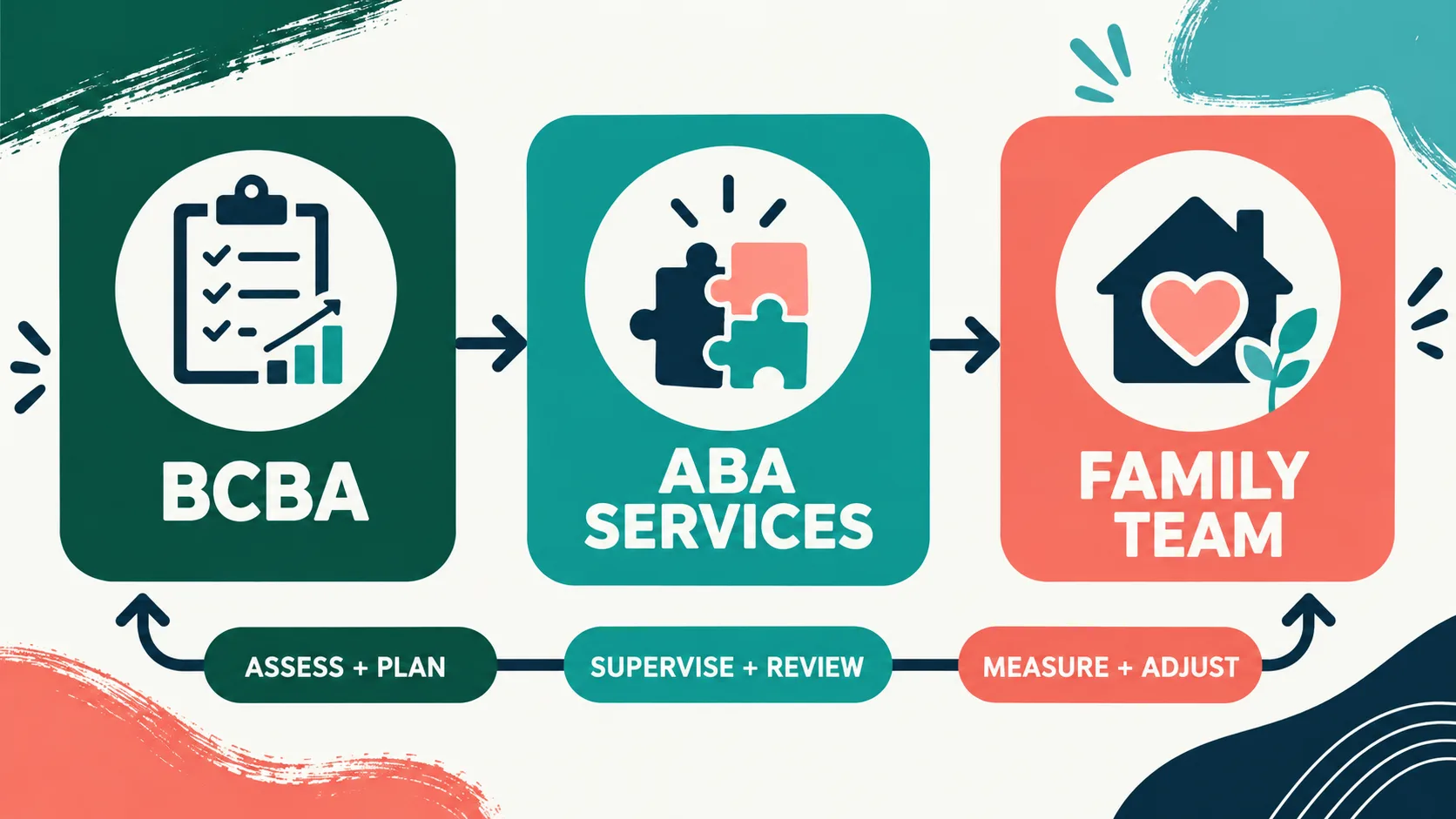
In a well-defined autism-service arrangement, a BCBA’s work often follows a cycle: understand the referral question, collect information, develop a plan, coordinate implementation, examine data, and revise the plan when the evidence or the learner’s circumstances change.
- Assess and define behavior: clarify the observable behavior, the context in which it occurs, its likely function, and the skill or quality-of-life goal behind the referral.
- Design individualized goals: translate broad concerns into goals that can be taught, practiced, observed, and reviewed instead of using vague promises about “fixing” a person.
- Write or oversee intervention plans: describe teaching procedures, supports, safety considerations, prompting, reinforcement, generalization, and criteria for changing the plan.
- Supervise implementation: coach technicians, caregivers, teachers, or other team members when that falls within the service arrangement and applicable rules.
- Review data: examine patterns over time, not just one successful or difficult session, and use the information to decide whether a strategy should continue, change, or stop.
- Collaborate with the family and team: explain decisions in understandable language and coordinate with other providers rather than treating one discipline as the answer to every question.
The work should be understandable to the people who are expected to participate in it. A family does not need to become a behavior analyst to ask what the goal is, why a procedure was selected, what counts as progress, and what will happen if the plan is not helping. Clear explanations and an open review process are part of responsible collaboration.
What a BCBA Credential Does Not Automatically Mean
Because BCBA is a recognized credential, it can sound broader than it is. Several assumptions are worth checking before services begin:
- It does not automatically mean autism diagnosis. A BCBA may contribute behavior information to a team, but families should ask the appropriate diagnostic or medical professional about diagnosis.
- It does not guarantee autism specialization. Ask about direct experience with the learner’s age, communication profile, support needs, and setting.
- It does not guarantee a particular intervention style. Ask how goals are selected, how assent and dignity are considered, and how the plan is individualized.
- It does not replace every other professional. Speech-language, occupational, educational, medical, and mental-health questions may require other members of the team.
- It does not guarantee an outcome. A responsible provider can explain what will be measured and how decisions will be made, but no credential can promise a specific result for every learner.
These boundaries are not a criticism of behavior analysis. They make the role more useful. When each professional is clear about scope, families can ask the right person the right question and avoid treating one service as a substitute for a coordinated support plan.
BCBA, RBT, and Other Professionals
Titles can become confusing when several people appear in the same service plan. The table below is a starting point, not a complete legal description of every role. Local licensure and employer policies still matter.
| Role | Typical contribution | What to clarify |
|---|---|---|
| BCBA | Behavior-analytic assessment, program design or oversight, data review, supervision, and team coaching within scope. | Experience, license rules, supervision frequency, goals, data access, and how the family participates. |
| RBT | A paraprofessional role that implements behavior-analytic services under responsible supervision. | Who supervises the work, how training happens, and how observations and concerns reach the BCBA. |
| SLP or OT | Speech, language, feeding, occupational, sensory, motor, or daily-living assessment and intervention within the professional’s scope. | How goals overlap, how providers communicate, and which professional owns each recommendation. |
| Diagnostician or physician | Medical, developmental, psychological, or diagnostic evaluation according to training and local authority. | Which question is being answered and how findings should be shared with the service team. |
The important question is not which title is “best.” It is whether the team’s responsibilities are clear, the goals are meaningful, and the learner and family can understand how decisions are made.
Questions Families Can Ask
Before agreeing to services, write down questions and ask for plain-language answers. You can also ask who to contact between formal meetings and how concerns will be documented.
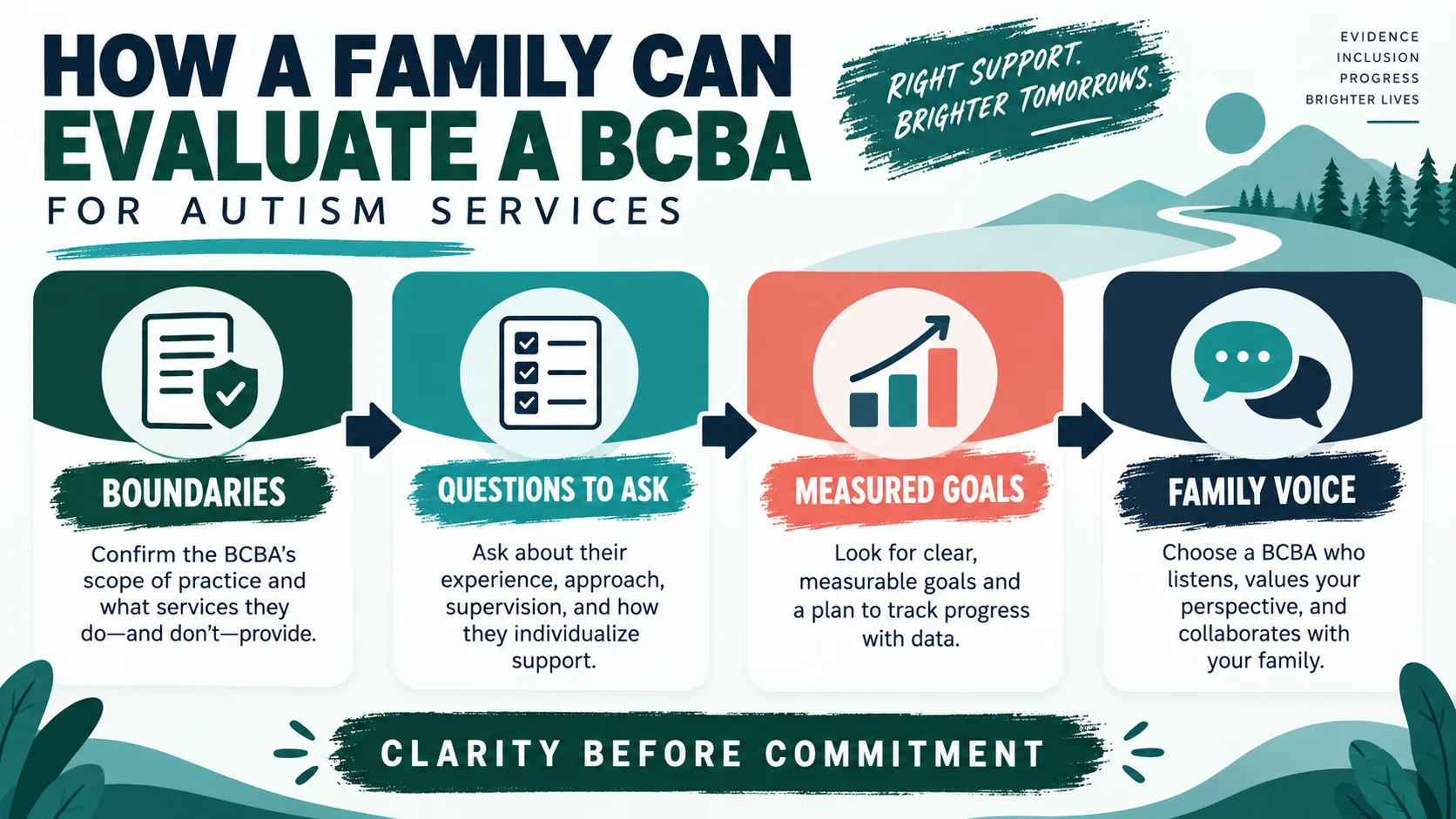
- What does the BCBA personally do in this service? Ask how often the BCBA observes, reviews data, meets with the family, and updates the plan.
- What experience do you have with this learner’s needs? Look for specific experience, not a generic statement that the provider “works with autism.”
- How are goals selected? Ask how the learner’s preferences, communication, safety, independence, relationships, and daily routines shape the goals.
- How will progress be measured? Ask to see an example of the type of data used and how often the team reviews it.
- What happens if a strategy is not helping? A good answer includes a review point, a way to report concerns, and a willingness to modify or discontinue an ineffective approach.
- How do you coordinate with other professionals? Ask how information is shared with permission and how conflicting recommendations are handled.
Families should feel able to ask for clarification without being treated as an obstacle. The relationship is part of the service. If the explanation is full of promises but light on goals, measurement, scope, and review, ask for more detail before making a decision.
What Good Goals and Data Review Look Like
A useful plan connects the learner’s real life to observable steps. For example, instead of describing a child as “more compliant,” a team might identify a specific routine, the communication or self-advocacy skill that would help, the support to be taught, and how the team will know whether the skill generalizes beyond one session. Data review should answer practical questions:
- Is the target behavior or skill defined in a way that different team members can recognize?
- Is the change meaningful to the learner and family, or is it only easy to count?
- Does progress appear across people, settings, and routines rather than only with one provider?
- Are there signs that the plan should be simplified, changed, paused, or discussed with another professional?
- Does the learner have a safe way to communicate discomfort, refusal, or a different preference?
Progress is not only a graph moving upward. It can include greater independence, access to communication, participation in valued activities, fewer barriers, or a plan that better respects the learner’s voice. Ask the BCBA to explain how the numbers connect to those outcomes.
A Practical Next Step
If you are a family member, use the questions above when interviewing a provider or reviewing an existing plan. If you are a BCBA candidate researching the profession, connect the real-world role to the certification concepts you are studying: measurement, assessment, intervention, supervision, ethics, and collaboration all require more than memorizing definitions.
To practise the exam-style decisions behind those concepts, try the Free BCBA Mock Exam. Use the result as a study baseline, review the explanation for every uncertain answer, and record one topic to revisit. It is a practice signal, not a promise about certification or clinical outcomes.
Frequently Asked Questions
What does BCBA stand for in autism?: BCBA stands for Board Certified Behavior Analyst. In autism services, the BCBA may assess behavior, develop or oversee behavior-analytic programs, supervise implementation, review data, and work with the family and team. The credential itself does not mean that every BCBA diagnoses autism or specializes in every autism-related need.
Is a BCBA the same as an autism diagnostician?: No. A BCBA is a behavior analyst credential. Diagnosis and medical or developmental evaluation may involve other qualified professionals depending on the question and local rules. Ask the provider to explain their scope and which questions should be referred to another member of the team.
Does every BCBA work with autistic clients?: No. BCBAs work in different settings and with different populations. Ask about direct experience with the learner’s age, communication, support needs, and daily environments rather than assuming that the credential alone establishes a match.
What is the difference between a BCBA and an RBT?: A BCBA is a graduate-level behavior analyst credential and may design or oversee services within scope. An RBT is a paraprofessional role that implements behavior-analytic services under responsible supervision. The exact service arrangement and local rules should be explained by the provider.
How can a family tell whether a BCBA is a good fit?: Ask how goals are chosen, how the learner’s preferences and communication are included, how progress is measured, how often the BCBA reviews data, and what happens when a strategy is not helping. Clear answers and respectful collaboration are stronger signals than a title alone.
Bottom line: In the context of autism services, BCBA means Board Certified Behavior Analyst—not autism diagnosis and not a guarantee of one particular treatment style. Look for clear scope, individualized and measurable goals, regular data review, coordination with other professionals, and a genuine place for the learner’s and family’s voice.
Quick Review Checklist
Use this final checklist to turn bcba meaning autism into exam-ready reasoning. The goal is not to memorize a label in isolation; it is to identify the relevant evidence and explain why the best answer fits the scenario. Key ideas to review:
- State the central definition or decision point for bcba meaning autism in your own words.
- Identify the detail that makes bcba meaning autism different from its closest related ABA term.
- Separate the observable facts in a scenario from assumptions that are not supported by the facts.
- Write one example and one nonexample so you can recognize the concept in a new setting.
Exam application checks:
- Ask what the question is actually requesting before comparing the answer choices.
- Mark the antecedent, response, consequence, or other evidence that supports the selected answer.
- Look for a distractor that describes a related process but does not answer the specific question.
Final self-check:
- Explain how you would verify the interpretation with clear observations or data.
- Change one detail in the scenario and decide whether your answer should change.
- Give a one-sentence rationale that a supervisor or study partner could evaluate.
Take the Free BCBA Mock Exam
When you are ready to apply the idea, use the free practice resource below for additional feedback. Take the Free BCBA Mock Exam



