How to Turn ABA Concepts into Exam Points: A Study Framework Using Mock Exams and Task List Terms
By BCBA Mock Exam
Introduction
You don’t pass the BCBA® exam just by “knowing ABA.” You pass when you turn ABA concepts into exam points on specific questions.
That means:
-
Connecting what you study to Task List terms
-
Practicing with mock exams in a targeted way
-
Learning from your mistakes instead of just feeling discouraged
In this article, we’ll walk through a practical study framework that helps you turn ABA concepts into exam points by:
-
Using the Task List as a roadmap
-
Using mock exams as active learning tools (not just score-checkers)
-
Building a system for tracking errors and filling in knowledge gaps
-
Practicing the exact kinds of decisions the exam expects you to make.
This BCBA exam study framework shows you exactly how to do that in a structured, repeatable way.

1. Change the Goal: Turn ABA Concepts into Exam Points
A lot of candidates study “hard”—they read textbooks, watch videos, highlight notes—but still get frustrated scores.
The problem isn’t effort. It’s alignment.
For the BCBA® exam, your real goal is: 👉 Turn what you know into the right answer choice under time pressure.
This requires three shifts:
-
From memorizing to discriminating (e.g., SD vs MO vs EO vs AO)
-
From “I understand this in theory” to “I can pick the right option in a scenario”
-
From random practice to Task-List-aligned practice
Once you see the exam as a set of predictable decision patterns, your studying becomes much more focused.
2. Use the Task List as Your BCBA Exam Study Framework
The Task List (5th/6th Edition, depending on your exam) is not just a long document—it’s basically the menu of what the exam can ask about.
Practical way to use it:
-
Print or save a copy you can mark up.
-
Go through each task and ask:
-
“Do I recognize this term?” (yes/no)
-
“Could I write a simple definition from memory?” (yes/no)
-
“Could I answer a scenario question about this?” (yes/no)
-
Create three categories:
-
Green – I know it well and can answer questions
-
Yellow – I kind of know it, but I’m not confident in scenarios
-
Red – I don’t know this yet or always miss it on questions
Your exam score will be built by:
-
Solidifying green areas
-
Converting yellow to green
-
Bringing the most high-yield red areas up to at least yellow/green
Mock exams become powerful when they are mapped back to this Task List and used as a core part of your BCBA exam study framework.
3. Break Each Concept into Three Exam Skills
For any concept on the Task List, the exam can test you in at least three ways:
-
Labeling/Definition – “What is this?”
-
Example: “Which of the following best defines a motivating operation?”
-
-
Discrimination – “Which one is it (and which are not)?”
-
Example: “Which option describes a CMO-T vs SD vs UMO?”
-
-
Application in a Scenario – “What would you do / what is happening here?”
-
Example: “In this vignette, what is the function of the behavior? Which graph shows treatment effectiveness?”
-
When you study a topic (e.g., reinforcement, extinction, functional analysis, MOs, functions of behavior, 7 dimensions of ABA), ask yourself:
-
Can I define it?
-
Can I tell it apart from similar terms?
-
Can I recognize it in a story or graph and choose the best action?
If any of these three pieces feels weak, that’s a clear study target.
4. Use Mock Exams as a Diagnostic Tool, Not Just a Grade
Mock exams are more than a way to see a score—they’re a goldmine of data about how your brain is working.
Here’s a simple framework:
Step 1 – Take a mock exam under real conditions
-
Timed
-
No notes, no pausing to study
-
Answer everything, even if you’re unsure
Step 2 – Score it, then ignore the total score for a moment
-
The score is useful, but what matters most is where you lost points.
Step 3 – For each missed question, tag it by Task List area
-
Example tags:
-
Measurement (continuous vs discontinuous, visual analysis)
-
Experimental design (reversal, multiple baseline, alternating treatments)
-
Behavior change procedures (reinforcement, punishment, extinction, DR schedules)
-
FBA and FA vs descriptive assessment
-
Ethics and professional conduct
-
MOs and SDs
-
Functions of behavior
-
Step 4 – Note why you missed each item
-
Didn’t know the term
-
Confused two similar concepts
-
Misread the stem or answer choices
-
Ran out of time and guessed
This gives you a personalized study map: not just what you got wrong, but why. Used well, they turn random practice into a focused BCBA exam study framework that actually earns you points.
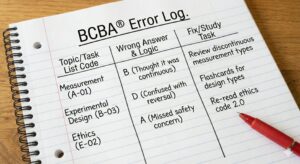
5. Build a Simple Error Log (This Is Where Learning Happens)
An error log turns wrong answers into future exam points.
You can keep it in a notebook, spreadsheet, or notes app. For each missed question, record:
-
Topic / Task List code – e.g., “Measurement – visual analysis,” “Differential reinforcement,” “MOs vs SDs.”
-
Question type – definition, discrimination, scenario.
-
Your wrong answer – write the letter and the logic you used.
-
Correct answer and why – short explanation in your own words.
-
Fix / study task – what you’ll do to improve (e.g., “Review extinction vs negative punishment with 3 new examples”).
This process helps you:
-
Spot patterns (e.g., “I miss a lot of graph questions” or “Ethics scenarios trip me up”).
-
Turn vague anxiety (“I’m bad at this exam”) into specific actions (“I need more practice with treatment integrity and social validity”).
6. Convert Errors into Flashcards and Micro-Drills
Once you’ve logged your errors, you can convert them into active practice.
Ideas:
-
Make flashcards with:
-
The question stem rewritten in your own words on the front
-
The correct rationale on the back
-
-
Create quick “If the stem says X, think Y” rules for yourself:
-
“If the question mentions staggered introduction across settings → multiple baseline.”
-
“If data are variable and treatment integrity is unknown → check fidelity before changing intervention.”
-
-
Build mini-quizzes focused on one theme (e.g., 10 questions just on functions of behavior or just on MOs).
Your goal is to repeatedly remind your brain: 🧠 “Next time I see a similar pattern, I know which answer to pick.”
7. Structure Your Weekly BCBA Exam Study Framework and Sessions Around This System
Instead of “studying whenever,” build a weekly BCBA exam study framework that connects the Task List, mock exams, and your error log.
1–2 days – Concept focus (Task List)
-
Pick 1–2 Task List areas (e.g., measurement + experimental design).
-
Review definitions and examples.
-
Write your own short explanations.
1 day – Targeted practice questions
-
Do sets of 10–20 questions only on that topic.
-
Immediately review and log mistakes.
1 day – Mixed mock exam practice
-
Take a mini-mock (e.g., 40–50 questions).
-
Tag missed items in your error log.
Ongoing – Flashcard/micro-drill time (10–15 minutes)
-
Review error-based flashcards.
-
Focus on yellow/red areas from your Task List map.
This way, every week you are:
-
Learning new content
-
Applying it to exam-style questions
-
Closing the loop by fixing specific weaknesses
8. How to Approach Tricky Scenario Questions
Many BCBA® questions are not about definitions; they’re about choosing the most appropriate action in a scenario.
Use a simple thought process:
Step 1 – Identify the core theme
-
Is this about: function, measurement, design, ethics, supervision, treatment integrity, social validity, or MOs/SDs?
Step 2 – Look for data and patterns, not just one event
-
Are you given a trend, level, or repeated outcome?
-
Is treatment integrity known or unknown?
Step 3 – Eliminate obviously unethical or non–data-based options
-
Any answer that ignores safety, consent, or data trends is usually wrong.
Step 4 – Ask: “What would a careful, data-based BCBA do next?”
-
Collect more information (e.g., ABC data, integrity checks)?
-
Adjust reinforcement or prompts?
-
Consult the Task List concept that fits best (e.g., DR vs extinction vs punishment)?
Practicing this process with mock exams trains the decision-making muscle you need on test day.

9. Common BCBA® Study Traps (and How to Avoid Them)
Trap 1 – Only re-reading notes
-
Passive review feels safe but doesn’t train you to answer questions.
-
Fix: Spend more time answering questions and reviewing errors than just reading.
Trap 2 – Studying randomly
-
Jumping from ethics to measurement to stimulus equivalence with no plan.
-
Fix: Let the Task List and your error log decide what’s next.
Trap 3 – Avoiding weak areas
-
Only doing questions you’re good at because they feel reassuring.
-
Fix: Schedule regular sessions for yellow/red topics so they don’t stay weak.
Trap 4 – Treating mock exams like “final verdicts”
-
Feeling discouraged by scores instead of using them as feedback.
-
Fix: After every mock, focus on: “What did this teach me about my next study steps?”
10. Mini BCBA® Exam–Style Questions About Studying (With Explanations)
Question 1 – Best Use of a Mock Exam
A candidate takes a full-length mock exam once a week, checks their total score, and then spends most of their time re-reading their textbook. They continue to miss similar types of questions across weeks.
What is the BEST adjustment to their study plan? A. Take more mock exams without reviewing them B. Focus only on high-scoring areas to build confidence C. Use each mock exam to identify missed items by Task List area and create an error log D. Stop using mock exams because they are discouraging
Correct Answer: C Explanation: Mock exams are most powerful when used diagnostically. Tagging missed items by topic and building an error log turns wrong answers into a focused study plan.
Question 2 – Task List Mapping
A candidate notices they frequently miss questions about visual analysis of graphs and treatment integrity. They decide to highlight these items on the Task List and schedule extra practice questions for these topics.
This approach BEST illustrates: A. Studying only by reading definitions B. Using the Task List as a roadmap to target weak areas C. Over-focusing on low-frequency exam topics D. Ignoring feedback from mock exams
Correct Answer: B Explanation: The candidate is using patterns from their performance to identify weak Task List areas and then plan targeted practice.
Question 3 – Fixing Repeated Concept Confusion
A candidate keeps confusing negative reinforcement and punishment on mock exams. They usually pick the correct answer if the question is purely definitional, but they miss scenario questions.
What should they do NEXT to improve? A. Memorize the definitions again B. Avoid that topic and hope fewer questions appear on the real exam C. Create side-by-side examples and practice scenario-only questions that require discriminating between the two D. Focus instead on experimental design
Correct Answer: C Explanation: The problem is not basic memory but discrimination in context. Side-by-side comparison and scenario practice directly target this skill.
Question 4 – Managing Exam Anxiety with a Framework
A candidate feels overwhelmed by the size of the BCBA® Task List and doesn’t know where to start. They plan to read a textbook from cover to cover and hope for the best.
Which alternative plan is MOST likely to improve both confidence and effectiveness? A. Ignore the Task List and rely on intuition B. Use the Task List to label topics as green/yellow/red, then build weekly study blocks that combine concept review, targeted questions, and mock exam analysis C. Only study ethics, because it applies to everything D. Take as many random quizzes as possible without tracking results
Correct Answer: B Explanation: Mapping strengths and weaknesses, then planning structured practice around them, creates a clear, manageable study framework.
11. Key Takeaways
Passing the BCBA® exam is not just about “knowing ABA”—it’s about building a BCBA exam study framework that turns knowledge into correct answer choices.
-
Use the Task List as your study map and mock exams as diagnostic tools.
-
Build an error log so every missed question becomes a future point on the real exam.
-
Break each concept into three skills: definition, discrimination, and application.
-
Structure your weeks so you’re consistently reviewing concepts, practicing questions, and closing gaps.
With a clear framework, your studying becomes less about guessing what might be on the test—and more about deliberately training the exact skills the BCBA® exam rewards.