

Introduction: Why the BCBA Exam Question Distribution Matters
Effective preparation for the BCBA certification requires strategic planning based on the actual content weighting. The 6th Edition Task List serves as the foundation for the exam blueprint, and understanding how questions are distributed across domains is essential for efficient study. This BCBA exam question distribution analysis helps candidates allocate their limited study time where it matters most.
Table of Contents
- Introduction: Why the BCBA Exam Question Distribution Matters
- The 6th Edition Task List: Domain-by-Domain Weighting
- From Blueprint to Study Plan: Strategic Implications
- Common Exam Traps Related to Content Distribution
- Quick-Reference Checklist and Summary
- References
Without this knowledge, candidates risk spending disproportionate time on lower-weight content while under-preparing for heavily tested domains. The 6th Edition Task List organizes content into five sections, but exam questions don’t appear in isolated blocks. Instead, they integrate concepts across domains in realistic scenarios that mirror professional practice.
The 6th Edition Task List: Domain-by-Domain Weighting
The BACB examination blueprint follows a specific weighting structure based on the 6th Edition Task List. While exact percentages can vary slightly between exams, the following distribution provides a reliable framework for study planning.
Ethical and Professional Conduct (Section 1)
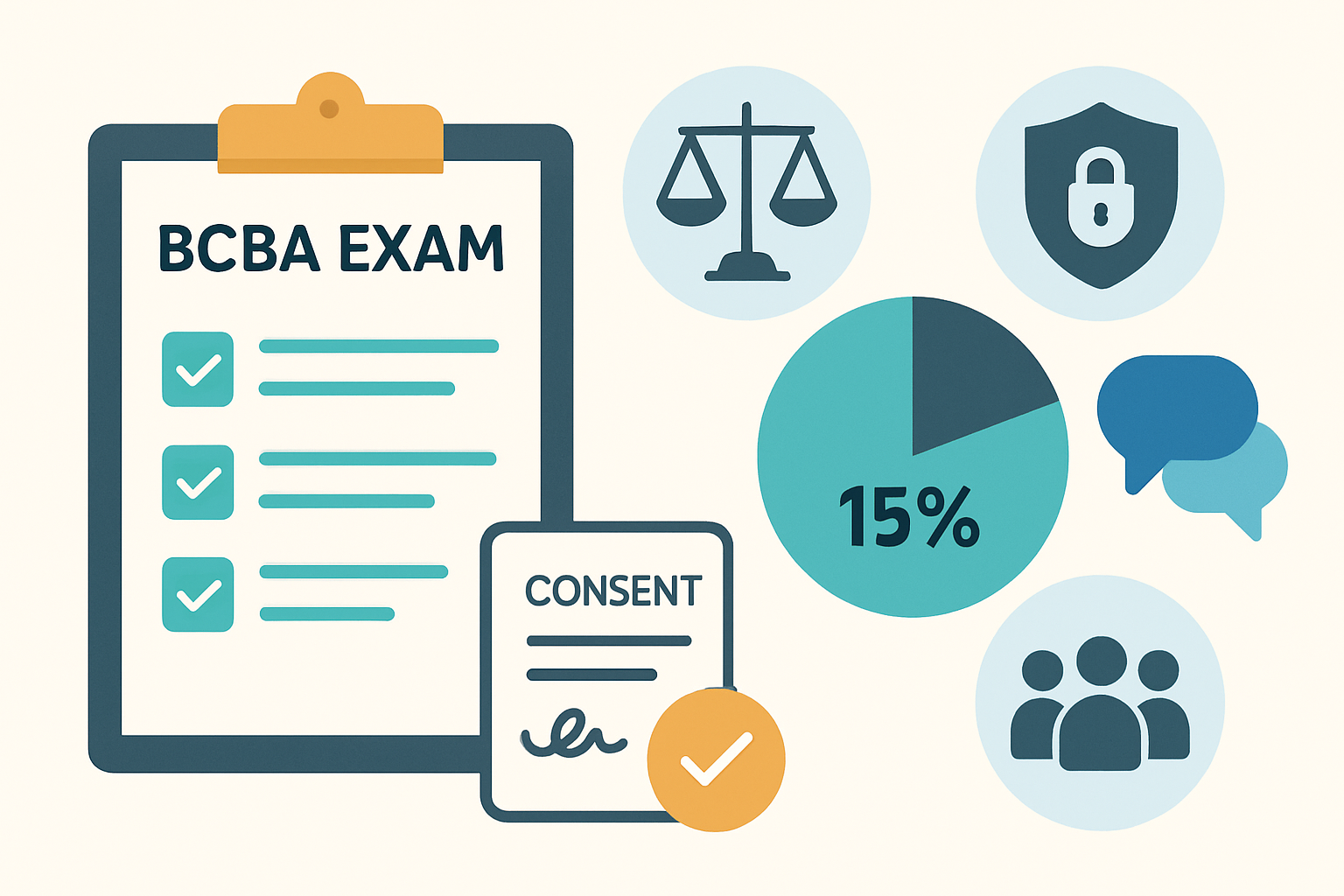
This domain typically accounts for 15-20% of exam questions. Ethics questions often appear in scenario-based formats that require application of the Professional and Ethical Compliance Code. These questions test your ability to identify ethical dilemmas, apply appropriate decision-making models, and recognize violations of professional standards.
- Cross-cutting application: Ethics questions frequently integrate with assessment and intervention scenarios
- Scenario-based format: Most questions present realistic professional situations requiring ethical analysis
- Code application: Requires memorization and application of specific code sections
- Boundary issues: Common topics include dual relationships, confidentiality, and informed consent
Concepts and Principles (Section 2) & Foundational Knowledge
While Section 2 appears separately in the Task List, these foundational principles are tested within application domains rather than as isolated definition questions. Candidates must demonstrate understanding of behavioral concepts through their application in assessment and intervention scenarios.
This includes mastery of operant conditioning principles, stimulus control, motivating operations, and other core concepts that form the theoretical foundation of applied behavior analysis. For detailed study of these principles, consider our concepts and principles study guide.
Assessment (Section 3)
The assessment domain carries substantial weight at approximately 25-30% of exam questions. This section tests your ability to select, implement, and interpret various assessment methods appropriate for different clinical situations.
- Functional behavior assessment: Includes both descriptive and experimental methods
- Data collection systems: Selection and implementation of appropriate measurement procedures
- Preference assessments: Various methods for identifying effective reinforcers
- Skill assessments: Tools like the VB-MAPP and ABLLS-R for evaluating current skill levels
Intervention (Section 4)
This is typically the largest content area, representing about 30-35% of exam questions. Intervention questions require application of evidence-based strategies for both skill acquisition and behavior reduction.
Key areas include differential reinforcement procedures, antecedent interventions, prompting and fading strategies, and generalization programming. Questions often test your ability to select appropriate interventions based on assessment data and client characteristics.
Supervision, Management, and Professional Development (Section 5)
This domain accounts for approximately 10-15% of exam questions. Supervision content integrates closely with ethics and requires understanding of effective supervision practices, performance monitoring, and professional development planning.
Questions often present supervision scenarios requiring application of behavior skills training methods, evaluation of supervisee performance, and ethical considerations in supervisory relationships. This domain has gained increased emphasis in recent years as the field recognizes the critical importance of quality supervision.
From Blueprint to Study Plan: Strategic Implications
Understanding the question distribution is only valuable if you translate it into an effective study strategy. The weighting percentages should directly influence how you allocate your preparation time across different content areas.
Prioritizing Your Study Sessions
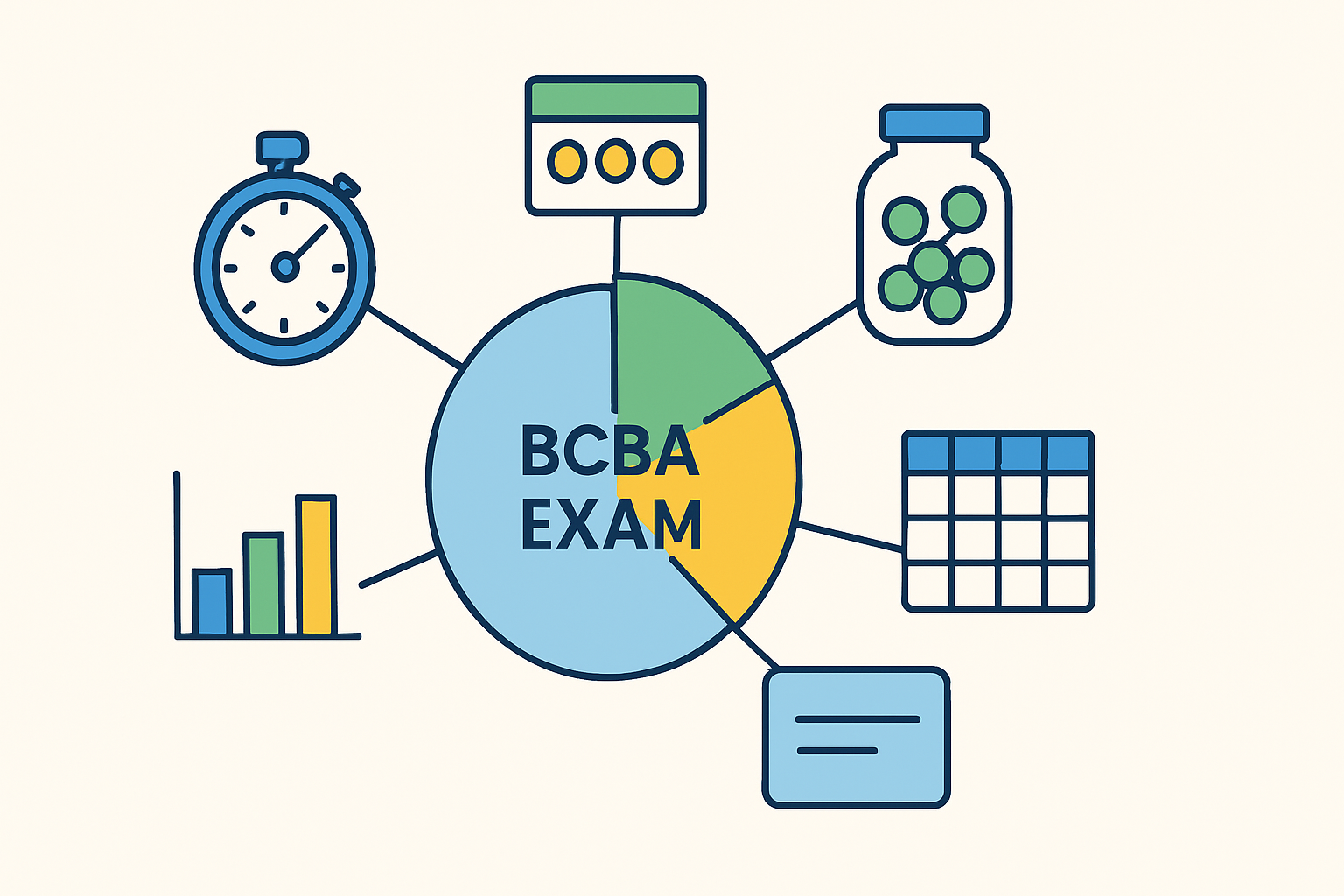
Based on the weighting percentages, your study schedule should reflect the following priorities:
- Allocate 30-35% of study time to intervention strategies and procedures
- Dedicate 25-30% of preparation to assessment methods and data interpretation
- Spend 15-20% of study hours on ethics and professional conduct scenarios
- Reserve 10-15% of preparation time for supervision and management content
- Integrate foundational principles throughout all application-focused study sessions
Connecting Domains: How Questions Are Integrated
Exam questions rarely test isolated concepts. Instead, they present integrated scenarios that require application of knowledge across multiple domains. For example, a single question might present an assessment scenario with ethical implications, requiring you to analyze both the assessment methodology and the ethical considerations simultaneously.
This integration reflects real-world practice where behavior analysts must consider multiple factors when making clinical decisions. Practice with mock exams that present integrated scenarios is essential for developing this skill.
Common Exam Traps Related to Content Distribution
Several common pitfalls stem from misunderstandings about how the exam content is distributed and tested. Being aware of these traps can help you avoid costly mistakes in your preparation approach.
The “Foundational Knowledge” Misdirection
A common error is treating Section 2 (Concepts and Principles) as a separate content block requiring isolated study. In reality, these principles are tested through their application in assessment and intervention scenarios. You won’t encounter questions asking for pure definitions of terms like “positive reinforcement” without context.
Instead, you’ll need to identify examples of these principles in clinical scenarios or select appropriate applications based on behavioral concepts. This requires deeper understanding than simple memorization of definitions.
Over- or Under-Studying Specific Areas
Two opposite but equally problematic approaches emerge from misunderstanding the weighting:
- Neglecting lower-weight domains: While supervision represents only 10-15% of questions, completely neglecting this area can cost you valuable points
- Over-studying minutiae: Spending excessive time on obscure details within high-weight domains at the expense of broader understanding
- Missing integration points: Failing to practice how concepts connect across different domains
- Timing mismatches: Allocating study time that doesn’t reflect actual exam weighting
Quick-Reference Checklist and Summary
Use this checklist to ensure your study plan aligns with the actual exam content distribution:
- Verify weighting percentages: Intervention (30-35%), Assessment (25-30%), Ethics (15-20%), Supervision (10-15%)
- Practice integrated scenarios: Use mock exams that blend multiple domains in single questions
- Balance depth and breadth: Cover all domains while focusing appropriate time on higher-weight areas
- Apply foundational principles: Study concepts through application rather than isolated definitions
- Monitor study time allocation: Track hours spent on each domain to ensure alignment with weighting
- Review ethical scenarios regularly: Ethics questions appear throughout the exam in integrated formats
The 6th Edition Task List provides the framework, but understanding the question distribution transforms this framework into an actionable study strategy. By aligning your preparation with the actual exam weighting, you can study more efficiently and increase your chances of success. Remember that the BACB examination tests integrated application of knowledge across domains, so your study approach should mirror this reality through practice with comprehensive scenarios and mock examinations.


