What Score Do You Need to Pass the BCBA Exam?
How the BACB Really Scores the Test
What score do you need to pass BCBA exam is one of the most common and confusing questions for BCBA exam candidates.
One of the most common questions BCBA candidates ask is:
“What score do I need to pass the BCBA exam?”
You might expect a simple number. But the truth is, the BACB does not score the BCBA exam the way most school tests are scored.
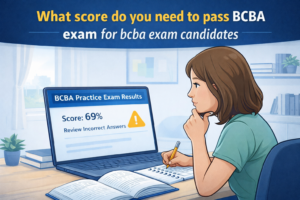
What score do you need to pass BCBA exam is one of the most common and confusing questions among exam candidates.
Many people expect a fixed percentage, but the BACB uses scaled scoring instead.
This article explains how the BCBA exam is really scored, what a “passing score” actually means, and how to think about your practice exam results without panicking. If you are preparing for the BCBA® exam, this will help you study smarter and reduce unnecessary stress.
Is There a Fixed Passing Score for the BCBA Exam?
Short answer: No.
There is no single fixed percentage (like 70% or 80%) that guarantees a pass on the BCBA exam.
The BACB uses a method called scaled scoring. This means:
-
You are not graded purely on the number of questions you get right
-
Different versions of the exam may require slightly different raw scores to pass
-
The difficulty of the test form matters
Because of this, two candidates could answer a different number of questions correctly and still both pass.
What score do you need to pass BCBA exam?
Let’s break this down in simple terms.
Raw score vs scaled score
-
Raw score = how many questions you answered correctly
-
Scaled score = your raw score converted to a standard scale
The BACB converts your raw score into a scaled score ranging from 0 to 500.
To pass the BCBA exam, you must earn a scaled score of 400 or higher.
You will not see your raw score. You will only see your scaled score and a pass/fail result.
What score do you need to pass BCBA exam on your first attempt?
The BCBA exam is offered many times per year. Each exam form is different.
Some versions may be slightly harder. Some may be slightly easier.
Scaled scoring helps ensure that:
-
Candidates are treated fairly across different test forms
-
You are not penalized for taking a harder version of the exam
-
Passing reflects competence, not luck
This is common in professional certification exams, not just ABA.
How the BACB scores the BCBA exam
This is where many candidates get confused.
The BCBA exam includes:
-
185 total questions
-
160 scored questions
-
25 unscored (pilot) questions
You do not know which questions are unscored.
Because of scaling and test difficulty, there is no official number like “you must get 120 correct.”
However, most training providers estimate that passing usually falls around:
-
65%–75% correct on scored items
This is only an estimate, not a guarantee.
Why Practice Exam Percentages Can Be Misleading
Many candidates panic when they see practice exam scores like:
-
“I’m only getting 68%”
-
“I need at least 80% to pass, right?”
Not necessarily.
Here’s why:
-
Practice exams are not scaled the same way
-
Some are harder than the real exam
-
Some overemphasize certain task list areas
-
Some include poorly written or overly tricky questions
A 70% on a well-designed mock exam may actually put you in a good position.
The key question is not just your percentage, but what kinds of questions you are missing.
What score do you need to pass BCBA exam according to the BACB?
For BCBA exam success, focus less on the final percentage and more on patterns.
Ask yourself:
-
Are you consistently missing ethics questions?
-
Do you struggle with measurement vs experimental design?
-
Are you falling for distractors that misuse ABA terminology?
The exam tests conceptual understanding, not memorization.
Many failed attempts come from candidates who “know the definitions” but cannot apply them in scenarios.
Common Myths About the BCBA Passing Score
Myth 1: You need at least 80% to pass
False. There is no published percentage requirement.
Myth 2: Everyone who passes gets about the same number correct
False. Scaled scoring allows variation.
Myth 3: If you fail, you were “close” or “far” based on points
Not exactly. A scaled score does not translate cleanly into “questions away from passing.”
Myth 4: The BACB makes the exam harder every year
There is no evidence for this. The task list and content change, but scoring fairness is maintained.
How to Study With Scoring in Mind
Instead of chasing a magic number, use these strategies:
-
Aim for consistent performance across task list areas
-
Practice explaining why an answer is correct or incorrect
-
Focus heavily on ethics, as those questions are often subtle
-
Learn to identify what behavior is actually changing in a scenario
-
Ignore emotional reactions to single mock exam scores
Passing the BCBA exam is about thinking like a behavior analyst, not being perfect.
What You Will See on Your Score Report
After the exam, the BACB will provide:
-
Your scaled score
-
A pass or fail result
-
Diagnostic feedback by content area (if you fail)
You will not see:
-
Number of questions correct
-
Which questions you missed
-
How close you were to passing in raw points
This is normal for certification exams.
Final Thoughts
The BCBA exam does not reward perfection. It rewards competent clinical judgment grounded in ABA principles.
If you understand how reinforcement works, how behavior changes over time, how ethics guide decisions, and how to analyze scenarios carefully, your score will reflect that.
Stop chasing a mythical passing percentage.
Focus on learning to think clearly, apply concepts accurately, and avoid common traps.
That is what actually helps candidates pass the BCBA® exam.