

If you searched for BACB intensive practicum, you may be looking at an older university page, a previous BACB handbook, or a fieldwork conversation that uses legacy language. The short answer for a current BCBA plan is that “intensive practicum” is not the current 2027 BCBA category to select. The BACB’s newer framework uses Supervised Fieldwork and Concentrated Supervised Fieldwork, with separate requirements and forms.
Table of Contents
- In This Guide
- BACB Intensive Practicum: What Did It Mean?
- Why Did the BACB Terminology Change?
- What Are the Current 2027 BCBA Fieldwork Options?
- How Should You Handle the 2022-to-2027 Transition?
- How to Plan and Document the Current Route
- Intensive Practicum Mistakes to Avoid
- Frequently Asked Questions
- Take the Free BCBA Mock Exam
That does not mean the phrase is irrelevant. If your record, course materials, or supervisor uses “intensive practicum,” you need to identify which requirement edition and application timeline control your case. A legacy label should not be silently converted into a 2027 category, and a current concentrated-fieldwork plan should not be documented with an old intensive-practicum form.
This guide explains what intensive practicum meant in older BACB materials, what the 2027 BCBA framework calls the current options, how the transition affects documentation, and what to ask before you choose a fieldwork route. Check the official 2027 BCBA Requirements and the BACB transition announcement for the current application rule.
In This Guide
BACB Intensive Practicum: What Did It Mean?
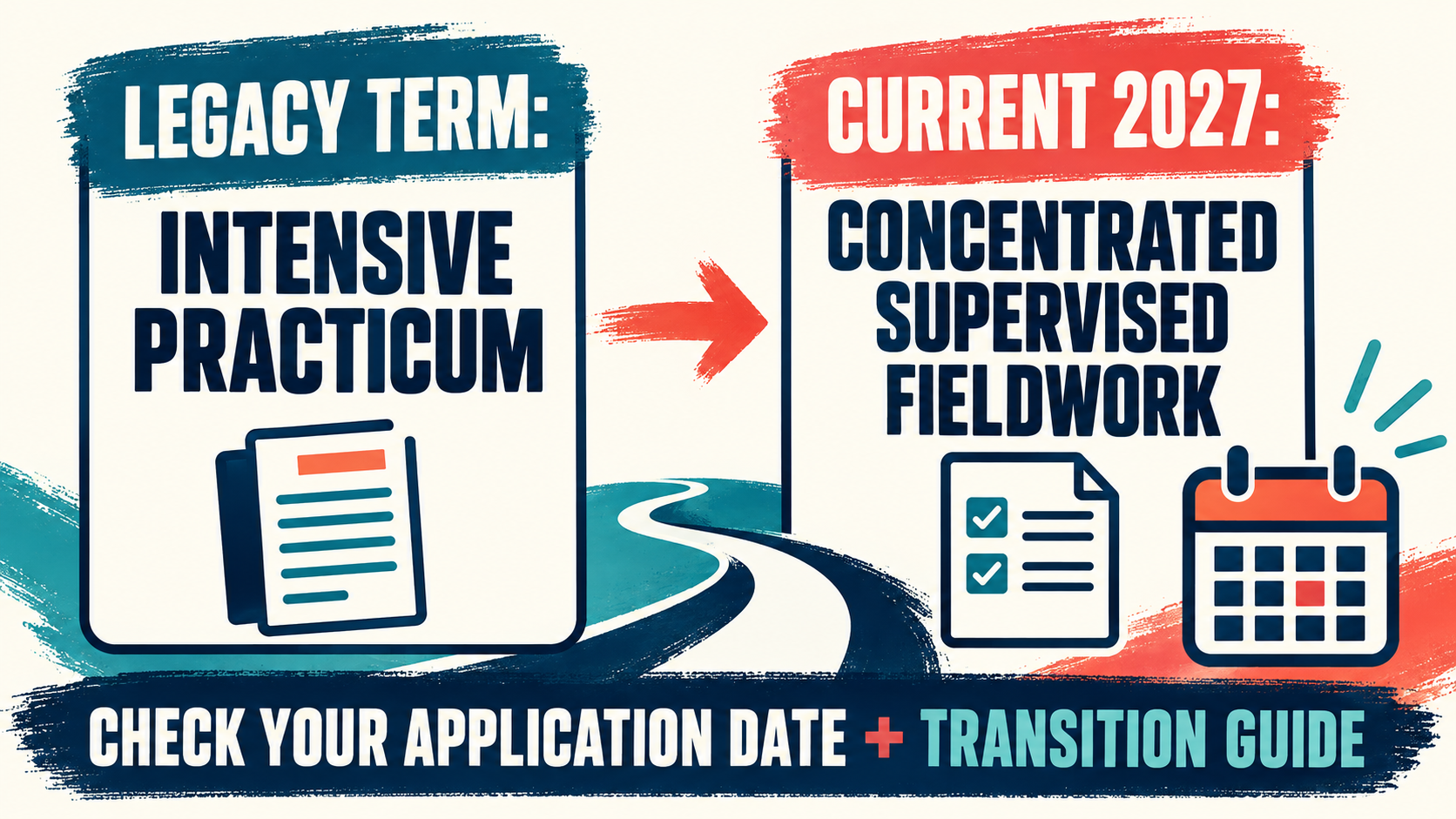
In older BACB experience frameworks, intensive practicum described a structured experience completed in fewer hours and with more supervision than a standard supervised independent fieldwork route. It was typically associated with a verified course sequence, a practicum course, and documentation showing that the trainee met the required supervision, contacts, observations, and course conditions.
The word “intensive” described the structure and supervision density; it did not mean that a trainee could simply work faster, count any extra hours, or skip the documentation system. A practicum experience still needed a qualified supervisor, acceptable activities, appropriate records, and the form set that matched the requirement edition.
| Phrase you may see | What it usually signals | What to verify |
|---|---|---|
| Intensive practicum | A legacy experience label involving a shorter, more closely supervised route in older requirements. | The handbook edition, fieldwork dates, course sequence, forms, and application deadline. |
| Concentrated Supervised Fieldwork | The current 2027 BCBA fieldwork category with its own hour, supervision, observation, and form rules. | Whether the 2027 requirements apply to your application and whether your placement meets the current definition. |
| Practicum course | A course or university experience that may use the word practicum in its program name. | Whether the program is a current qualifying route, not simply whether the course title contains “practicum.” |
The label is therefore a historical clue, not an eligibility decision. If a page says “intensive practicum” without a version date, treat it as incomplete until you compare it with the BACB handbook and transition guidance that apply to your application.
Why Did the BACB Terminology Change?
The BACB’s published fieldwork history explains that the revised supervised-fieldwork standards eliminated the practicum and intensive-practicum options and introduced two fieldwork categories available across settings. The change was designed to use clearer terminology, raise or restructure experience expectations, and make the requirements easier to apply consistently across placements.
The important SEO and planning distinction is this: “intensive practicum” may still appear in old search results, archived handbooks, university pages, or a trainee’s historical record, while the current BCBA page directs applicants to a different set of categories. That is why a modern article should explain the old phrase instead of presenting it as a current form choice.
- Older materials may describe experience types that are no longer the current 2027 BCBA selection.
- Current forms may use Monthly and Final Fieldwork Verification Form language rather than an intensive-practicum form.
- A university may continue to use “practicum” as a program or course name even when the BACB eligibility category has changed.
- The application date can determine which requirement edition and transition rule controls.
Do not treat the presence of the word practicum in a program name as proof that the experience automatically qualifies. Confirm the BACB pathway, the supervisor’s role, the documentation system, and the form version.
What Are the Current 2027 BCBA Fieldwork Options?
Under the current 2027 BCBA overview, the two fieldwork options are Supervised Fieldwork and Concentrated Supervised Fieldwork. The BACB lists separate total-hour requirements, supervision percentages, observations, and forms. Neither option should be casually labeled “intensive practicum” in a new record.
| 2027 planning point | Supervised Fieldwork | Concentrated Supervised Fieldwork |
|---|---|---|
| Hours required to qualify | 2,000 | 1,500 |
| Supervision per supervisory period | 5% of hours | 7.5% of hours |
| Fieldwork hours per period | 20–160 hours | 20–160 hours |
| Client observation per period | 60 minutes cumulative | 90 minutes cumulative |
| Unrestricted activities | At least 60% of total supervised fieldwork hours | At least 60% of total supervised fieldwork hours |
These figures are a high-level summary, not a substitute for the handbook. The current BACB materials also address supervisor qualifications, individual and group supervision, forms, documentation, and the transition from the 2022 requirements. Use the exact form and handbook instructions for your fieldwork dates.
How Should You Handle the 2022-to-2027 Transition?
The transition question is usually more important than the label. The BACB’s current transition announcement says that significant eligibility changes take effect January 1, 2027, and that an application intended to be reviewed under the current 2022 requirements must be complete, including payment and required documents, by December 31, 2026. Confirm the live BACB announcement because deadlines and instructions are time-sensitive.
If your historical records use intensive-practicum language, create a version-controlled record rather than renaming every old entry. Keep the original label in the source documents, then add a supervisor-reviewed note explaining which current or transitional requirement the record is being used to support. Do not make a conversion based only on the number of hours.
- List the dates of the experience and the date you expect to submit the complete application.
- Identify the BACB handbook and requirement edition tied to those dates.
- Collect the monthly and final documents that belong to that edition.
- Ask the supervisor or program coordinator how the historical label should be represented in the current application record.
- Keep a copy of the transition guidance used to make the decision.
Most importantly, do not use a current concentrated-fieldwork form as evidence that an older intensive-practicum record automatically satisfies 2027 requirements. The two labels point to different frameworks, and the BACB—not a generic study article—controls the eligibility decision.
How to Plan and Document the Current Route
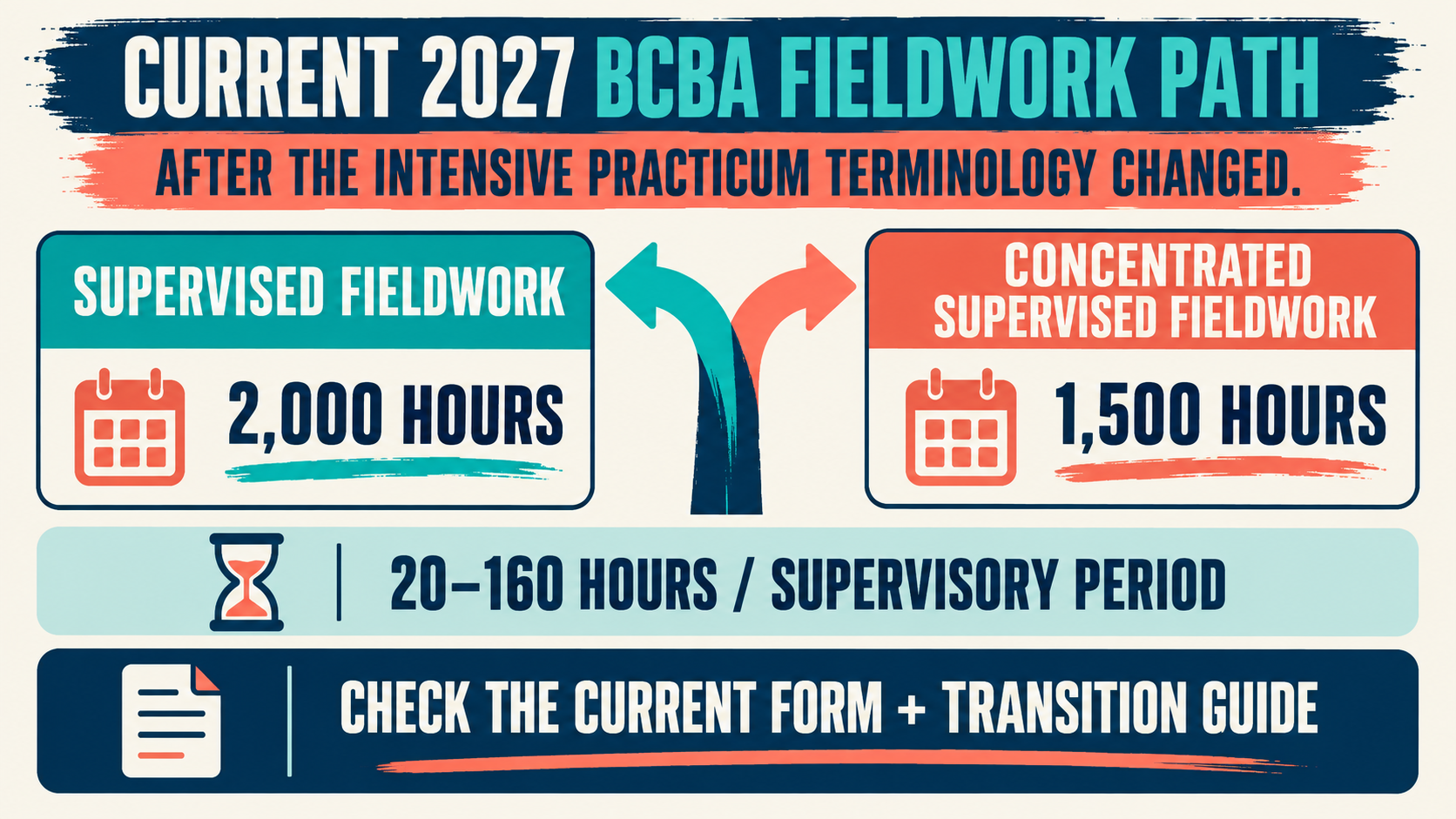
Once you know which edition applies, plan the experience around the current category name. A reliable documentation system should show the supervisory period, total fieldwork hours, supervision, client observations, restricted and unrestricted activity mix, supervisor identity, forms, and signatures. It should also make clear whether the placement is an individual-supervisor structure or an organization structure.
- Choose the category first. Write “Supervised Fieldwork” or “Concentrated Supervised Fieldwork” when the 2027 rules apply; do not create a new “intensive practicum” column.
- Track each month. Record activities close to the date and preserve de-identified products that explain the work.
- Review the percentage. The 2027 overview requires at least 60% unrestricted activities for total supervised fieldwork hours; verify your calculation with the supervisor.
- Match the form. Use the current Monthly and Final Fieldwork Verification Forms that correspond to the requirement edition and supervision structure.
- Retain the source trail. Keep the tracker, signed forms, supervision contract, corrections, and transition notes together.
Use the BACB fieldwork hub and the current BCBA Handbook as the source of truth. The BACB also provides a fieldwork documentation FAQ that explains how records and form versions fit together.
Intensive Practicum Mistakes to Avoid
- Using an old handbook as a current eligibility guide. Archived documents can explain the search term but may not control a 2027 application.
- Assuming concentrated means identical to intensive. The current category has its own requirements; do not convert by intuition.
- Using a university course title as proof. “Practicum” in a course name does not by itself establish BACB eligibility.
- Changing labels without preserving history. Keep the original record and add a supervisor-reviewed transition note.
- Missing the application deadline distinction. The requirement edition can depend on when a complete application is received.
- Copying old hour or supervision numbers. Verify the live handbook, forms, and transition guidance.
If you are studying for the BCBA exam while sorting fieldwork records, the free BCBA mock exam is a separate practice resource. It does not determine whether an intensive-practicum record qualifies, replace supervision, or guarantee certification.
Frequently Asked Questions
Is intensive practicum still a current 2027 BCBA option?: No. The current 2027 BCBA framework uses Supervised Fieldwork and Concentrated Supervised Fieldwork. Intensive practicum may still appear in older records or search results, so use transition guidance when interpreting it.
Is concentrated supervised fieldwork the same as intensive practicum?: They are not interchangeable labels. Concentrated Supervised Fieldwork is the current 2027 category with its own requirements. A historical intensive-practicum record needs to be evaluated under the applicable edition and transition rules.
Can a practicum course still count toward BCBA certification?: A course or program may use “practicum” in its name, but the course title alone does not answer the BACB eligibility question. Confirm the current pathway, fieldwork category, supervisor, documentation, and application timing.
What happened to the old intensive practicum forms?: They belong to an older experience framework. Current applicants should use the Monthly and Final Fieldwork Verification Forms that match the applicable requirement edition and supervision structure.
Where can I verify the change?: Start with the BACB’s current 2027 BCBA Requirements, the recent and upcoming changes page, the transition guidance, and the current BCBA Handbook. These sources are updated more reliably than an undated university page or study forum.
The practical answer to BACB intensive practicum is: treat it as a legacy search term, identify the requirement edition and application deadline, and use the current Supervised Fieldwork or Concentrated Supervised Fieldwork rules when they apply. Preserve the historical record, verify the transition with the supervisor, and never convert a fieldwork category by name alone. For targeted review, use our bacb intensive practicum practice questions to apply the concept in exam-style scenarios.
Take the Free BCBA Mock Exam
If you want a low-pressure way to check your recall, use the free practice resource below. Take the Free BCBA Mock Exam



