
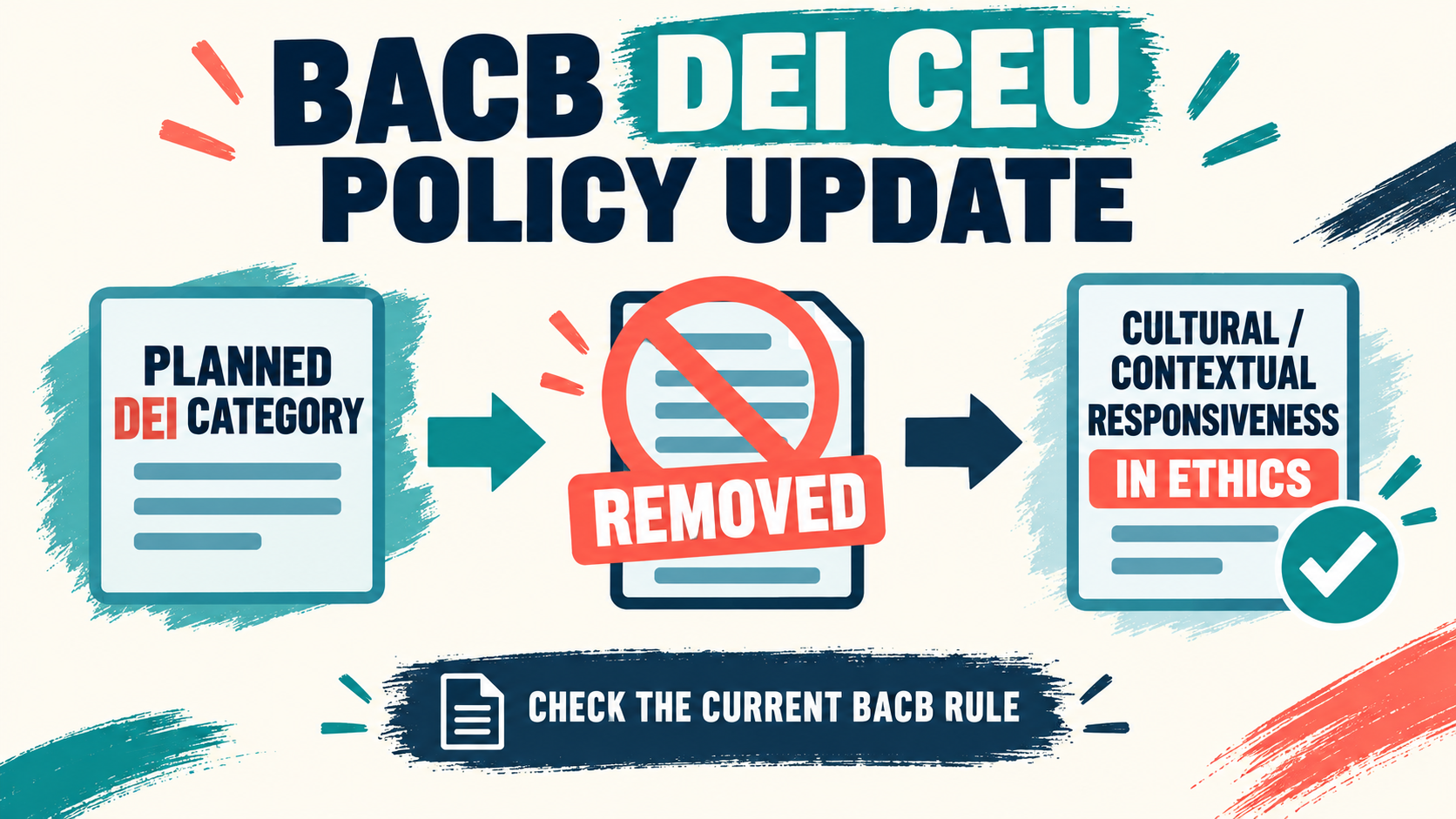
If you are searching for a BACB DEI CEU, the short answer is: the BACB’s planned standalone DEI CEU category was removed from the 2027 continuing-education plan. The current direction is to treat qualifying content about cultural and contextual responsiveness within the Ethics CE category—not as a separate DEI line item.
Table of Contents
- In This Guide
- Does BACB Require a Separate DEI CEU?
- What Changed for 2027?
- When Can a DEI-Related Event Fit Ethics CE?
- A Four-Part Event-Screening Checklist
- Examples and Nonexamples
- How to Plan for the Transition
- Common BACB DEI CEU Mistakes
- Frequently Asked Questions
- Take the Free BCBA Mock Exam
That does not mean every course with “DEI” in its title automatically counts. For a current ACE event, the content still needs to relate to behavior-analytic practice or applied research, connect directly to behavior-analytic literature or established practice, and satisfy the current event and documentation rules. Read the BACB March 2025 Newsletter with the current ACE Provider Handbook; the newsletter explains the policy change, while the handbook tells providers and certificants how to evaluate an event.
In This Guide
Does BACB Require a Separate DEI CEU?
No—not as a separate 2027 CEU category for BCBA or BCaBA maintenance. The BACB’s March 2025 Newsletter states that the originally planned DEI category requirement was removed. Instead, the Ethics CE category was expanded to explicitly include content on cultural and contextual responsiveness.
| Question | Current answer | What to verify |
|---|---|---|
| Is “DEI” its own CEU category? | No. The planned standalone category was removed. | Use the current BACB maintenance document for the cycle that applies to you. |
| Can cultural or contextual responsiveness count? | It can fit within Ethics CE when the official content and event rules are met. | Check the behavior-analytic connection, event focus, category, provider, and certificate. |
| Does the title decide the category? | No. “DEI,” “equity,” or “inclusion” in a title is not proof of qualifying Ethics CE. | Read the objectives, description, certificate, and current BACB rules together. |
If you need the full number of CEUs, cycle dates, or supervision-category comparison, use our separate BCBA CEU requirements 2026 versus 2027 guide. This page answers the narrower question: what happened to the DEI category and how should you screen a related event?
What Changed for 2027?
The original plan would have created a named DEI CEU category. The BACB later revised the policy. The March 2025 Newsletter says the Ethics CE definition now includes events related to BACB ethics requirements and/or cultural/contextual responsiveness. It also says the content must relate to behavior-analytic practice or applied research and be directly linked to behavior-analytic literature or established practice.
For the announced 2027 BCBA maintenance requirements, the newsletter lists 32 CEUs per two-year cycle, including 4 Ethics CEUs and 4 Supervision CEUs when the supervision requirement applies. The DEI question is about classification, not about adding extra credits. A qualifying cultural/contextual-responsiveness event may help satisfy the Ethics category; it is not a fifth category added on top of the total.
There is an important timing issue. A BCBA whose active recertification cycle is governed by current pre-2027 maintenance rules should not copy a 2027 table into that cycle. A BCBA planning a cycle or application affected by the January 1, 2027 change should check the current BACB documents and portal instructions. The 2027 BCBA Requirements document is a high-level reference, not an individualized determination.
When Can a DEI-Related Event Fit Ethics CE?
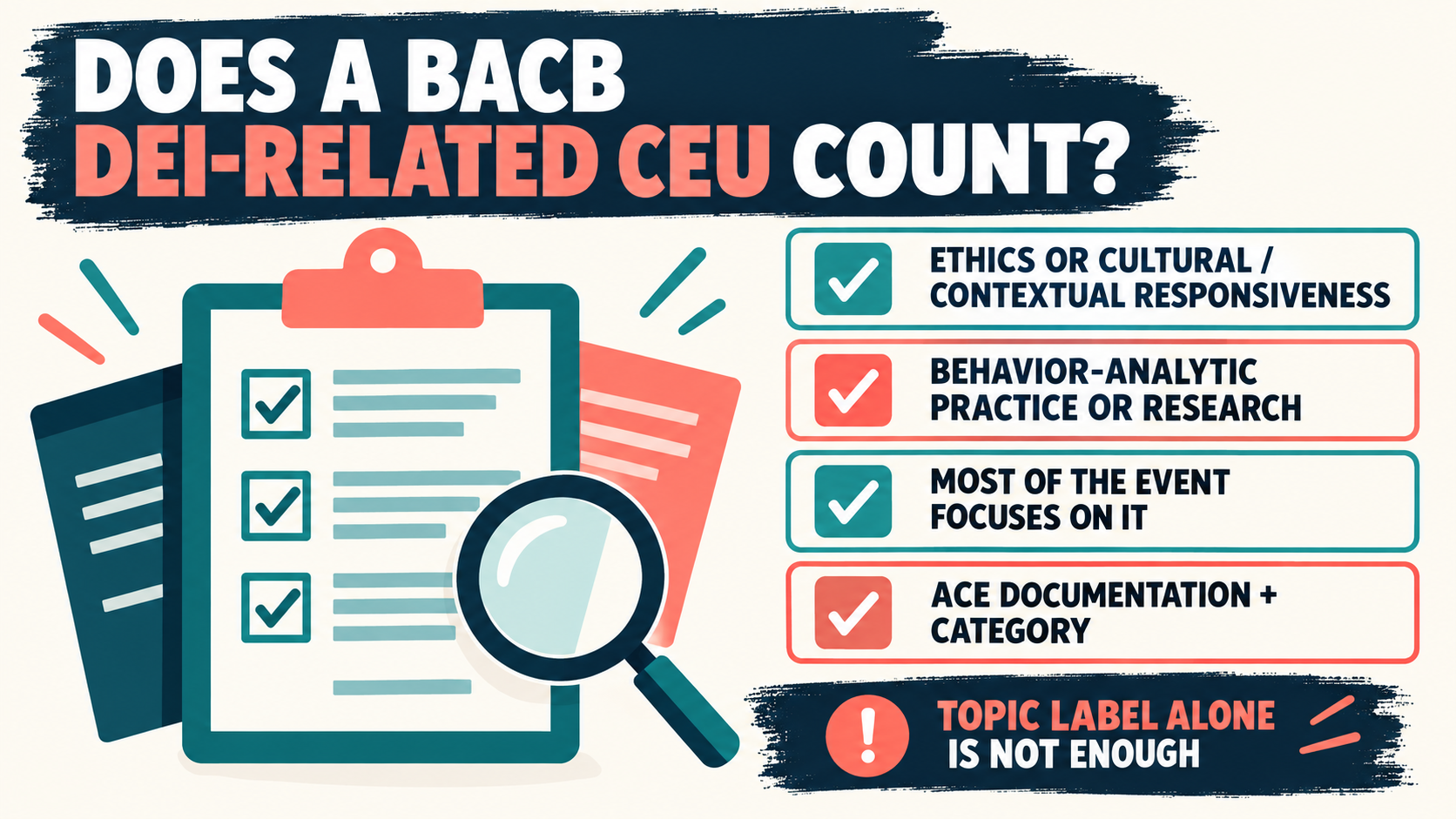
The current ACE Provider Handbook does not use a simple keyword test. It gives a content-and-evidence test. A DEI-labeled event is more likely to fit the Ethics category when it shows all of the following:
- Behavior-analytic connection: the material is about behavior-analytic practice or applied research, not only a general social, political, or workplace discussion.
- Literature or established-practice connection: the objectives and teaching are tied to behavior-analytic literature or established behavior-analytic practice.
- Substantive focus: most of the event focuses on ethics or cultural/contextual responsiveness rather than mentioning the topic briefly.
- Professional audience and level: the event meets the applicable ACE learning-event requirements, including the appropriate professional audience and content level.
- Documented category: the certificate or provider record identifies the number of CEUs and the Ethics category in a way you can enter and support in your BACB account.
The phrase “cultural/contextual responsiveness” is deliberately practical. The current ACE Handbook gives examples such as choosing assessment tools that are validated and appropriate for a client’s contextual circumstances, engaging in collaborative goal setting, working with caregivers to identify goals aligned with their cultural priorities, and delivering feedback in a manner consistent with cultural norms.
Those examples do not mean a provider can relabel any general inclusion seminar as Ethics CE. The event must connect the content to behavior analysis, and the provider’s documentation should match the event that was actually delivered.
A Four-Part Event-Screening Checklist
Before you register for or record a DEI-related CE event, work through this checklist:
- Verify the provider: search the organization or individual in the BACB ACE Provider Verification Registry. Provider authorization does not endorse every event, but an unverified provider is an immediate reason to pause.
- Read the objectives: look for behavior-analytic practice, applied research, assessment, goals, intervention, supervision, professional judgment, or another clear connection. A marketing slogan is not enough.
- Check the focus and category: ask whether most of the event is about ethics or cultural/contextual responsiveness. Confirm whether the provider will document Ethics CEUs rather than leaving you to guess after completion.
- Save the proof: retain the certificate, event title, date, modality, total CEUs, Ethics CEUs, provider number, and any description or objectives that explain the classification.
The current ACE Handbook says the documentation format can be flexible, but it still needs to contain the information required for the event. Participants are responsible for entering the information and uploading documentation in their BACB account. If the certificate says only “professional development” and does not identify a qualifying CE category, ask the provider for clarification before counting it.
Examples and Nonexamples
| Event description | Likely treatment | Why |
|---|---|---|
| Culturally responsive assessment and collaborative goal setting in ABA, with learning objectives tied to behavior-analytic literature. | Potential Ethics CE | The content has the required practice connection and a cultural/contextual focus. Confirm the provider’s category and certificate. |
| A general workplace inclusion presentation with no behavior-analytic practice, research, or client-service application. | Do not assume it counts | The title may be relevant, but the required behavior-analytic connection is not shown. |
| A behavior-analytic ethics event that briefly mentions diversity but focuses mainly on unrelated billing or documentation procedures. | Check the assigned category carefully | A passing reference may not satisfy the current majority-content test for Ethics CE. |
| A political or societal event with no substantive connection to behavior-analytic practice or applied research. | Not enough by itself | The ACE Handbook identifies this type of disconnected content as a nonexample. |
“Potential” is intentional. A reader cannot make a final BACB determination from a title or a short description. Provider authorization, event content, category allocation, documentation, and the rule for the reader’s cycle all matter.
How to Plan for the Transition
Use two separate notes in your CE tracker:
- Current cycle rule: record the recertification dates and the maintenance requirements that apply to the cycle now in progress.
- 2027 planning rule: keep the current BACB newsletter, handbook, and 2027 requirements document together, then recheck the category totals and effective date before the next cycle begins.
Do not create a line called “DEI CEU” and assume that filling it proves compliance. A better tracker records the event’s official CE type, the Ethics allocation if applicable, the date, the provider, and the evidence file. This avoids a category mismatch when a provider uses “DEI” in marketing but the certificate identifies only general Learning CE.
For a broad comparison of total CEUs and supervision changes, use the site’s 2026 versus 2027 BCBA CEU overview. For the activity taxonomy, see our guide to BACB CEU types. Those pages answer adjacent questions; this one remains focused on the DEI-policy change.
Common BACB DEI CEU Mistakes
- Adding DEI as a fourth category: the planned standalone category was removed; qualifying cultural/contextual responsiveness content fits within the Ethics framework.
- Using the title as proof: “DEI” or “inclusive practice” does not establish the behavior-analytic connection or the category.
- Ignoring the event’s majority focus: the current ACE Handbook does not treat a brief ethics or cultural reference as enough.
- Confusing provider authorization with event approval: verify the provider, then inspect the specific event’s content and certificate.
- Mixing cycles: a 2027 table cannot automatically be applied to a pre-2027 cycle, and a prior cycle’s document does not prove the next cycle’s requirement.
- Counting the same CEU twice: an event cannot be used to fill multiple categories simply because its topic sounds related.
Frequently Asked Questions
Do I need two DEI CEUs for BCBA recertification?: No separate two-CEU DEI category appears in the revised 2027 plan. The BACB removed the originally planned standalone DEI requirement and expanded Ethics CE to include cultural/contextual responsiveness. Check your actual cycle and current documents before recording a course.
Can a cultural responsiveness course count as Ethics CE?: It can, when the event meets the current BACB content and documentation rules. It should connect to behavior-analytic practice or applied research, be tied to behavior-analytic literature or established practice, and focus substantively on ethics or cultural/contextual responsiveness. The provider’s certificate and event record should support the classification.
Does every DEI course count as a BACB CEU?: No. A generic, political, or workplace course may be valuable professional development without meeting the BACB’s Ethics CE definition. Look for a clear behavior-analytic connection and verify the provider and category before you count it.
Where should I verify the current BACB DEI CEU rule?: Start with the BACB March 2025 Newsletter for the policy change, then read the current ACE Provider Handbook and the current BCBA maintenance materials. If the documents or your provider’s certificate do not line up, ask the provider or use the BACB’s official contact route rather than guessing.
Does a BCBA mock exam award DEI or Ethics CEUs?: No. An exam-preparation resource is not automatically an ACE event and does not award CEUs. Our free BCBA mock exam is for practice questions and feedback; it does not replace provider documentation or a BACB maintenance record.
The safest way to handle a BACB DEI CEU search is to translate the old label into the current rule: no standalone DEI line item, but qualifying cultural/contextual responsiveness may fit Ethics CE when the behavior-analytic content, event focus, provider status, and documentation all support it. Try the Free BCBA Mock Exam For targeted review, use our bacb dei ceu practice questions to apply the concept in exam-style scenarios.
Take the Free BCBA Mock Exam
If you want a low-pressure way to check your recall, use the free practice resource below. Take the Free BCBA Mock Exam



