

If you are searching for a BACB approved course sequence, do not stop at a program website that uses the phrase “approved.” The important question is whether the coursework process, institution, and documentation can support the BCBA pathway you plan to use when you apply.
Table of Contents
- In This Guide
- What a BACB Approved Course Sequence Means
- What Changed for Pathway 2 in 2026
- How to Verify a Course Sequence Before Enrolling
- How the 2027 Date Changes Your Checklist
- What to Compare in the Curriculum
- What a Course Sequence Does Not Prove
- Questions to Ask the Program Contact
- Common BACB Course-Sequence Verification Mistakes
- BACB Approved Course Sequence FAQ
- Take the Free BCBA Mock Exam
The terminology is also changing. The BACB’s current university guidance describes a Pathway 2 Coursework Attestation System beginning in 2026, while the 2027 BCBA Requirements introduce a new requirements set beginning January 1, 2027. Use this article as a verification checklist, not as a guarantee of eligibility or a replacement for the current BCBA Handbook.
In This Guide
What a BACB Approved Course Sequence Means
In everyday search language, an approved course sequence usually means a planned set of behavior-analytic courses that a university or other education provider says can satisfy the coursework portion of BCBA eligibility. A sequence is more than one interesting ABA class. It is an organized curriculum with a defined order, content coverage, program contact, and documentation process.
That distinction matters because the BACB does not award BCBA certification merely because a student completed a course with “ABA” in its title. The applicant must meet all applicable requirements, including the degree, coursework or program pathway, supervised fieldwork, application, and examination rules. A course sequence can address one part of that pathway without proving the rest. The safest working definition is:
- Sequence: the complete set of courses the program expects you to finish.
- Pathway: the BCBA eligibility route under which those courses will be evaluated.
- Attestation: the institution’s formal confirmation that your coursework meets the applicable BACB coursework requirements.
- Application: your separate request for the BACB to review your complete eligibility evidence.
What Changed for Pathway 2 in 2026
The BACB’s current university-training page explains that ABAI discontinued its Verified Course Sequence system for Pathway 2 and that the BACB implemented a Pathway 2 Coursework Attestation System beginning January 1, 2026. The page says an authorized Pathway 2 Program Contact reviews the student’s coursework and, when appropriate, submits an attestation to the BACB.
That means an old page saying “VCS approved” is not enough evidence for a new applicant. It may describe a historical status, a different certification year, or a program that has not explained how it handles the current attestation process. Ask the school how it will document your coursework under the requirements that apply on your application date.
| Term you may see | What it should prompt you to verify | Do not assume |
|---|---|---|
| Approved course sequence | Which credential, pathway, requirement version, and institution the sequence applies to | That every individual class is independently approved for every applicant |
| VCS or verified sequence | Whether the reference is historical and how the school now handles BACB attestations | That a past VCS label replaces the current application evidence |
| Pathway 2 coursework | The current Pathway 2 Program Contact, sequence completion rule, and attestation timing | That coursework alone covers degree, fieldwork, or examination eligibility |
How to Verify a Course Sequence Before Enrolling
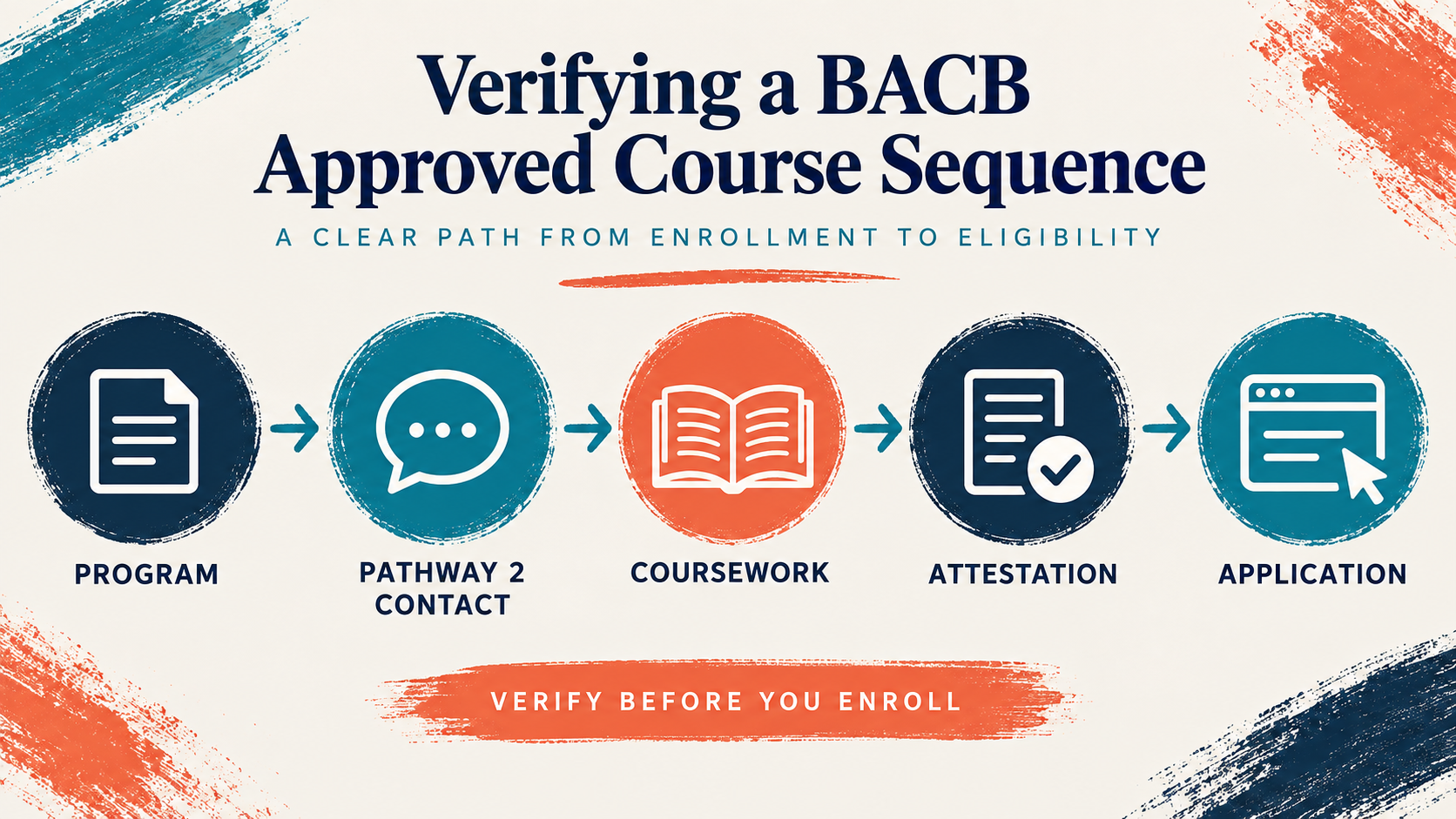
Use the following process before you pay tuition or assume that a degree plan will qualify you for the BCBA examination.
- Identify the credential and pathway. Ask whether the sequence is intended for BCBA certification, BCaBA certification, or another purpose. For a BCBA applicant, ask whether the program is supporting Pathway 1, Pathway 2, or both.
- Ask for the current program contact. A serious Pathway 2 program should be able to identify the person responsible for coursework review and attestation. Ask whether that person is the program’s authorized Pathway 2 Program Contact.
- Request the complete sequence. Obtain the course list, order, credit or instructional-hour information, syllabi or content descriptions, and the rule for transfer or previously completed courses. Do not evaluate the program from a marketing headline alone.
- Match the sequence to your application date. Ask which requirements the curriculum is designed to meet before January 1, 2027 and which changes are built into the program for applications on or after that date.
- Confirm the attestation step. Ask when the institution submits the coursework attestation, what must be completed first, whether you need a BACB account, and how you will know that the attestation is available for your application.
- Separate coursework from fieldwork. Request a different explanation of supervised fieldwork. A course sequence may be academically appropriate while the program’s fieldwork options still require a separate review.
- Save written evidence. Keep the catalog year, course list, syllabi, program-contact email, transfer-credit decision, and any attestation confirmation. Programs can change, and your future application may involve a different document version.
If a program cannot explain who verifies the sequence, how the current attestation works, or which requirement version it supports, pause before enrolling. “Our courses have always worked for the exam” is not the same as current, applicant-specific evidence.
How the 2027 Date Changes Your Checklist
The BACB has published a major transition for January 1, 2027. The current transition materials say the requirements that apply depend on the application timing and whether the complete application is received under the applicable rules. Do not decide which coursework you need based only on your expected graduation date. Create a date record with your advisor that answers:
- When will the application be submitted and paid?
- When will the required transcripts and supplemental documents be received?
- Which pathway and coursework requirements will the BACB apply to that submission?
- Does the program’s current sequence meet the 2027 content and timing expectations?
- What happens if a course, degree, transcript, or attestation is delayed past the transition date?
| Decision point | Before the transition | For a 2027 application |
|---|---|---|
| Coursework evidence | Confirm the current handbook and the school’s Pathway 2 documentation process. | Confirm the 2027 BCBA Requirements and whether the sequence was updated for the new content. |
| Program terminology | Treat “VCS” or “approved sequence” as a starting clue, not final proof. | Ask how the program’s current contact and attestation process supports the 2027 route. |
| Application planning | Use the current BACB Handbook and processing updates. | Use the BACB transition guidance and recheck every document version before submission. |
Because a program may have students in more than one catalog year, request an answer tied to your specific coursework and intended application date. A general statement that “the curriculum is BACB aligned” is not precise enough for a transition decision.
What to Compare in the Curriculum
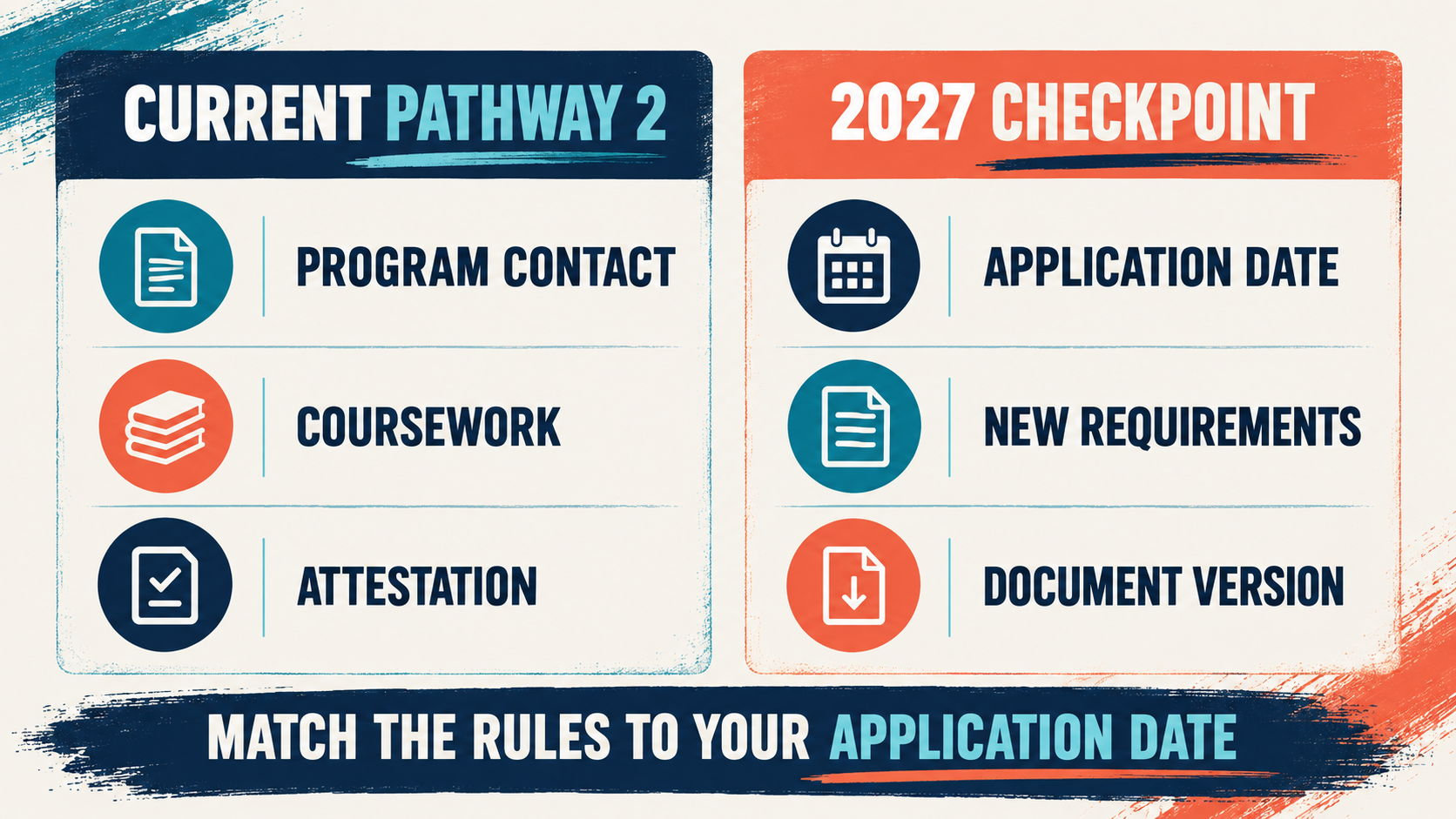
When you compare two possible sequences, look at evidence rather than course names. The same title can describe different content, and a familiar title can omit a topic required by the applicable BACB rules.
- Content coverage: Ask how the sequence covers ethics and professional conduct, concepts and principles, measurement and research methods, assessment, intervention, behavior-change systems, and supervision or management topics required by the applicable rule set.
- Instructional structure: Confirm the number of courses, credits or instructional hours, minimum grades, completion order, and whether the program requires the full sequence rather than a selection of classes.
- Course currency: Check the catalog year and ask whether syllabi changed for the 2027 content. Save the version you were evaluated under.
- Transfer and substitutions: Ask whether previously completed classes are accepted, how equivalency is decided, and whether a substitution can still support the institution’s attestation.
- Documentation: Find out what the program sends to the BACB, what the student sends, and how the official transcript connects to the attestation.
A good comparison table is simple: course name, content areas, credits or hours, catalog year, sequence position, transfer decision, and evidence source. If the school will not provide enough information to complete that table, you do not yet have a reliable basis for choosing the program.
What a Course Sequence Does Not Prove
Even a complete and properly documented sequence does not automatically prove that you can apply or sit for the BCBA examination. Keep these responsibilities separate:
- Degree: You still need the degree and program evidence required by the applicable pathway.
- Fieldwork: Supervised fieldwork has its own hours, supervisor, documentation, supervision, and activity rules.
- Application: You must complete the BACB application accurately, pay the applicable fee, and submit official documents.
- Ethics and disclosures: A coursework attestation does not answer personal disclosure or disciplinary questions for you.
- Examination: Application approval authorizes the next step; it is not a passing result or a certification.
This separation prevents a common planning error: choosing a course sequence and assuming that the rest of the certification pathway will automatically fit around it. Confirm the academic, fieldwork, application, and exam calendars together.
Questions to Ask the Program Contact
- Is this sequence intended for BCBA Pathway 2, and which requirement version does it support?
- Who is the current Pathway 2 Program Contact for students in my catalog year?
- When can the program submit my coursework attestation?
- What happens if I transfer a course or completed coursework at another institution?
- Which courses must be taken in order, and are there minimum grades or completion rules?
- How do the sequence and fieldwork plans fit together?
- What documents will I receive, and what documents will the institution send directly?
- What should I do if my application date moves from 2026 to 2027?
Common BACB Course-Sequence Verification Mistakes
- Searching only for the word “approved”: The word can appear in old pages, marketing copy, or a different credential’s materials.
- Confusing a course with a sequence: One ABA course rarely answers the complete coursework question.
- Confusing BCBA with BCaBA: The credentials have different education and fieldwork requirements. Confirm the credential in writing.
- Ignoring the program contact: Current Pathway 2 evidence depends on the institution’s attestation process, not only on a student’s transcript.
- Assuming old VCS language is current: Ask how the program handles the 2026 attestation change.
- Waiting until application week: Transfer decisions, syllabi, transcripts, and attestations can take time.
- Using a 2026 answer for a 2027 application: Recheck the official transition guidance and current requirements before you enroll or submit.
BACB Approved Course Sequence FAQ
Is a BACB approved course sequence the same as a master’s degree?: No. A course sequence is the behavior-analytic coursework component. A master’s degree or other qualifying degree evidence is a separate requirement under the applicable BCBA pathway.
Does finishing the sequence guarantee BCBA exam eligibility?: No. You must also satisfy the applicable degree, fieldwork, application, documentation, disclosure, and examination requirements. A program’s attestation supports coursework evidence but does not replace BACB review.
Is a VCS still the only way to verify Pathway 2 coursework?: Do not assume that. The BACB’s current university guidance describes a Pathway 2 Coursework Attestation System beginning in 2026. Ask the program how its current contact and attestation process applies to your application date.
What should I do if a school will not explain its BACB status?: Pause before enrolling, request written clarification from the program, and compare the answer with the current BACB Handbook and university-training guidance. If the school cannot identify the pathway, requirement version, or documentation process, you do not have enough evidence to rely on the “approved” label.
Once your coursework pathway is verified and your application plan is clear, you can use the free BCBA mock exam to practice the current BCBA content areas. It is study practice, not a substitute for BACB eligibility review, coursework attestation, supervision, or official application instructions.
Take the Free BCBA Mock Exam
If you want a low-pressure way to check your recall, use the free practice resource below. Take the Free BCBA Mock Exam



