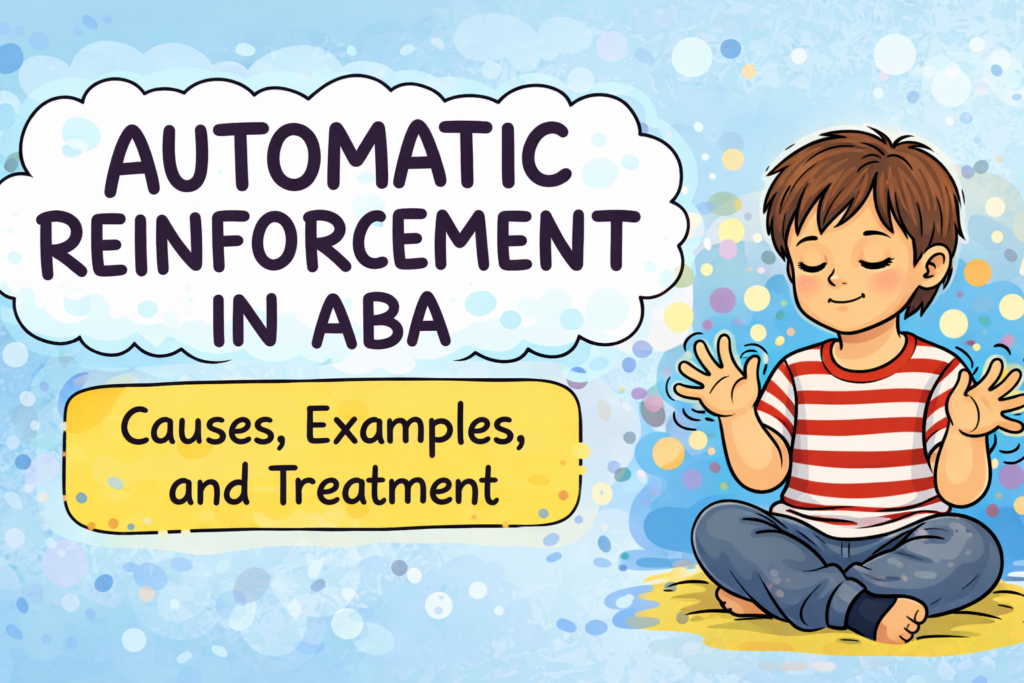
Automatic Reinforcement in ABA: Causes, Examples, and Treatment
Automatic reinforcement is one of the more confusing concepts in applied behavior analysis (ABA), especially for students preparing for the BCBA® exam. Unlike many other behaviors, automatically reinforced behavior does not depend on attention, escape, or access to tangible items.
Instead, the behavior itself produces reinforcement. This makes automatic reinforcement harder to observe, assess, and treat—but also essential to understand for effective clinical practice. Because the reinforcement is internal, this function of behavior is frequently tested on the BCBA® exam and emphasized in professional guidelines published by the Behavior Analyst Certification Board (BACB) at https://www.bacb.com.
Many BCBA® candidates first build their understanding of reinforcement through structured study resources such as https://bcbamockexam.com and comprehensive review materials like https://bcbamockexam.com/exam-study-materials/. While concepts like positive and negative reinforcement often involve visible consequences, automatic reinforcement requires closer attention to patterns of behavior that persist even when social consequences are absent.
This guide explains automatic reinforcement in ABA using simple language, real-life examples, and treatment strategies grounded in established ABA literature, including Applied Behavior Analysis by Cooper, Heron, and Heward, as well as current best practices discussed by organizations such as the Association for Behavior Analysis International at https://www.abainternational.org. The goal is to help you recognize this function of behavior and apply it confidently on the exam and in real-world practice.
What Is Automatic Reinforcement in ABA?
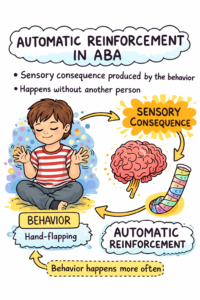
Automatic reinforcement occurs when a behavior increases because the sensory consequences produced by the behavior itself are reinforcing.
The reinforcement is considered automatic because it does not rely on another person. No one needs to provide attention, remove a demand, or deliver a preferred item.
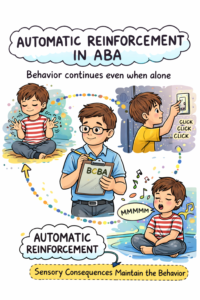
If a behavior continues even when the individual is alone or when social consequences are absent, automatic reinforcement should be considered.
Definition (task-list style):
Automatic reinforcement occurs when a behavior increases because the behavior itself produces reinforcing sensory or internal consequences.
Basic Pattern of Automatic Reinforcement
The basic pattern of automatic reinforcement follows the same operant learning principles as other types of reinforcement, but the source of reinforcement is different.
A behavior occurs. The behavior produces sensory stimulation or internal relief. Over time, the behavior becomes more likely to occur again in similar situations.
Because the reinforcement comes directly from the behavior, automatically reinforced behaviors can occur frequently and across many settings.
Automatic Reinforcement vs Social Reinforcement
Understanding the difference between automatic and social reinforcement is critical for assessment and treatment planning.
With social reinforcement, another person delivers the consequence. For example, a child screams and receives attention, or a student completes work and earns praise.
With automatic reinforcement, the behavior itself produces the reinforcing outcome. This may include visual, auditory, tactile, or internal sensations.
If a behavior occurs at similar rates whether others are present or not, automatic reinforcement is more likely than social reinforcement.
Common Causes of Automatically Reinforced Behavior
Automatically reinforced behaviors are often maintained by sensory or internal consequences rather than social outcomes.
Some behaviors produce pleasurable sensory stimulation, such as movement, pressure, sound, or visual input. Examples include rocking, hand flapping, spinning objects, or repetitive vocalizations.
In other cases, behavior may reduce discomfort or help regulate internal states. Pressing on a body part or engaging in repetitive movement may temporarily relieve tension or pain.
Neurological, biological, or sensory processing differences may also contribute. This is why medical and sensory factors should always be considered during assessment.
Everyday Examples of Automatic Reinforcement
Automatically reinforced behaviors often appear repetitive and continue regardless of social consequences.
Repetitive motor behavior
A child rocks back and forth while sitting alone. The behavior continues whether adults are present or not. The movement itself provides vestibular or proprioceptive input that reinforces the behavior.
Vocal stereotypy
A learner hums or repeats sounds during free time and instructional periods, even when no attention is provided. The auditory feedback from the sounds functions as automatic reinforcement.
Self-injurious behavior
In some cases, behaviors such as skin picking or head banging may be automatically reinforced if they produce sensory input or internal relief. These cases require careful assessment and safety planning.
BCBA-style exam example
A client repeatedly flicks a light switch on and off when alone in a room. The behavior continues regardless of staff reactions and occurs most often in quiet environments. The clicking sound and visual change function as automatic reinforcement.
How Automatic Reinforcement Appears on the BCBA® Exam
BCBA® exam questions often include subtle clues that point to automatic reinforcement.
The behavior occurs even when the individual is alone. Staff attention does not change the behavior. Removing social consequences does not reduce responding.
The behavior may appear repetitive, stereotyped, or self-stimulatory. When these features are present, automatic reinforcement should be considered as the maintaining variable.
Assessment of Automatically Reinforced Behavior
Assessing automatically reinforced behavior can be challenging because the reinforcement is internal.
Indirect assessments and interviews may provide limited information, since caregivers cannot directly observe sensory consequences.
Direct observation across settings, times, and levels of stimulation is critical. Behaviors that persist across conditions without social consequences suggest automatic reinforcement.
Alone or ignore conditions during functional analysis may help confirm the function. Medical and sensory factors should also be ruled out when appropriate.
Treatment Strategies for Automatic Reinforcement
Treatment for automatically reinforced behavior often focuses on altering sensory consequences or providing alternative sources of reinforcement.
One common approach is providing competing stimulation. Competing stimuli produce similar sensory input and reduce motivation to engage in the problem behavior. Examples include fidget toys, textured materials, music, movement activities, or visual input.
Teaching alternative behaviors that provide similar sensory consequences can also be effective. For example, squeezing a stress ball instead of skin picking.
Environmental enrichment increases access to preferred sensory input throughout the day, reducing reliance on automatically reinforced behavior.
In some cases, response interruption and redirection may be used, especially when combined with reinforcement for appropriate engagement.
Because automatic reinforcement is internally maintained, punishment-based procedures are rarely effective and raise ethical concerns. Reinforcement-based approaches are always preferred.
Why Automatic Reinforcement Matters in Practice
Automatically reinforced behavior often requires longer-term and more individualized intervention.
Misidentifying the function can lead to ineffective strategies, such as removing attention when attention is not the maintaining variable.
Correct functional identification supports better treatment outcomes, improved quality of life, and safer behavior plans.
Quick Study Checklist
Before the exam, make sure you can:
Explain automatic reinforcement in your own words.
Distinguish automatic reinforcement from social reinforcement.
Identify examples of automatically reinforced behavior.
Recognize exam clues that point to automatic reinforcement.
Describe at least two treatment strategies for automatically reinforced behavior.
Final Thoughts
Automatic reinforcement in ABA refers to behavior maintained by its own sensory consequences. These behaviors can be challenging, but they are not untreatable.
With careful assessment, ethical intervention, and reinforcement-based strategies, automatically reinforced behaviors can be reduced while teaching meaningful alternatives.
For BCBA® candidates, mastering this concept improves both exam performance and real-world clinical decision-making.