
Assessment of Basic Language and Learning Skills (ABLLS): A Practical Guide for ABA Professionals
By BCBA Mock Exam
The Assessment of Basic Language and Learning Skills (ABLLS) is a foundational ABA tool in Applied Behavior Analysis (ABA) to evaluate a learner’s strengths and needs across a comprehensive range of skills. Especially helpful for children with autism or developmental delays, the ABLLS helps behavior analysts, educators, and parents design individualized treatment plans grounded in measurable progress.
This guide will walk you through what the ABLLS is, how it’s structured, how it’s used in ABA programs, and what professionals need to know to implement it effectively.
What Is the Assessment of Basic Language and Learning Skills (ABLLS)?
The ABLLS-R (revised version) is a criterion-referenced assessment, curriculum guide, and skills-tracking system originally developed by Dr. James Partington. It is designed for individuals with language delays, including autism spectrum disorder, and measures performance across key developmental domains.
You can find a description of the official ABLLS-R system and materials here:
https://www.partingtonbehavioranalysts.com/pages/ablls-r
Core Domains in the ABLLS-R
The ABLLS-R contains 25 skill areas that fall under major developmental and functional life categories. These include:
-
Language (receptive, expressive, intraverbal, labeling)
-
Social interaction
-
Self-help (toileting, dressing, eating)
-
Academic skills (reading, math, spelling, writing)
-
Motor skills
-
Classroom routines
-
Group instruction
-
Generalization and cooperation
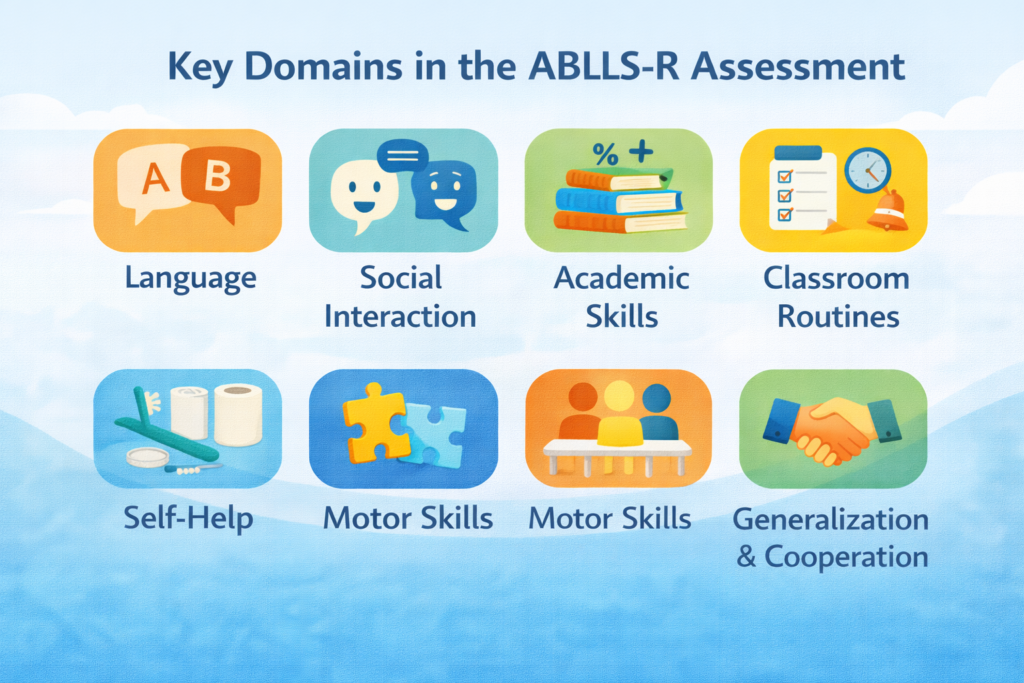
Each skill is broken down into smaller measurable units called “task items,” with scoring based on the level of assistance required.
For a full breakdown of the 25 skill areas and sample grids, visit:
https://autismpartnershipfoundation.org/aba-terms/ablls/
ABLLS vs VB-MAPP: What’s the Difference?
Many professionals compare ABLLS with another popular assessment tool, the Verbal Behavior Milestones Assessment and Placement Program (VB-MAPP). While both are rooted in Skinner’s verbal behavior framework, they serve different needs:
-
ABLLS-R is more comprehensive across functional living and academic skills
-
VB-MAPP focuses heavily on verbal milestones and developmental language levels
-
ABLLS-R is often used across broader age ranges and functional capacities
-
VB-MAPP is more structured for early learners in intensive ABA programs
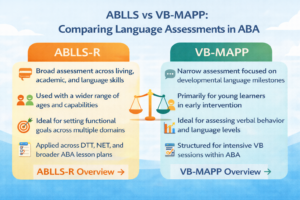
You can explore a side-by-side comparison here:
https://www.crossrivertherapy.com/autism/ablls-vs-vbmapp
How the ABLLS Is Used in ABA Programs
The ABLLS is typically administered by a BCBA, speech-language pathologist, or trained ABA practitioner. It serves multiple roles:
-
Initial Assessment: Establishes a baseline for skill levels and identifies deficits
-
Curriculum Guide: Drives treatment targets and instructional sequences
-
Progress Monitoring: Allows for repeated scoring and visual progress tracking
-
Caregiver Collaboration: Highlights areas for practice at home and in community settings
For a step-by-step guide on how BCBAs implement ABLLS in real treatment plans, visit:
https://www.appliedbehavioranalysisedu.org/what-is-the-ablls/
Key Benefits of Using the ABLLS
-
Covers a wide range of developmental and functional skills
-
Allows highly individualized treatment plans
-
Integrates well with DTT and NET approaches
-
Helps identify prerequisite skills before moving to advanced concepts
-
Enables frequent re-assessment and visual tracking
-
Offers clear documentation for insurance and IEP planning
Want to see how to combine ABLLS data with Discrete Trial Training (DTT)? Learn more here:
https://masteraba.com/what-is-ablls-r/
Limitations and Considerations
While the ABLLS is highly flexible and detailed, professionals should be aware of a few limitations:
-
It requires trained observers for accurate scoring
-
It does not use standardized norms for peer comparison
-
It may be overwhelming for beginners without clinical guidance
-
It may not be suitable for higher-functioning learners with abstract goals
If you’re just getting started and want a simpler framework first, check out this guide on how skill acquisition is structured before diving into multi-domain assessments.
Using the ABLLS Alongside Reinforcement-Based Programming
The ABLLS is not a standalone therapy method. It works best when integrated into a reinforcement-rich ABA program that includes:
-
Discrete Trial Training (DTT): https://en.wikipedia.org/wiki/Discrete_trial_training
-
Natural Environment Teaching (NET)
-
Incidental teaching
-
Task analysis
-
Functional communication training
If you’re unsure how reinforcement shapes ABLLS progress, review the basics of reinforcement here:
https://bcbamockexam.com/positive-reinforcement-aba/


