

ABA methodologies are best understood as a map of behavior-analytic approaches and procedures, not as one single technique. Applied Behavior Analysis is the applied branch of behavior analysis; within it, practitioners may use structured teaching such as Discrete Trial Training (DTT), natural-context teaching such as Natural Environment Teaching (NET), Behavior Skills Training (BST), task analysis and chaining, prompting and shaping, differential reinforcement, and assessment procedures such as a Functional Behavior Assessment (FBA).
Table of Contents
- ABA methodologies: the short answer
- Methodology, procedure, principle, and measurement
- The main ABA methods and procedures
- Choose a procedure from the goal, context, and data
- Three quick examples of method selection
- Study methodology questions for the BCBA exam
- Common mistakes when comparing ABA methods
- FAQ about ABA methodologies
- Sources for Further Study
- Take the Free BCBA Mock Exam
The useful question is not “Which ABA method is always best?” It is “What is the learner or team trying to change, what does the baseline show, and which procedure fits the context while producing measurable and meaningful progress?” This guide gives BCBA learners a method map, separates terms that are often blended together, and shows how to choose a procedure without treating a label as a complete intervention plan.
ABA methodologies: the short answer
ABA methodologies are the organized ways behavior-analytic principles are translated into assessment, teaching, intervention, and evaluation. Some terms name a teaching arrangement, such as DTT or NET. Some name a training package, such as BST. Some name a way to teach a sequence, such as chaining. Others describe support procedures, such as prompting, prompt fading, shaping, or differential reinforcement. FBA is primarily an assessment process, not a teaching method by itself.
That distinction matters because a learner may receive more than one procedure in the same plan. For example, a BCBA might use an FBA to clarify the function of a problem behavior, NET to teach a communication response during routines, prompting to support the first few responses, differential reinforcement to strengthen the replacement behavior, and direct measurement to evaluate change.
Methodology, procedure, principle, and measurement
Before comparing ABA methods, identify what kind of term the question is using. This prevents a common exam error: treating every familiar abbreviation as if it were a complete intervention.
| Term type | What it organizes | Study question |
|---|---|---|
| Method or teaching arrangement | How teaching is arranged across trials, routines, or settings | Where and how will learning opportunities be arranged? |
| Procedure | The steps used to evoke, strengthen, connect, or change responding | What exactly will the practitioner do after a response? |
| Assessment | How the team gathers evidence about behavior and context | What information is needed before selecting an intervention? |
| Measurement | How responding is defined, counted, timed, or displayed | What number will show whether the plan is working? |
| Outcome dimension | Whether a skill persists or transfers across people, materials, and settings | Does the change maintain and generalize? |
The current BCBA Test Content Outline is the right anchor for exam terminology. A blog, course, or flashcard set may group terms differently, so use the official outline and your course materials when a distinction matters.
The main ABA methods and procedures
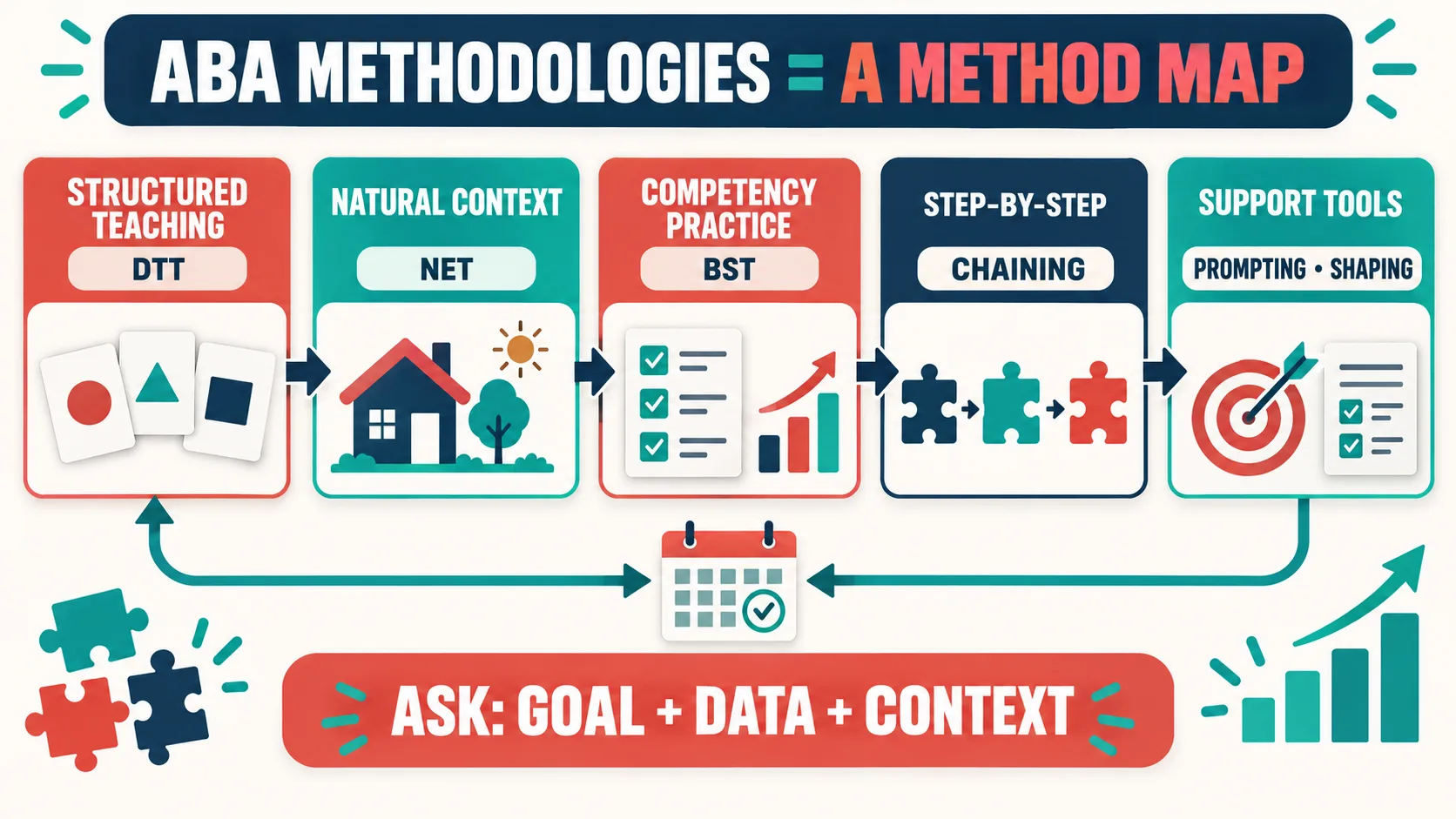
Discrete Trial Training (DTT) arranges clear learning trials with an instruction or discriminative stimulus, an opportunity to respond, a consequence, and an intertrial interval. It can be useful when the target requires repeated practice and clear discrimination. DTT is not synonymous with all ABA, and its structure should not prevent the team from programming choice, natural reinforcement, communication, dignity, and generalization.
Natural Environment Teaching (NET) arranges learning opportunities within meaningful routines and naturally occurring motivation. The exact teaching sequence can be less scripted than a table-based trial, but it should still have a defined target, an observable response, an appropriate prompt plan, and data that answer the instructional question. “Natural” does not mean “unplanned.”
Behavior Skills Training (BST) is a competency-training package commonly described through instruction, modeling, rehearsal, and feedback. It is especially useful when the target is a person’s implementation skill, such as teaching a caregiver or staff member how to run a procedure. The trainer should define the competency, observe performance, and use feedback tied to the behavior rather than offering only general encouragement.
Task analysis and chaining address complex routines. Task analysis breaks the skill into observable steps; forward, backward, or total-task chaining determines how those steps are taught. This is different from prompting, which provides assistance for a response, and different from shaping, which reinforces closer approximations to a target response.
Prompting and prompt fading help evoke a response when the learner does not yet respond independently. A prompt must be defined, delivered at the right time, recorded when relevant, and faded according to a plan so that the prompt does not become the only cue controlling the behavior. Shaping is useful when the final response is not yet in the learner’s repertoire and successive approximations can be reinforced.
Differential reinforcement changes the relative consequences for different responses. A plan may reinforce an alternative response, an incompatible response, a lower rate, or other defined pattern. The label alone is not the intervention: define what will be reinforced, when it will be reinforced, and how the plan will be monitored.
Functional Behavior Assessment (FBA) gathers information about behavior and its context to develop or test hypotheses about function. It belongs in the assessment portion of the map. An FBA is not a synonym for DTT, NET, or reinforcement, and an ABC observation does not automatically establish a functional relation without the appropriate design.
| Method or procedure | Best matching question | Do not confuse it with |
|---|---|---|
| DTT | How can repeated, clearly defined trials teach a discrimination? | All ABA or every structured intervention |
| NET | How can the target be taught in a meaningful routine with natural outcomes? | Unplanned teaching with no target or data |
| BST | How can an implementer demonstrate a defined competency? | A learner-facing teaching arrangement |
| Chaining | How should connected steps in a complex routine be taught? | Task analysis itself or prompt fading |
| FBA | What evidence is needed to develop or test a function hypothesis? | A complete treatment procedure |
Choose a procedure from the goal, context, and data
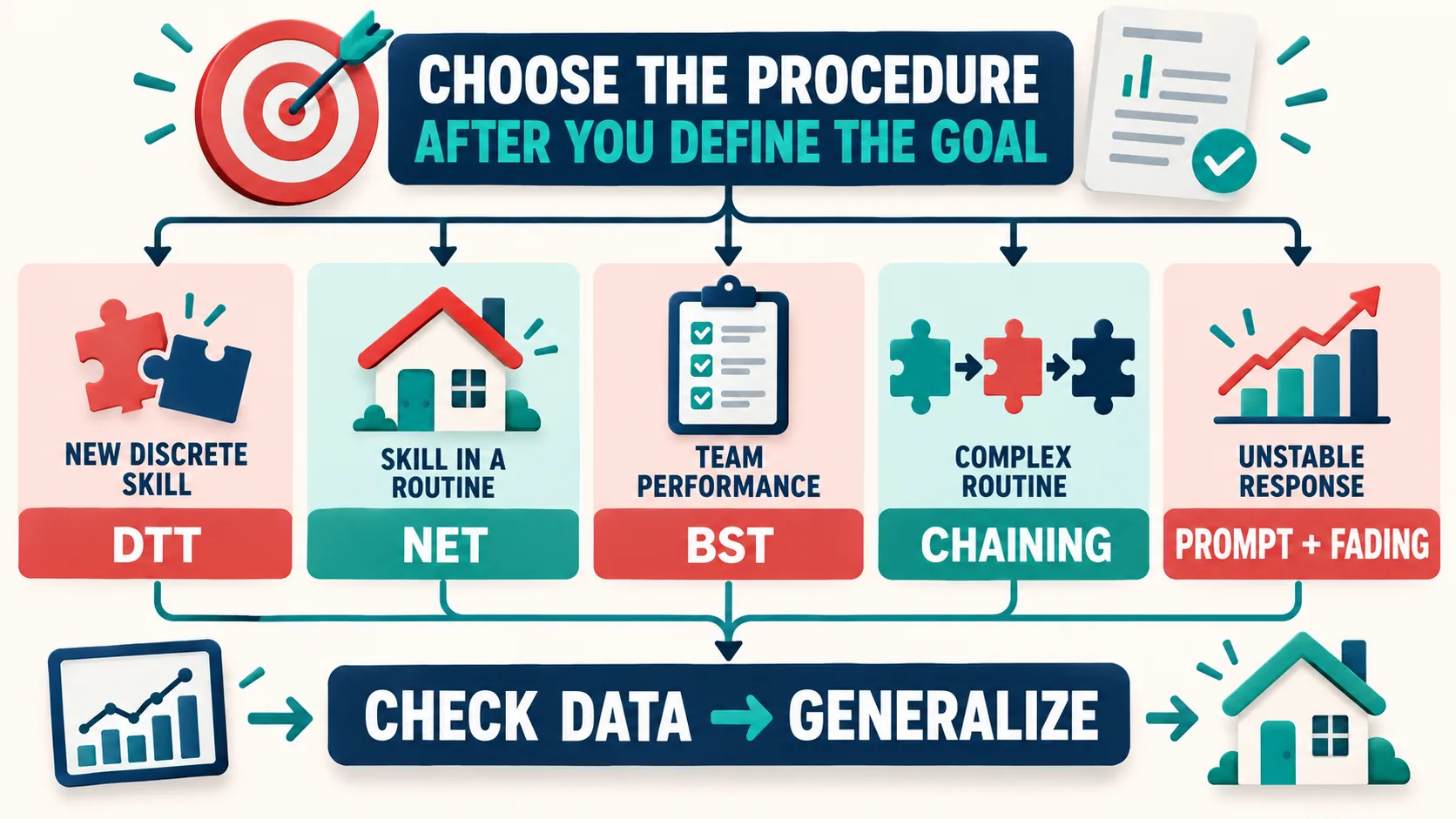
A practical selection sequence is simple: define the socially meaningful goal, specify the context, review baseline data, select the least complicated procedure that can answer the question, and plan for maintenance and generalization from the beginning. The procedure should fit the learner’s communication, preferences, current skills, safety needs, and the people who will implement it.
- Define the goal: Is the target a new discrimination, a daily routine, a communication response, a staff skill, a reduction in a dangerous behavior, or transfer across settings?
- Define the context: Does the behavior occur at a table, during play, during transitions, at home, in a classroom, or across several environments?
- Review data: Look at the baseline level, response definition, prompt history, relevant antecedents, consequences, and likely barriers.
- Choose the arrangement and procedures: A method organizes opportunities; procedures specify prompts, reinforcement, correction, chaining, shaping, or training steps.
- Measure and adjust: Use data to decide whether the learner is acquiring the skill, whether prompts are fading, and whether the result transfers beyond the teaching arrangement.
There is no rule that DTT and NET must be mutually exclusive. A learner could practice a discrimination in brief structured trials and then use the skill during a naturally occurring routine. Likewise, BST may train the adults implementing a program while DTT or NET is the learner-facing teaching arrangement. The correct unit of analysis is the goal and the evidence, not the popularity of the method name.
Three quick examples of method selection
Example 1: teaching a new discrimination: If the goal is for a learner to select a named item from an array, a structured DTT arrangement may make the stimulus, response, prompt, and consequence easy to define and measure. The analyst should still plan varied examples, reinforcement, error correction, and later practice with different materials so correct responding is not limited to one table or one instructor.
Example 2: teaching a communication response during a routine: If the goal is requesting help while opening a container or starting an activity, NET may create more meaningful opportunities because motivation and the natural consequence occur within the routine. The team can prompt the communication response, reinforce it with the relevant help or access, and probe whether the response occurs with different people and materials.
Example 3: training staff to implement a procedure: If the goal is accurate staff implementation of a prompting and reinforcement plan, BST is a logical training package. The trainer gives instructions, models the steps, has the staff member rehearse, and provides specific feedback. Staff performance should be measured directly rather than inferred from a learner outcome alone.
Study methodology questions for the BCBA exam
On an exam scenario, first identify whether the question is asking about assessment, skill acquisition, behavior reduction, supervision, measurement, or generalization. Then look for the defining feature of the procedure. “Break a routine into steps” points toward task analysis. “Teach the last step first so the learner contacts the terminal outcome” points toward backward chaining. “Instruction, modeling, rehearsal, and feedback” points toward BST. “Learning in everyday routines with naturally relevant outcomes” points toward NET.
- Do not equate ABA with DTT: DTT is one structured teaching arrangement within a broader discipline.
- Do not call every assessment an intervention: FBA gathers information and develops hypotheses; it does not by itself teach a replacement response.
- Separate prompt use from prompt fading: assistance can evoke a response, while fading plans for transfer of stimulus control.
- Separate shaping from chaining: shaping builds a response through approximations; chaining connects component responses in a sequence.
- Follow the data: method selection is not complete until the response definition, measurement system, mastery criterion, and generalization probe are clear.
When a question seems to offer several plausible procedures, ask which option directly matches the stated problem. A method can be valid in general and still be a poor answer if the scenario asks about staff competency, a complex routine, an assessment hypothesis, or natural reinforcement.
Common mistakes when comparing ABA methods
- Using “methodology” as a synonym for “therapy type”: many ABA terms describe procedures or assessment processes rather than separate therapies.
- Choosing a procedure before defining the goal: DTT, NET, BST, chaining, and prompting solve different instructional problems.
- Ignoring the learner’s context: an efficient teaching arrangement must still be meaningful, respectful, safe, and practical to implement.
- Measuring only the final outcome: collect enough information to see prompt dependence, errors, latency, generalization, and maintenance when those dimensions matter.
- Making a method the identity of the program: let data and socially significant outcomes guide the plan rather than loyalty to a label.
- Copying a procedure without supervision: exam explanations are study aids; clinical implementation requires qualified oversight and current professional requirements.
FAQ about ABA methodologies
What are the main ABA methodologies?: Commonly discussed ABA approaches and procedures include DTT, NET, BST, task analysis and chaining, prompting and prompt fading, shaping, differential reinforcement, and assessment processes such as FBA. They do not all belong to the same category, so the method map is more accurate than a single ranked list. Is DTT the same as ABA?: No. DTT is one structured teaching arrangement used within ABA. ABA is a broader applied discipline that includes assessment, measurement, intervention, evaluation, generalization, and multiple teaching procedures.
Is NET better than DTT?: Neither method is universally better. NET can fit learning opportunities embedded in meaningful routines, while DTT can make repeated discriminations and trial-level measurement easier. The learner, goal, context, data, reinforcement, and generalization plan should determine the arrangement.
How do I choose an ABA method for a BCBA exam question?: Match the defining feature to the scenario: structured trials suggest DTT, natural routines suggest NET, instruction-modeling-rehearsal-feedback suggests BST, connected skill steps suggest chaining, and successive approximations suggest shaping. Then check whether the question is actually asking about assessment or measurement instead.
For more practice distinguishing teaching procedures, assessment terms, and data-based decisions in scenarios, try the Free BCBA Mock Exam. It is a study and feedback resource, not a substitute for current BACB materials, qualified supervision, or individualized clinical planning.
Sources for Further Study
- BACB: BCBA Test Content Outline (6th ed.)
- APBA: About Behavior Analysis
- BACB: Ethics Codes
- NICHD: Behavioral Management Therapy for Autism
- BCBA Mock Exam: Task Analysis ABA Guide
This article is an educational study framework. Use current official BACB materials, ethical guidance, and qualified supervision for certification preparation and clinical decision-making.
Take the Free BCBA Mock Exam
When you are ready to apply the idea, use the free practice resource below for additional feedback. Take the Free BCBA Mock Exam



