
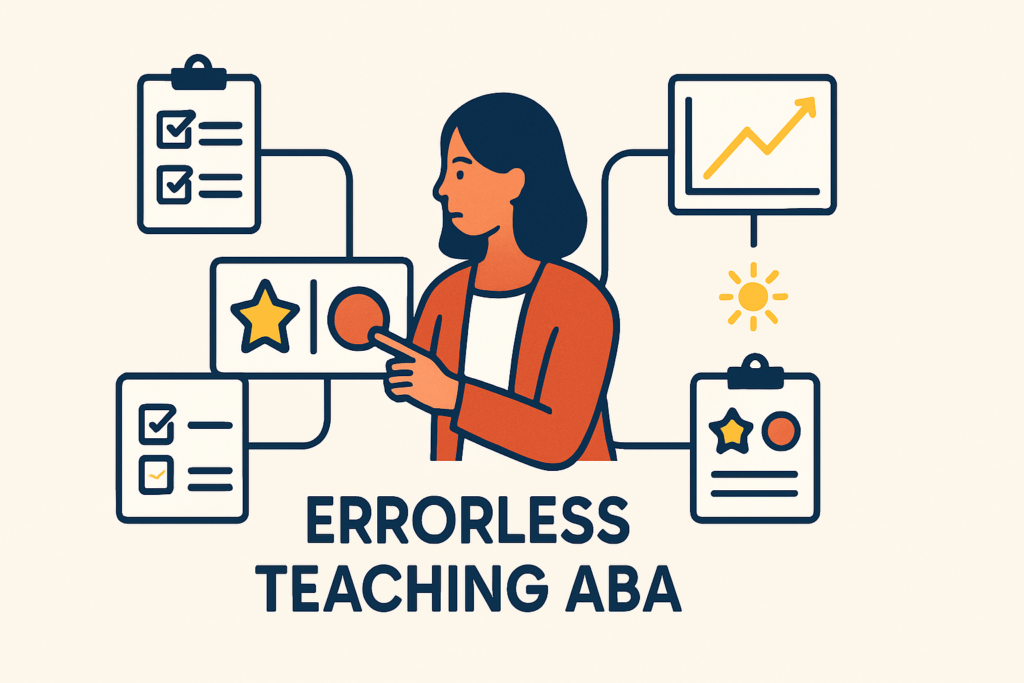
Errorless Teaching ABA: What is Errorless Teaching in ABA?
Errorless teaching represents a fundamental instructional approach in applied behavior analysis that prioritizes preventing incorrect responses rather than correcting them after they occur. This methodology traces its roots to Herbert Terrace’s 1963 research with pigeons, which demonstrated that preventing errors during initial learning leads to more efficient skill acquisition and stronger stimulus control.
Table of Contents
- Errorless Teaching ABA: What is Errorless Teaching in ABA?
- Implementing Errorless Teaching: Worked Examples
- Errorless Teaching and the BCBA Exam
- Quick-Reference Implementation Checklist
- Summary and Key Takeaways
- References
The primary goal of errorless teaching is to minimize learner frustration while maximizing opportunities for reinforcement. By ensuring correct responses from the beginning, practitioners build learning momentum and reduce the likelihood of escape-maintained behaviors that often develop when learners experience repeated failure.
Key Principles and Rationale
Errorless teaching operates on several core principles that distinguish it from traditional trial-and-error approaches. First, it emphasizes proactive prompting where controlling prompts are provided immediately after the instruction, before the learner can make an incorrect response. This contrasts sharply with error correction procedures that intervene after mistakes occur.
The approach leverages stimulus control by ensuring the discriminative stimulus reliably evokes the correct response. It also considers response effort and motivating operations to create optimal learning conditions. By reducing response effort through effective prompting and capitalizing on current motivation, errorless teaching makes correct responding the path of least resistance.
Errorless Teaching vs. Other Prompting Strategies
It’s crucial to distinguish errorless teaching as an instructional goal from the specific procedures used to achieve it. Errorless teaching represents the desired outcome of zero or minimal errors during skill acquisition, while prompting strategies like most-to-least prompting and time delay are the means to achieve this outcome.
Most-to-least prompting begins with the most intrusive prompt necessary to ensure a correct response, then systematically fades to less intrusive prompts. Time delay introduces a brief pause between the instruction and prompt delivery, gradually increasing this delay as the learner demonstrates mastery. Both strategies aim for errorless learning but use different procedural approaches.

Implementing Errorless Teaching: Worked Examples
Understanding errorless teaching requires seeing it in action across different skill domains. These practical examples demonstrate how the approach prevents errors while systematically building independence through prompt fading.
Example 1: Teaching Receptive Identification
Scenario: Teaching a child to identify ‘cat’ from two picture cards (cat and dog).
- Antecedent: Instructor presents instruction “Touch cat” while immediately pointing to the cat card
- Behavior: Child touches the cat card (correct response facilitated by prompt)
- Consequence: Immediate reinforcement with praise and preferred item
- Prompt Fading Plan: Gradually reduce pointing prompt to gestural prompt, then to no prompt
This approach prevents the child from practicing incorrect responses. If errors occurred frequently, we might hypothesize the function as escape from difficult tasks, which errorless teaching helps mitigate by ensuring success.
Example 2: Teaching a Self-Help Skill
Scenario: Teaching handwashing steps via task analysis with physical guidance.
- Antecedent: Instruction “Wash hands” with immediate hand-over-hand guidance through first step
- Behavior: Child completes step one with physical prompt
- Consequence: Social praise and continuation to next step with continued guidance
- Prompt Fading: Move from full physical to partial physical, then to shadowing
This errorless approach builds motor patterns correctly from the start. The hypothesized function here is access to independence and social reinforcement, as each successful step brings the learner closer to independent completion.
Example 3: Errorless Academic Instruction
Scenario: Teaching a learner to trace letters using faded visual prompts.
- Antecedent: Present tracing worksheet with bold dotted lines and instruction “Trace the letter”
- Behavior: Learner traces along dotted lines (correct response ensured by visual prompt)
- Consequence: Token delivered for completion, exchangeable for preferred activity
- Prompt Fading: Gradually lighten dotted lines, then provide only starting dots
This prevents practicing incorrect motor patterns that would require extensive correction later. The function is likely access to tangible reinforcers for completed work, with errorless teaching ensuring consistent access to reinforcement.
Errorless Teaching and the BCBA Exam
Errorless teaching appears frequently on the BCBA exam because it integrates multiple content areas from the BACB Task List. Understanding this approach requires synthesizing knowledge about prompting, reinforcement, stimulus control, and ethical implementation considerations.

Core Exam Relevance and Content Areas
Errorless teaching connects directly to several Task List items that candidates must master. For B-11, it demonstrates positive reinforcement contingencies by ensuring correct responses receive reinforcement. In G-2, it utilizes interventions based on motivating operations and discriminative stimuli to establish stimulus control.
The approach also relates to G-13’s high-probability instructional sequence by creating a history of successful responding. Additionally, it touches on ethical considerations in B-1 regarding selecting interventions based on assessment data and client characteristics. Understanding these connections helps candidates answer integrated questions that test application across domains.
Common Exam Traps and Misconceptions
Candidates often stumble on errorless teaching questions due to several persistent misconceptions. The most frequent error is confusing errorless teaching with error correction procedures. While both address incorrect responses, errorless teaching prevents them proactively, while error correction responds reactively.
- Mistake 1: Thinking errorless teaching eliminates the need for prompt fading
- Mistake 2: Believing it’s a standalone procedure rather than an outcome of other strategies
- Mistake 3: Over-applying it when error correction might be more efficient for some skills
- Mistake 4: Failing to recognize when prompt dependency develops
Another common trap involves misidentifying the appropriate prompting hierarchy for achieving errorless learning. Candidates should review prompt dependency prevention strategies to understand how to balance error prevention with independence building.
Quick-Reference Implementation Checklist
Use this actionable checklist to implement errorless teaching effectively in practice and prepare for related exam questions.
- Conduct prerequisite assessment to ensure learner has necessary attending and imitation skills
- Select appropriate prompt type based on skill and learner characteristics
- Implement immediate prompt delivery after instruction to prevent errors
- Reinforce correct responses immediately and consistently
- Systematically fade prompts using predetermined criteria
- Monitor for prompt dependency and adjust fading schedule as needed
- Collect data on prompt levels and independence to guide decisions
- Consider when to switch to error correction for maintenance or generalization phases
Summary and Key Takeaways
Errorless teaching represents a powerful instructional approach that prevents incorrect responses through proactive prompting and systematic fading. Its benefits include reduced learner frustration, more efficient skill acquisition, and stronger stimulus control establishment.
For BCBA exam preparation, remember that errorless teaching is an instructional goal achieved through specific prompting procedures. It connects to multiple Task List areas, particularly those involving reinforcement, prompting, and stimulus control. Avoid common traps by distinguishing it from error correction and understanding that prompt fading is essential to prevent dependency.
In clinical practice, errorless teaching aligns with ethical principles by respecting learner dignity and maximizing learning opportunities. When implemented correctly with appropriate data collection and fading procedures, it represents one of the most effective approaches for teaching new skills while maintaining learner motivation and engagement. For more on related concepts, explore our guide on stimulus control in ABA and differential reinforcement procedures.


