

Understanding reinforcement behavior is fundamental to applied behavior analysis and essential for BCBA exam success. This principle explains how consequences shape future actions, forming the basis of effective interventions. Mastering this concept requires moving beyond simple definitions to grasp its practical application and ethical implementation.
Table of Contents
- What is Reinforcement Behavior? A Foundational Definition
- Reinforcement Behavior in Action: Worked ABC Examples
- Reinforcement on the BCBA Exam: Common Traps and Tips
- Applying Reinforcement Ethically: A Quick Checklist
What is Reinforcement Behavior? A Foundational Definition
Reinforcement behavior refers to the process where a consequence follows a behavior, increasing the likelihood of that behavior occurring again in similar circumstances. The core mechanism involves strengthening behavior through its consequences, making it more probable in the future.
Reinforcement vs. Reinforcer: Getting the Terms Straight
Many candidates confuse these related terms. Reinforcement describes the process or principle itself—the functional relationship between behavior and consequence. A reinforcer is the specific stimulus or event that follows behavior and strengthens it. Positive reinforcement involves adding a stimulus, while negative reinforcement involves removing a stimulus.
The Key Criterion: Future Increase in Behavior
The defining feature of reinforcement is its effect on future behavior. If a behavior’s frequency, duration, or intensity increases following a consequence, reinforcement has occurred. This future probability increase serves as the only reliable proof that reinforcement has taken place.

Reinforcement Behavior in Action: Worked ABC Examples
Exam questions often present scenarios requiring analysis of reinforcement contingencies. Understanding these practical examples helps translate theory into application.
Example 1: Positive Reinforcement in a Classroom
Antecedent: Teacher asks a question. Behavior: Student raises hand. Consequence: Teacher provides verbal praise. Function: Access to social attention. The added stimulus (praise) strengthens the hand-raising behavior through positive reinforcement.
Example 2: Negative Reinforcement During Toothbrushing
Antecedent: Parent presents toothbrush. Behavior: Child screams. Consequence: Parent removes toothbrush. Function: Escape from aversive task. The removed stimulus (toothbrush) strengthens screaming through negative reinforcement. This demonstrates escape-maintained behavior.
Example 3: Tangible Reinforcement and Ethical Delivery
Antecedent: Visual schedule shows work task. Behavior: Client completes assignment. Consequence: Client earns token exchangeable for preferred item. Function: Access to tangible reinforcement. This example illustrates how token economies can effectively deliver reinforcement while promoting skill acquisition.
Reinforcement on the BCBA Exam: Common Traps and Tips
Exam questions test your ability to distinguish reinforcement from related concepts and apply the principle correctly. Several common traps consistently challenge candidates.
Trap 1: Confusing Reinforcement with Reward or Bribery
Reinforcement is defined by its effect on behavior, not by the nature of the consequence. A reward is a colloquial term that may or may not function as reinforcement. Bribery involves offering reinforcement before behavior to stop something aversive, while reinforcement follows behavior to increase it.
Trap 2: Misidentifying Negative Reinforcement as Punishment
This is perhaps the most frequent exam error. Both positive and negative reinforcement increase behavior. Punishment decreases behavior. Negative reinforcement involves removing a stimulus to increase behavior, while punishment involves adding or removing a stimulus to decrease behavior.
Exam Strategy: The ‘Future Behavior’ Litmus Test
Use this mental checklist for reinforcement questions: First, ask “Did the behavior increase in the future?” If yes, it’s reinforcement. Then determine whether a stimulus was added (positive) or removed (negative). This systematic approach prevents confusion with punishment procedures.
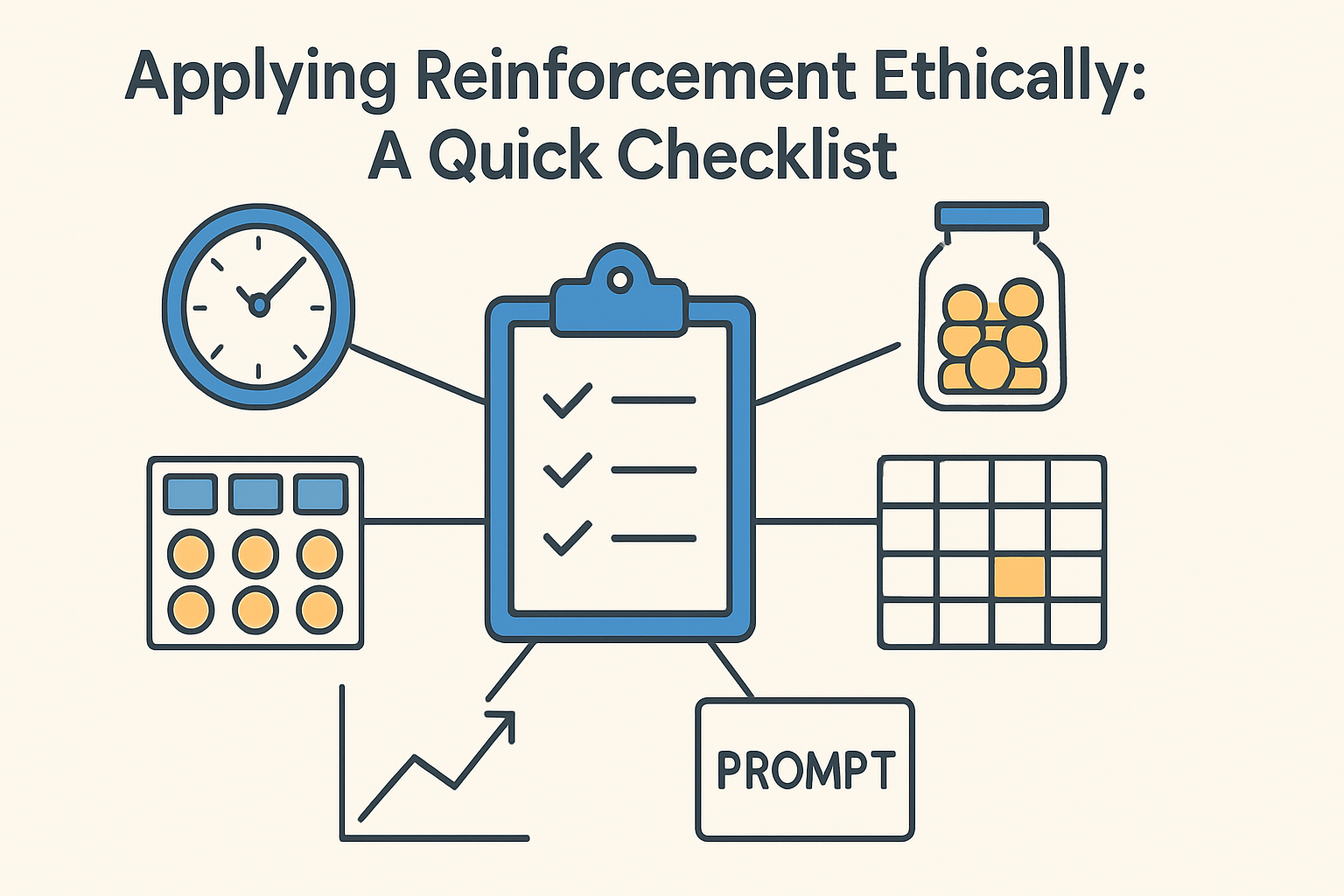
Applying Reinforcement Ethically: A Quick Checklist
Effective reinforcement goes beyond technical correctness to include ethical considerations. BCBAs must ensure interventions respect client dignity while achieving meaningful outcomes.
1. Identify Function First
Before implementing reinforcement, conduct a thorough functional behavior assessment to understand the behavior’s purpose. Reinforcement should be contingent on specific, targeted behaviors rather than delivered non-contingently. This ensures interventions address the actual maintaining variables.
2. Ensure Client Dignity and Choice
Respect client autonomy by offering choices among potential reinforcers whenever possible. Monitor for assent and withdrawal throughout intervention. Use person-centered language and consider the social validity of reinforcement procedures from the client’s perspective.
3. Monitor for Unintended Effects
Regularly assess whether reinforcement procedures produce desired outcomes without creating dependency or other side effects. Watch for satiation effects that reduce reinforcement effectiveness. Ensure reinforcement doesn’t inadvertently strengthen challenging behaviors through accidental contingencies.
Mastering reinforcement behavior requires understanding both its technical definition and practical application. The future behavior criterion remains the most reliable indicator of reinforcement effectiveness. By combining this understanding with ethical implementation strategies, BCBA candidates can approach exam questions with confidence and apply reinforcement principles effectively in practice. For additional study resources, explore our BCBA mock exam materials and review the BACB Ethics Code for guidance on ethical reinforcement practices.


