
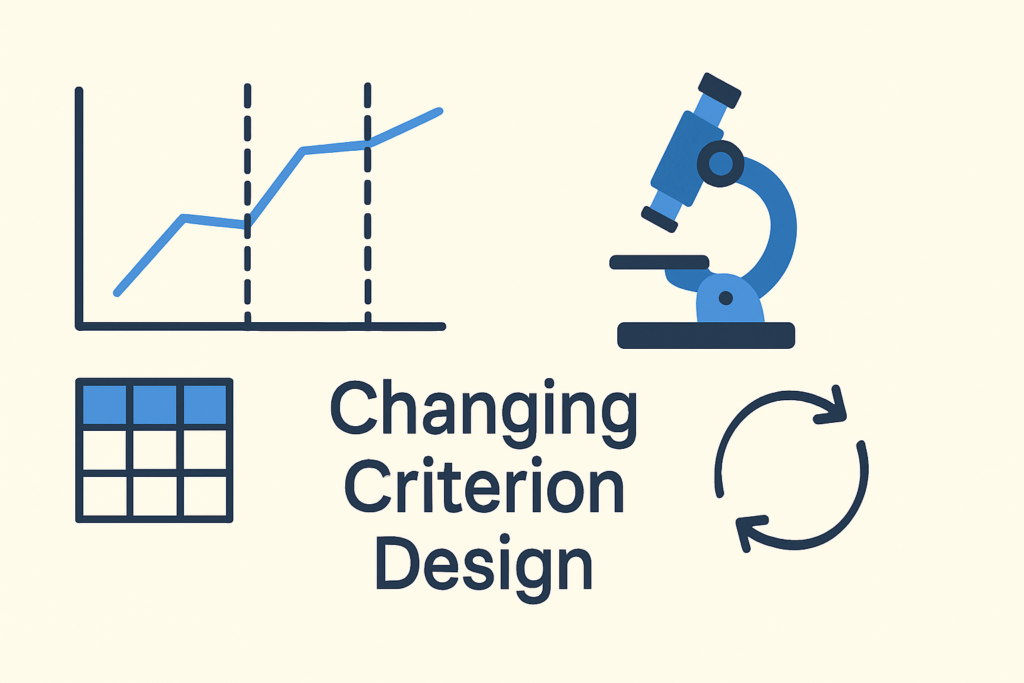
How the Changing Criterion Design Works
A changing criterion design raises (or lowers) a performance criterion in successive steps and checks whether behavior changes to match each new criterion.
- Reading the graph: each phase has a horizontal criterion line set a bit higher (or lower) than the last; the data path “steps” up with it.
- Experimental control: demonstrated when behavior repeatedly changes to meet each new criterion — and even more convincingly if a criterion is briefly reversed and behavior follows.
- Best for: behaviors that should change gradually (e.g., increasing exercise minutes, reducing cigarettes per day).
Exam tip: the effect is behavior tracking the stepped criterion, not a jump after a single phase line. Compare with the multielement design.
What is a Changing Criterion Design?
The changing criterion design is a single-subject experimental design used to evaluate the effects of an intervention on a single target behavior. This design is particularly effective for behaviors that can be shaped gradually through successive approximations toward a final goal.
Table of Contents
- What is a Changing Criterion Design?
- Applied Examples of the Changing Criterion Design
- Exam Relevance and Common Pitfalls
- Implementation Checklist for Practitioners
- Summary and Key Takeaways
Its primary purpose is to demonstrate experimental control by showing that the dependent variable consistently tracks changes in the performance criterion.
Core Components and Visual Pattern
This design consists of several essential elements that create its characteristic visual pattern on a graph.
- Baseline phase: Initial data collection without intervention establishes the starting level of the target behavior
- Intervention phases: A series of consecutive phases where the performance criterion changes systematically
- Stepwise criteria: Each phase has a specific performance goal that represents a gradual change from the previous phase
- Dependent variable tracking: The behavior must consistently meet or approach each new criterion to demonstrate control
The resulting graph shows a distinctive stairstep pattern where the data path follows the changing criteria lines upward or downward.
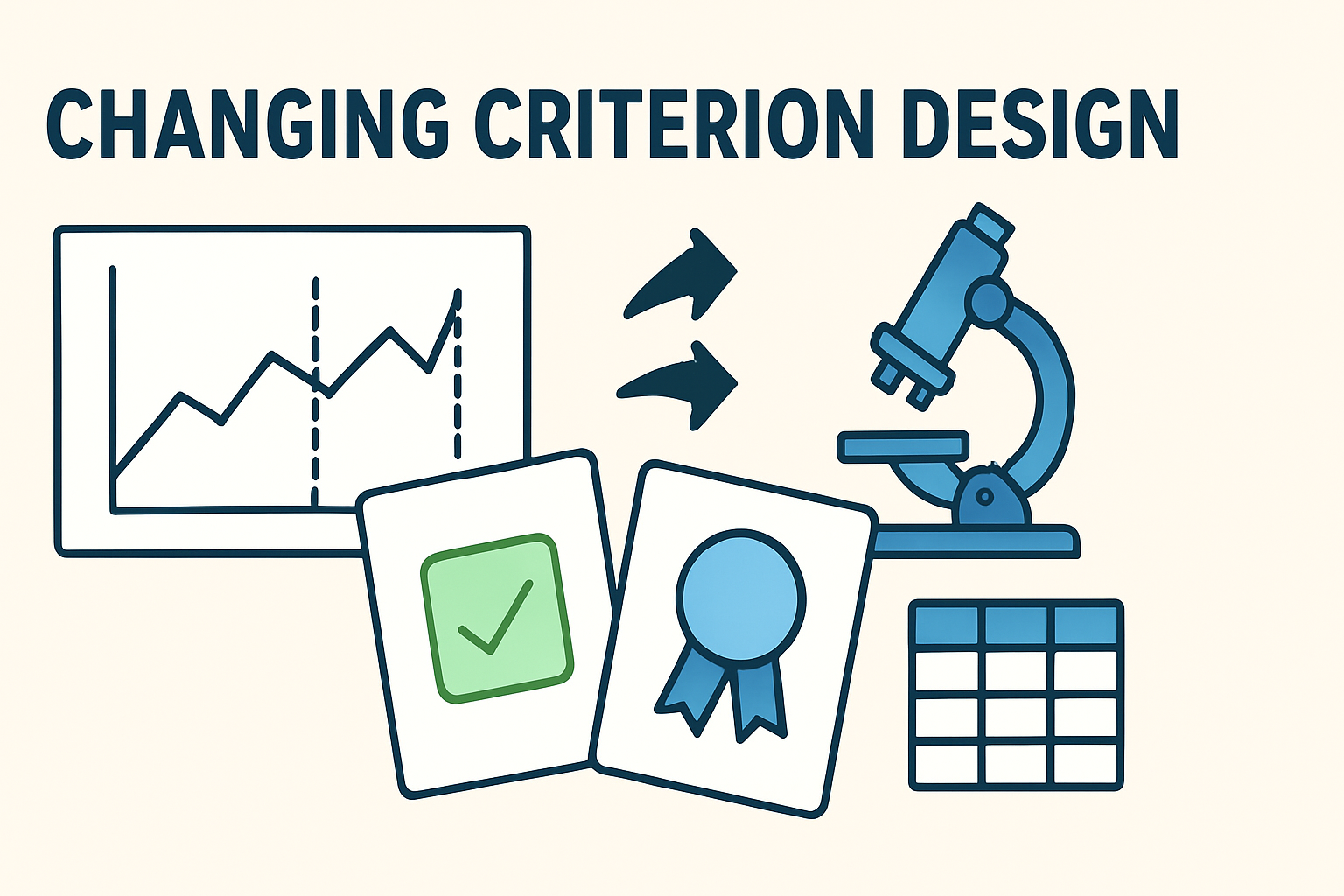
Applied Examples of the Changing Criterion Design
Understanding this design requires seeing it in action with realistic ABA scenarios. These examples illustrate how practitioners implement this approach with actual behavioral data.
Example 1: Increasing Independent Work Duration
Scenario: A student with ADHD struggles to complete independent desk work. Baseline data shows an average of 2 minutes before task avoidance behaviors occur.
- Intervention: Token economy system where tokens are delivered for meeting duration criteria
- Phase 1 criterion: 5 minutes of independent work
- Phase 2 criterion: 10 minutes of independent work
- Phase 3 criterion: 15 minutes of independent work
ABC data analysis reveals the behavior is maintained by escape from demands. The intervention provides reinforcement for tolerating work demands, gradually increasing the required duration.
Example 2: Decreasing Latency to Compliance
Scenario: A child with autism demonstrates delayed responses to instructions, with baseline latency averaging 30 seconds.
- Intervention: High-probability instructional sequence to build momentum
- Phase 1 criterion: 20-second latency maximum
- Phase 2 criterion: 10-second latency maximum
- Phase 3 criterion: 5-second latency maximum
The hypothesized function is access to tangibles (preferred play activities). The intervention establishes a pattern of quick responding that generalizes to lower-probability instructions.
Exam Relevance and Common Pitfalls
This design appears regularly on the BCBA examination and requires careful understanding of its unique characteristics and appropriate applications.
Distinguishing It from Other Designs
Candidates must differentiate the changing criterion design from other single-subject designs. Unlike multiple baseline designs that demonstrate control across behaviors, settings, or subjects, the changing criterion focuses on a single behavior. It also differs from reversal designs because it doesn’t require a return to baseline conditions.
The control in this design is demonstrated through the step-tracking relationship between the criterion changes and the dependent variable’s performance.
Trick Questions and What to Look For
Several common traps appear on examinations that can confuse unprepared candidates.
- Variable data patterns: This design requires stable responding at each criterion level; highly variable data weakens the demonstration of control
- Changing conditions confusion: Don’t confuse this with a ‘changing conditions’ design that compares different interventions
- Inappropriate behaviors: This design works best for behaviors suitable for shaping, not for behaviors requiring immediate reduction like aggression
- Criterion step size: Steps that are too large may not show tracking; steps that are too small may not demonstrate meaningful change
For more on experimental designs, see our guide to single-subject experimental designs.
Implementation Checklist for Practitioners
Use this practical checklist when considering whether to implement a changing criterion design in your practice.
- Assess behavior suitability: Ensure the target behavior can be shaped gradually and measured quantitatively
- Establish stable baseline: Collect sufficient baseline data to determine the starting performance level
- Determine criterion steps: Plan successive criteria that represent meaningful but achievable improvements
- Select appropriate intervention: Choose an intervention that can be applied consistently across all phases
- Monitor data tracking: Regularly check that the dependent variable follows the changing criteria
- Adjust as needed: Be prepared to modify criterion steps if data don’t track appropriately
- Document decisions: Record rationale for criterion changes and intervention adjustments

Summary and Key Takeaways
The changing criterion design serves a specific but important role in applied behavior analysis. Its strength lies in demonstrating experimental control through the systematic shaping of a single behavior.
Key points to remember include its characteristic stairstep graph pattern, its appropriateness for behaviors that can be shaped gradually, and its reliance on the dependent variable tracking criterion changes. For BCBA candidates, understanding when to select this design and how to interpret its data is essential.
This design exemplifies the scientific approach to behavior change that characterizes our field. By systematically shaping behavior toward meaningful goals, practitioners can achieve lasting change while maintaining experimental rigor. For additional study resources, explore our BCBA exam preparation guide and the official BACB Professional and Ethical Compliance Code.
Test yourself on experimental design
Practice with a free, full-length BCBA mock exam — real exam-style questions, instant scoring, and answer explanations.
Frequently Asked Questions
How does a changing criterion design show experimental control?
By showing that behavior repeatedly changes to match each new, stepwise criterion — strengthened if a criterion is reversed and behavior follows.
When should you use a changing criterion design?
For behaviors that should change gradually and in one direction, such as steadily increasing exercise or decreasing a habit.
What does a changing criterion graph look like?
A series of phases, each with a horizontal criterion line set slightly higher or lower than the previous one, with the data stepping to meet each line.
References
- Cooper, J. O., Heron, T. E., & Heward, W. L. (2020). Applied Behavior Analysis (3rd ed.). Pearson.
- Behavior Analyst Certification Board — BACB.com 6th Edition Task List.



