
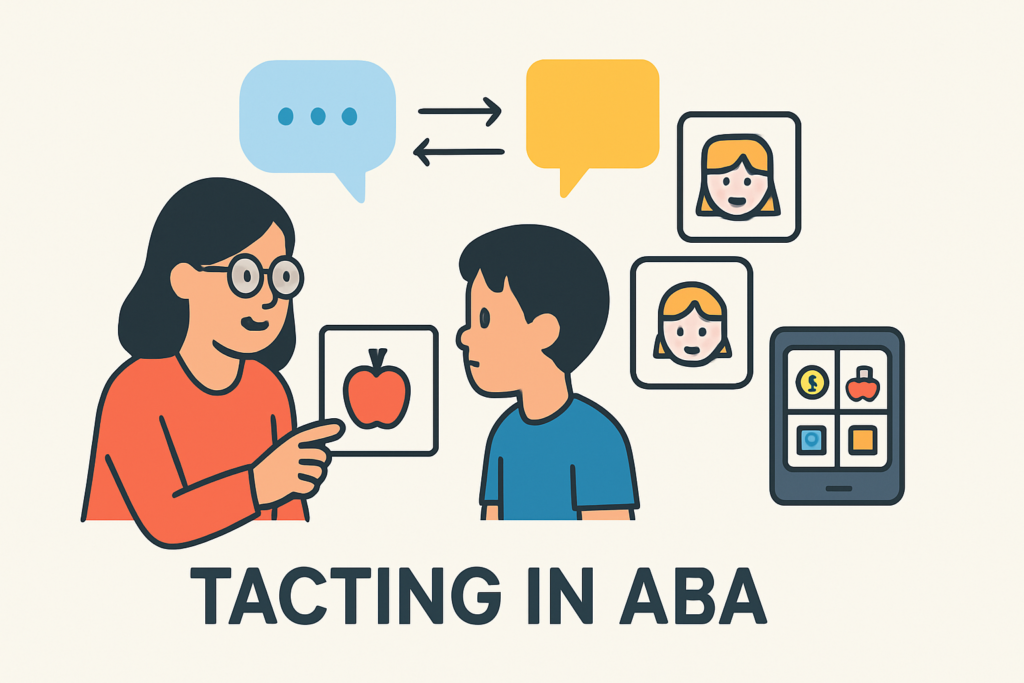
Tacting in ABA: What is Tacting? A Skinnerian Verbal Operant Defined
In Skinner’s analysis of verbal behavior, tacting represents a fundamental verbal operant that serves as the foundation for descriptive language. This concept is essential for BCBA candidates to master, as it forms the basis for understanding how individuals learn to label and describe their environment.
Table of Contents
- Tacting in ABA: What is Tacting? A Skinnerian Verbal Operant Defined
- Tacting in Practice: Worked Examples and Analysis
- Tacting on the BCBA Exam: Relevance and Common Traps
- Quick-Reference Tacting Checklist for BCBA Candidates
- Summary and Key Takeaways
The term ‘tact’ originates from Skinner’s work and refers to a specific type of verbal response that allows individuals to communicate about their surroundings.
The Formal Definition and Key Characteristics
A tact is formally defined as a verbal response under the control of a non-verbal stimulus and reinforced by generalized conditioned reinforcement. This means when someone sees an object, event, or property and labels it correctly, they’re engaging in tacting behavior.
The key characteristics include:
- Non-verbal antecedent: The stimulus that evokes the response is not verbal (e.g., seeing a ball, feeling pain, smelling cookies)
- Generalized reinforcement: The consequence is typically social approval or acknowledgment rather than a specific tangible item
- Descriptive function: The response serves to label or describe something in the environment
- Socially mediated: Reinforcement comes from another person’s response
Tacting vs. Manding, Intraverbal, and Echoic
Understanding how tacting differs from other verbal operants is crucial for exam success. The primary differentiators are the antecedent stimulus and the type of reinforcement that maintains the behavior.
For manding, the antecedent is a motivating operation (MO) and the reinforcement is specific to that MO. When a child says ‘cookie’ because they’re hungry and want a cookie, that’s a mand. In contrast, when they see a cookie and say ‘cookie’ without wanting to eat it, that’s a tact.
Intraverbals involve verbal antecedents and verbal responses, like answering questions or having conversations. Echoics are imitative responses to verbal stimuli. The BCBA exam frequently tests these distinctions, so understanding the ABC contingencies for each operant is essential. For more on verbal operants, see our complete verbal operants guide.
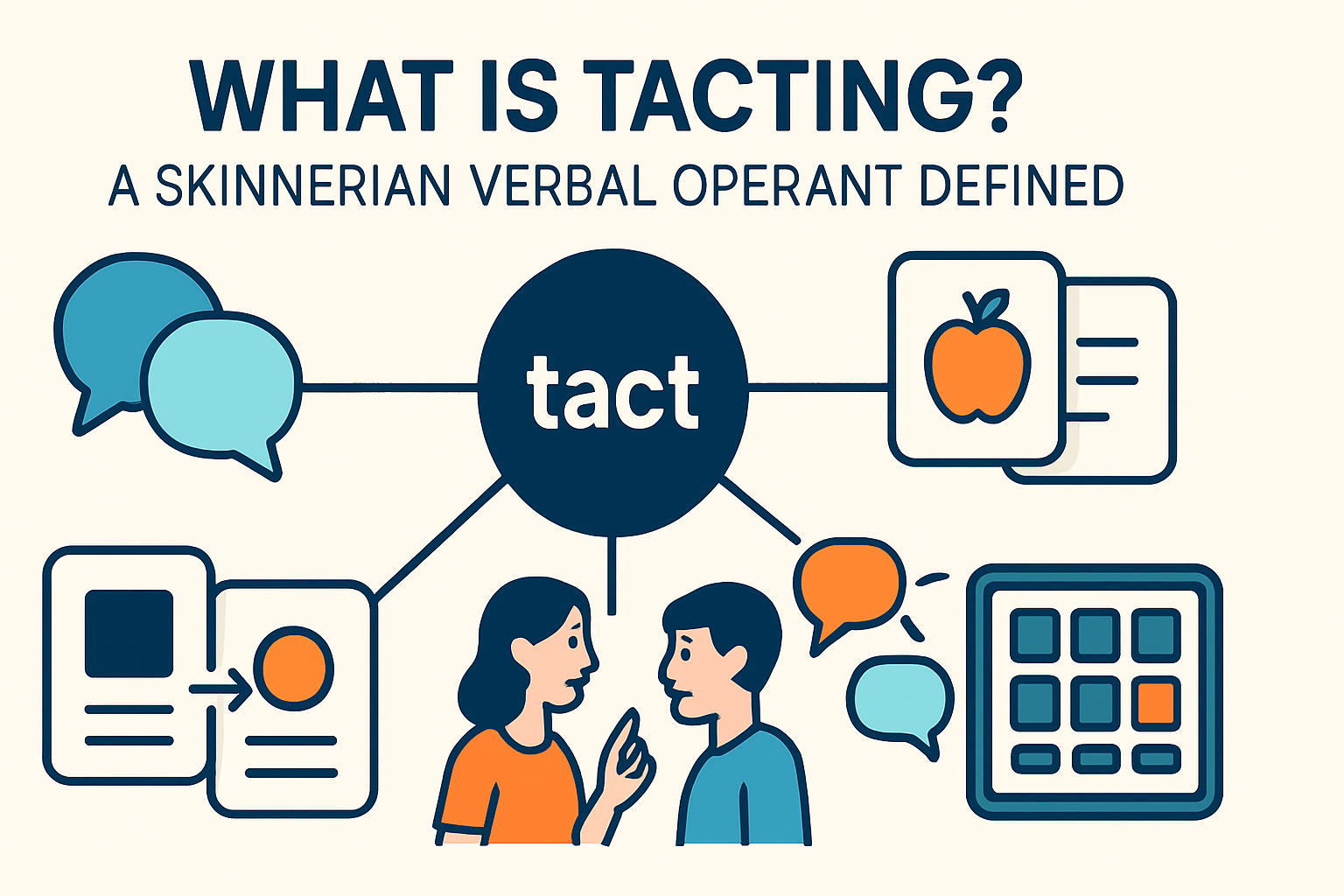
Tacting in Practice: Worked Examples and Analysis
Moving from theory to application, let’s examine concrete scenarios that illustrate tacting in action. Each example includes the ABC contingency analysis that BCBA candidates must master.
Example 1: Simple Tact of an Object
Antecedent: Therapist holds up a red ball during a teaching session.
Behavior: Child looks at the ball and says ‘ball’ or ‘red ball.’
Consequence: Therapist responds with ‘That’s right! It’s a ball!’ accompanied by a smile and head nod.
Function analysis: The hypothesized function is access to social reinforcement and attention. The child’s response is controlled by the visual stimulus (red ball) and reinforced by the therapist’s verbal praise and attention.
Example 2: Tact of an Action or Event
Antecedent: Child observes a peer falling down on the playground.
Behavior: Child turns to teacher and says ‘He fell!’
Consequence: Teacher responds, ‘You’re right, he fell. Good telling me.’
Function analysis: This represents a tact of an event. The response is under the control of the observed action (peer falling) and reinforced by the teacher’s acknowledgment. The reinforcement is generalized social reinforcement rather than a specific tangible item.
Example 3: Complex or Conditional Tact
Antecedent: Therapist presents a blue car and a red car, then asks ‘Which one is blue?’
Behavior: Child points to the blue car and says ‘blue car.’
Consequence: Therapist provides praise: ‘Excellent! You found the blue car!’
Function analysis: This demonstrates a conditional discrimination where the discriminative stimulus (SD) includes both the visual array of cars and the verbal question. The response must match both conditions, making this a more advanced tacting skill. For related concepts, explore stimulus equivalence.
Tacting on the BCBA Exam: Relevance and Common Traps
Tacting questions appear throughout the BCBA exam, particularly in sections covering verbal behavior, assessment, and intervention planning. Candidates must be prepared to identify tacting in various contexts and distinguish it from other verbal operants.
How Tacting is Tested
The exam assesses tacting knowledge through multiple question formats:
- Scenario identification: Given a brief description, identify which verbal operant is being demonstrated
- Teaching procedure selection: Choose appropriate methods for teaching tacting skills based on client characteristics
- Data analysis: Interpret graphs or data from tact training programs
- Error analysis: Identify why a tacting intervention might not be working
- Generalization planning: Select strategies to promote tacting across settings and stimuli
Frequent Misconceptions and Exam Traps
Several common traps consistently challenge BCBA candidates:
- Social reinforcement confusion: Mistaking a tact for a mand when the consequence involves social attention (remember: the antecedent determines the operant)
- Verbal stimulus oversight: Confusing intraverbals with tacts when any verbal prompt is present in the antecedent
- Generalization misunderstanding: Overlooking that generalized reinforcement defines the tact, not the specific form of praise used
- Function misattribution: Assuming all labeling behavior serves the same function without analyzing the three-term contingency
- Complex tact oversight: Failing to recognize conditional tacts that involve multiple discriminative stimuli
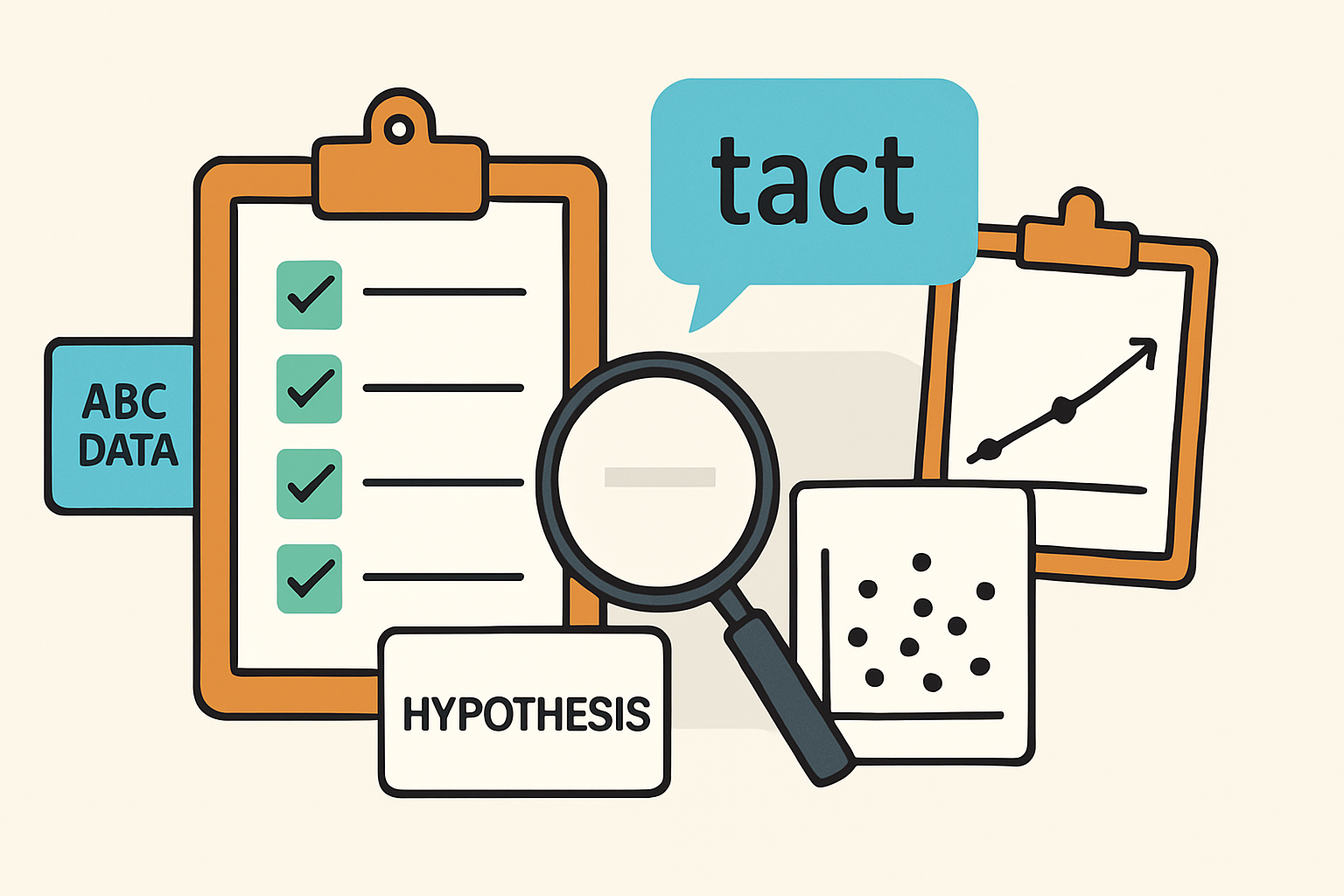
Quick-Reference Tacting Checklist for BCBA Candidates
Use this actionable checklist during your exam preparation and when reviewing practice questions:
- Identify the antecedent: Is it non-verbal (tact) or verbal (intraverbal/echoic)?
- Check for MO presence: Is there a motivating operation suggesting a mand?
- Analyze reinforcement: Is it generalized social reinforcement (tact) or specific to an MO (mand)?
- Consider response form: Does the response match the stimulus properties being described?
- Evaluate complexity: Is this a simple tact or conditional tact requiring discrimination?
- Review teaching context: Are appropriate prompting and fading strategies being used?
- Assess generalization: Has the skill been programmed to occur across settings and people?
- Check maintenance: Is there evidence the tact persists over time without continuous reinforcement?
Summary and Key Takeaways
Tacting represents a critical verbal operant in Skinner’s analysis that enables individuals to describe their environment. For BCBA exam success, remember these essential points:
The antecedent stimulus must be non-verbal, and the reinforcement must be generalized rather than specific. This distinguishes tacting from manding, where an MO drives the response toward specific reinforcement.
Common exam traps include confusing tacts with mands when social reinforcement is involved and overlooking conditional tacts that involve multiple discriminative stimuli. Always analyze the complete three-term contingency before classifying verbal behavior.
In practice, tacting skills form the foundation for descriptive language and social communication. Effective teaching requires careful programming of generalization and maintenance. For additional exam preparation resources, consider our BCBA exam prep guide and review the official BACB Task List for complete coverage of verbal behavior requirements.



