
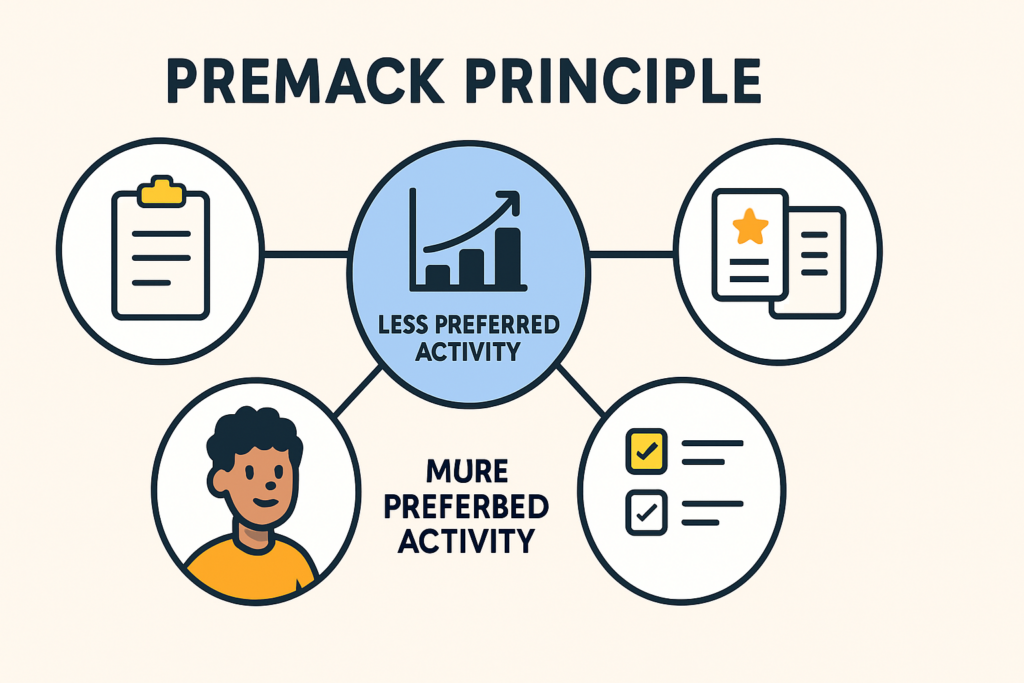
The Premack Principle represents one of the most practical and frequently applied concepts in applied behavior analysis. Often called ‘Grandma’s Rule’ in everyday language, this principle provides a systematic approach for increasing low-probability behaviors by making access to high-probability behaviors contingent upon their completion.
Table of Contents
- What is the Premack Principle?
- Applying the Premack Principle: ABA Examples
- Premack on the BCBA Exam: Relevance and Common Traps
- Quick Checklist for Implementation and Exam Questions
- Summary and Key Takeaways
- References
For BCBA candidates, understanding this principle goes beyond memorization—it requires recognizing its application across diverse settings and distinguishing it from similar behavioral procedures.
What is the Premack Principle?
Developed by psychologist David Premack in 1965, this principle establishes a fundamental relationship between behaviors of different probabilities. The formal definition states: making the opportunity to engage in a high-probability behavior contingent upon the occurrence of a low-probability behavior increases the low-probability behavior.
This principle operates as a form of positive reinforcement, where access to preferred activities serves as the reinforcing consequence.
The Formal Definition and Its Origin
Premack’s original research demonstrated that behaviors could be ranked by their probability of occurrence. When a less probable behavior is followed by a more probable one, the contingent relationship strengthens the less probable behavior. This differs from traditional reinforcement using external rewards.
The everyday version—’eat your vegetables, then you can have dessert’—captures the essence but lacks the behavioral precision required for clinical application and exam success.
Key Components for BCBA Candidates
Three essential elements define the Premack Principle’s application:
- High-probability behavior identification: Determining what activities an individual naturally engages in frequently without external prompts
- Low-probability behavior targeting: Identifying the specific behavior you want to increase that occurs less frequently
- Contingent relationship establishment: Creating a clear ‘first-then’ sequence where the low-probability behavior must occur before access to the high-probability behavior
Remember that this is fundamentally a positive reinforcement procedure, not punishment or escape-based intervention.
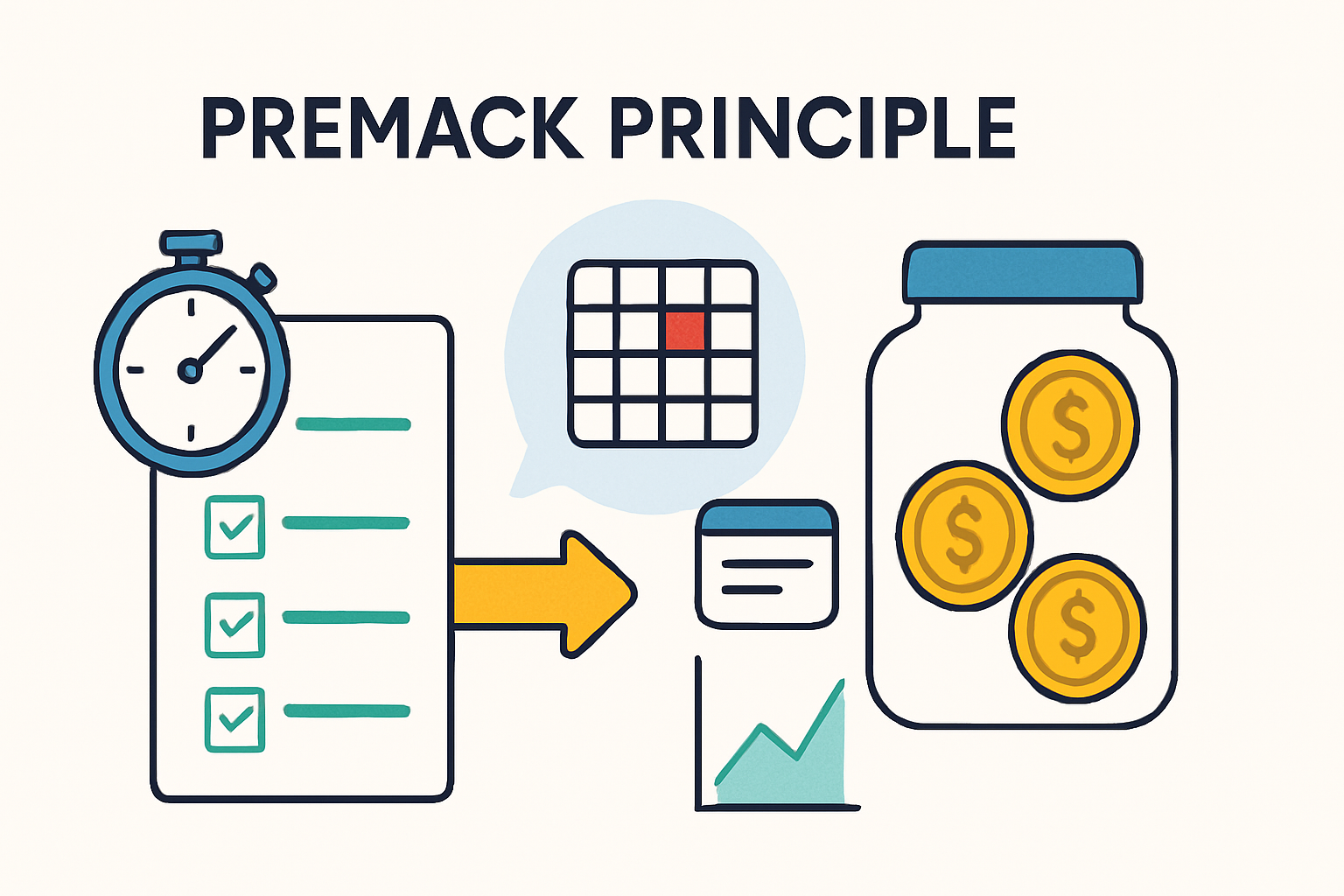
Applying the Premack Principle: ABA Examples
Real-world application requires careful analysis of behavioral functions and appropriate implementation. These examples demonstrate how the principle works across different settings and populations.
Example 1: Increasing Academic Engagement
A student consistently avoids math worksheets but eagerly engages with computer games during free time. The intervention uses the Premack Principle with clear ABC data:
- Antecedent: Math worksheet presented with instruction to complete 5 problems
- Behavior: Student completes 5 math problems
- Consequence: Immediate access to 5 minutes of preferred computer time
The hypothesized function is escape/avoidance of non-preferred academic tasks. By providing access to a highly preferred activity contingent upon task completion, we address the escape function while building academic engagement.
Example 2: Promoting Daily Living Skills
A child resists toothbrushing routines but consistently plays with a train set when given the opportunity. The implementation follows this sequence:
- Antecedent: Toothbrush and toothpaste presented with verbal prompt to brush
- Behavior: Child completes 2-minute brushing routine with minimal prompting
- Consequence: Immediate access to train set for 10 minutes of uninterrupted play
This targets the function of access to tangibles. The highly probable train play reinforces the lower probability hygiene behavior, making it more likely to occur in the future.
Example 3: Workplace Application for Staff
A behavior technician consistently delays data entry after sessions, preferring to socialize with colleagues. The supervisor implements a Premack-based intervention:
- Antecedent: Session ends, data sheet and tablet available
- Behavior: Technician enters session data within 15 minutes of session completion
- Consequence: Permission to take a 10-minute coffee break with peers
This demonstrates the principle’s versatility beyond client interventions, addressing escape from tedious tasks in professional settings. Understanding these applications helps with staff training and organizational behavior management questions on the exam.
Premack on the BCBA Exam: Relevance and Common Traps
The Premack Principle appears across multiple exam domains, often disguised in scenario-based questions. Recognizing its application requires understanding both the principle itself and how it differs from similar concepts.
How the Exam Tests This Concept
You’ll encounter this principle in several key areas of the BACB Task List:
- Fundamental principles (Domain B-1): Defining and providing examples of basic principles
- Behavior-change procedures (Domain G-14): Using reinforcement procedures effectively
- Scenario-based questions: Identifying appropriate interventions based on behavioral functions
Questions may use ‘first-then’ language without explicitly naming the principle, requiring you to recognize the underlying behavioral mechanism.
Frequent Mistakes and How to Avoid Them
Common exam traps involve misidentification and confusion with other principles:
- Confusing Premack with negative reinforcement: Remember that Premack provides access to preferred activities (positive reinforcement), while negative reinforcement removes aversive stimuli
- Misidentifying the high-probability behavior: The reinforcing activity must occur naturally at high rates without the contingency in place
- Overlooking the probability requirement: Simple ‘if-then’ statements without the probability element don’t constitute the Premack Principle
- Failing to distinguish from other reinforcement types: The reinforcer must be engagement in another behavior, not a tangible item or social praise alone
These distinctions are crucial for exam success and clinical decision-making. For more on reinforcement distinctions, see our guide on positive reinforcement procedures.
Quick Checklist for Implementation and Exam Questions
Use this checklist to guide both clinical applications and exam preparation:
- Identify natural behavioral probabilities through observation and preference assessments
- Establish clear contingent relationships using ‘first-then’ language that clients understand
- Monitor effectiveness by tracking increases in the target low-probability behavior
- Recognize exam scenarios by looking for behavior-behavior contingencies rather than behavior-tangible contingencies
- Distinguish from negative reinforcement by asking: does this provide access or remove something?
- Verify the probability requirement – both behaviors must have established baseline probabilities
This systematic approach ensures both ethical implementation and exam readiness.
Summary and Key Takeaways
The Premack Principle remains a cornerstone of effective behavior change across educational, clinical, and organizational settings. Key points for BCBA candidates include:
- The principle uses high-probability behaviors to reinforce low-probability behaviors through contingent access
- It operates as a form of positive reinforcement, distinct from negative reinforcement or punishment procedures
- Successful application requires accurate identification of natural behavioral probabilities through observation and assessment
- Exam questions often test your ability to distinguish Premack from similar principles and recognize appropriate applications
- Real-world implementation should always consider the behavioral function and individual preferences
Mastering this principle enhances both exam performance and clinical effectiveness, providing a versatile tool for behavior analysts across diverse practice settings. For additional exam preparation resources, explore our comprehensive BCBA exam prep guide.



