
Pragmatism in ABA: What is Pragmatism in Applied Behavior Analysis?
Pragmatism in ABA represents a philosophical approach that prioritizes practical solutions over rigid theoretical adherence. This perspective emphasizes selecting interventions based on their real-world effectiveness and contextual fit rather than following protocols without consideration of individual circumstances.
Table of Contents
- Pragmatism in ABA: What is Pragmatism in Applied Behavior Analysis?
- Pragmatism in Action: Clinical Decision-Making Examples
- Pragmatism and the BCBA Exam: What You Need to Know
- A Pragmatic Practitioner’s Quick Checklist
- Summary: Integrating Pragmatism into Your Practice
- References
The core of pragmatism in ABA involves making decisions that produce meaningful outcomes for clients while respecting their unique needs and environmental constraints.
Core Principles: Practicality, Context, and Outcomes
Three fundamental principles guide pragmatic practice in behavior analysis. First, practical utility determines intervention selection—what works best in the specific situation takes precedence over what is theoretically ideal. Second, contextual factors including client characteristics, environmental constraints, and available resources shape decision-making. Third, observable outcomes serve as the ultimate measure of success, with data driving adjustments to interventions.
This approach contrasts sharply with a protocol-only methodology that applies standardized procedures regardless of individual differences or situational variables.
Pragmatism vs. Other Philosophical Underpinnings
While radical behaviorism focuses on understanding behavioral principles and methodological behaviorism emphasizes observable phenomena, pragmatism centers on applied effectiveness. Pragmatic practitioners ask “what works” in specific situations rather than seeking universal theoretical purity.
This distinction becomes crucial when considering how radical behaviorism differs from methodological approaches in their philosophical foundations.
Pragmatism in Action: Clinical Decision-Making Examples
Real-world applications demonstrate how pragmatic thinking transforms standard ABA practice. These examples show the dynamic adaptation of evidence-based procedures to meet individual client needs.
Example 1: Adapting a Token Economy for a Young Learner
A standard token board fails with a 4-year-old client who has fine motor challenges. The pragmatic analysis reveals several issues: the small tokens are difficult to manipulate, the visual schedule lacks personal relevance, and the reinforcement schedule doesn’t match the child’s attention span.
The practitioner makes these adaptations:
- Replace small tokens with larger magnetic pieces that are easier to handle
- Incorporate the child’s special interests into the token design
- Shorten the response requirement to match developmental level
- Use immediate backup reinforcers rather than delayed exchange
This approach maintains the functional components of the token economy while adapting the form to ensure practical success.
Example 2: Balancing Fidelity with Functional Communication Training (FCT)
During FCT implementation, a client shows increased distress with standard prompting procedures. The pragmatic practitioner analyzes whether the intervention itself has become aversive, potentially creating an escape function for problem behavior.
Adaptations might include:
- Reducing prompt intrusiveness while maintaining teaching effectiveness
- Incorporating choice-making opportunities within the teaching sequence
- Adjusting the pace of instruction based on client readiness
- Using naturalistic teaching moments alongside structured trials
These modifications preserve the core teaching objective while respecting the client’s comfort and reducing intervention-related stress.
Pragmatism and the BCBA Exam: What You Need to Know
Understanding pragmatism’s role in behavior analysis is essential for exam success and clinical competence. The BCBA exam frequently tests your ability to apply pragmatic principles to complex scenarios.
Linking to the Task List and Ethical Code
Pragmatism connects directly to several BACB Task List items and ethical standards. Key areas include:
- G-2: Consider biological and medical variables that might affect intervention selection
- G-21: Use procedures with contextual fit that match client characteristics and environmental factors
- Ethics Code 2.09: Treatment/Intervention Efficacy requiring practitioners to select interventions based on best available evidence
- Ethics Code 4.07: Environmental Conditions that promote client dignity and success
These connections emphasize how pragmatic decision-making aligns with both technical competence and ethical practice.
Common Exam Traps and How to Avoid Them
Several misconceptions can lead to incorrect answers on pragmatism-related questions:
- Confusing pragmatism with shortcuts—pragmatic solutions must still be evidence-based and ethical
- Prioritizing convenience over effectiveness—the easiest solution isn’t always the most pragmatic
- Ignoring long-term outcomes for short-term gains—true pragmatism considers sustainability
- Overlooking client preferences in favor of technical purity—social validity matters
Remember that pragmatism in ABA always operates within the framework of the seven dimensions of applied behavior analysis, ensuring interventions remain conceptually systematic and effective.
A Pragmatic Practitioner’s Quick Checklist
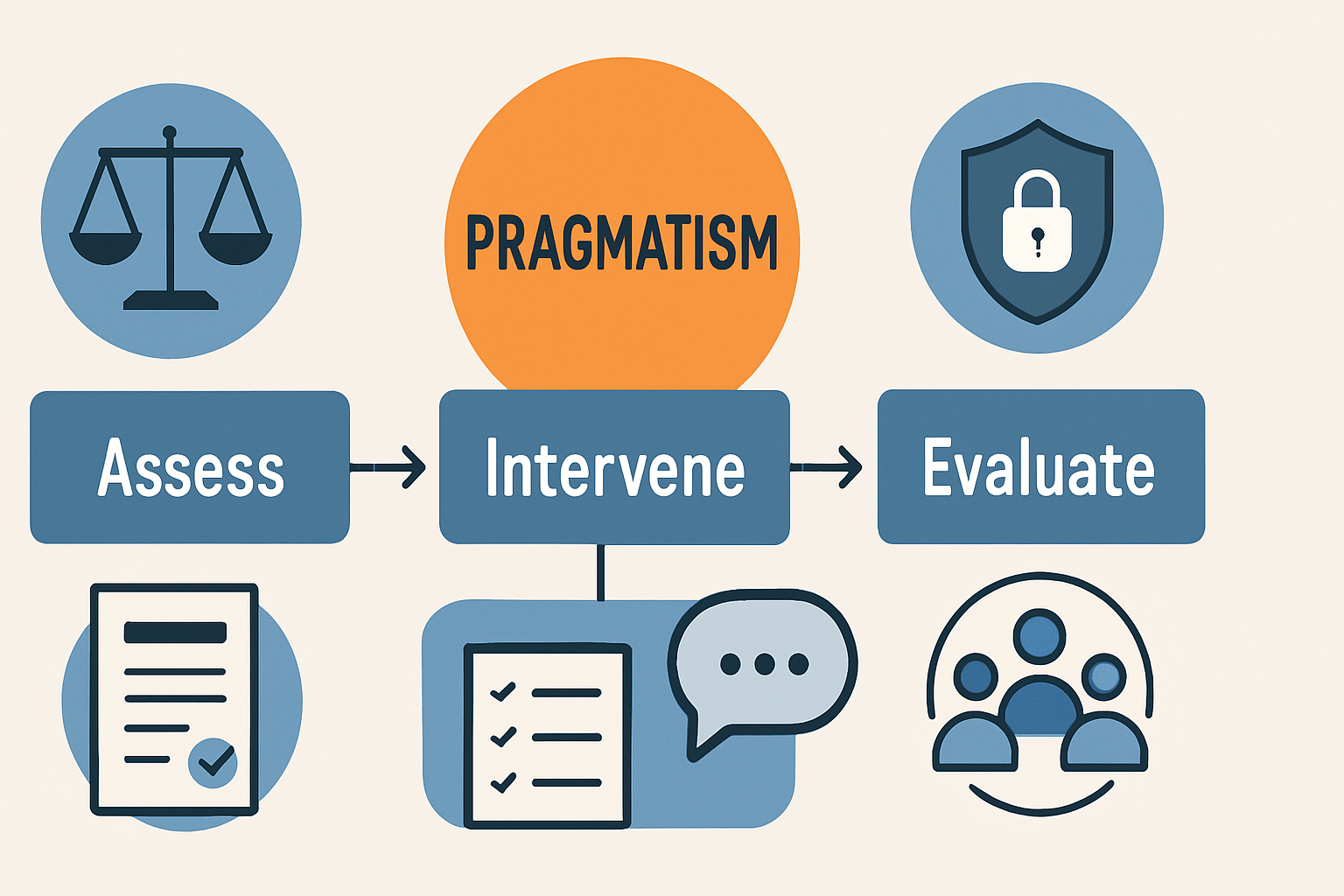
Use this practical guide to evaluate your clinical decisions through a pragmatic lens:
- Assess contextual fit—Does the intervention match the client’s environment and resources?
- Evaluate practical constraints—What limitations exist in implementation settings?
- Measure social validity—Do stakeholders find the intervention acceptable and meaningful?
- Consider adaptation needs—What modifications might improve effectiveness or acceptability?
- Balance fidelity with flexibility—How can you maintain core components while adapting delivery?
- Monitor outcomes continuously—Are you achieving meaningful, measurable results?
- Review ethical implications—Does your approach respect client dignity and autonomy?
This checklist helps ensure your interventions remain both technically sound and practically feasible.
Summary: Integrating Pragmatism into Your Practice
Pragmatism serves as a vital decision-making framework that bridges evidence-based practice with real-world application. By focusing on what works in specific contexts, practitioners can develop more effective, sustainable interventions that respect individual differences.
The true power of pragmatism in ABA lies in its ability to balance scientific rigor with clinical wisdom. This approach recognizes that while principles remain constant, their application must adapt to unique circumstances. As you prepare for the BCBA exam and develop your clinical skills, remember that pragmatic thinking enhances both your analytical abilities and your practical effectiveness.
For further exploration of related philosophical concepts, consider reviewing the philosophical assumptions underlying behavior analysis to deepen your understanding of how different perspectives shape clinical practice.


