
Differential Reinforcement ABA: What is Differential Reinforcement in Applied Behavior Ana
Differential reinforcement is a fundamental behavior reduction strategy that involves reinforcing one behavior while withholding reinforcement for another. This approach serves as an ethical alternative to punishment procedures and aligns with the least restrictive intervention principle.
Table of Contents
- Differential Reinforcement ABA: What is Differential Reinforcement in Applied Behavior Ana
- The Four Differential Reinforcement Procedures Explained
- Applied Examples: From ABC Data to Intervention
- Common Exam Traps and How to Avoid Them
- Quick-Reference Implementation Checklist
- Summary and Key Takeaways for Your Study
The technique directly addresses Section G of the BACB Task List, focusing on behavior-change procedures that prioritize client dignity and effective outcomes.
The Core Principle: Reinforcing One Behavior, Withholding for Another
At its essence, differential reinforcement involves a two-part process. First, you systematically reinforce a specific behavior or class of behaviors. Second, you deliberately withhold reinforcement for a target behavior you want to decrease. This creates a contingency contrast that shapes behavior toward more appropriate alternatives.
Why Differential Reinforcement is a BCBA Exam Staple
This topic appears consistently on the BCBA exam because it represents evidence-based practice that balances effectiveness with ethical considerations. Understanding differential reinforcement demonstrates mastery of behavior-analytic principles and their practical application in real-world settings.
For more on ethical behavior-analytic practice, see our guide on ethics in ABA practice.
The Four Differential Reinforcement Procedures Explained
Each differential reinforcement procedure serves distinct clinical purposes and requires careful selection based on behavioral function and client needs.
Differential Reinforcement of Alternative Behavior (DRA)
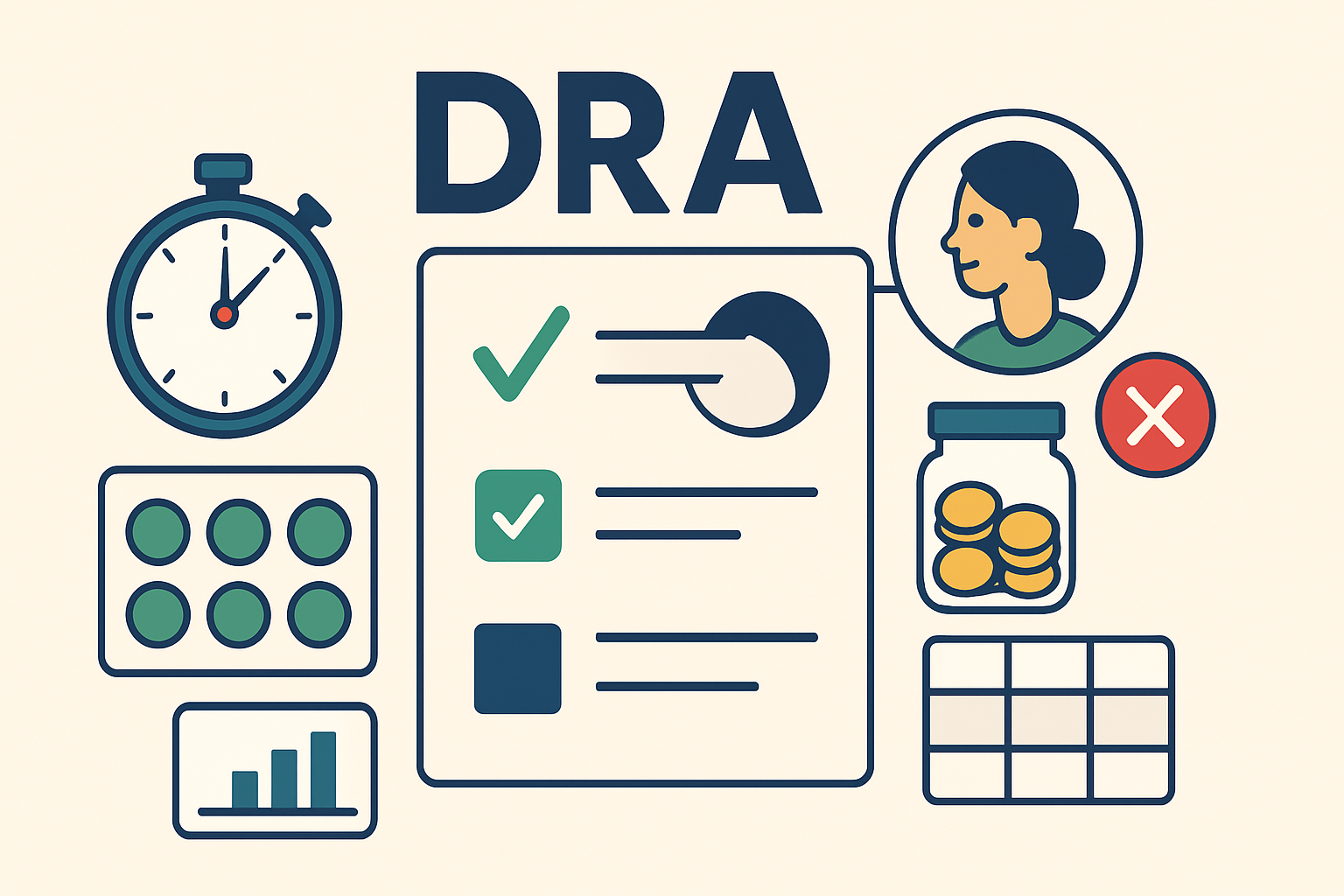
DRA involves reinforcing a specific, appropriate alternative behavior while extinguishing the target behavior. The key distinction is that the alternative behavior must be functionally equivalent to the problem behavior. For example, if a child screams to get attention, you might reinforce raising a hand instead.
Differential Reinforcement of Other Behavior (DRO)
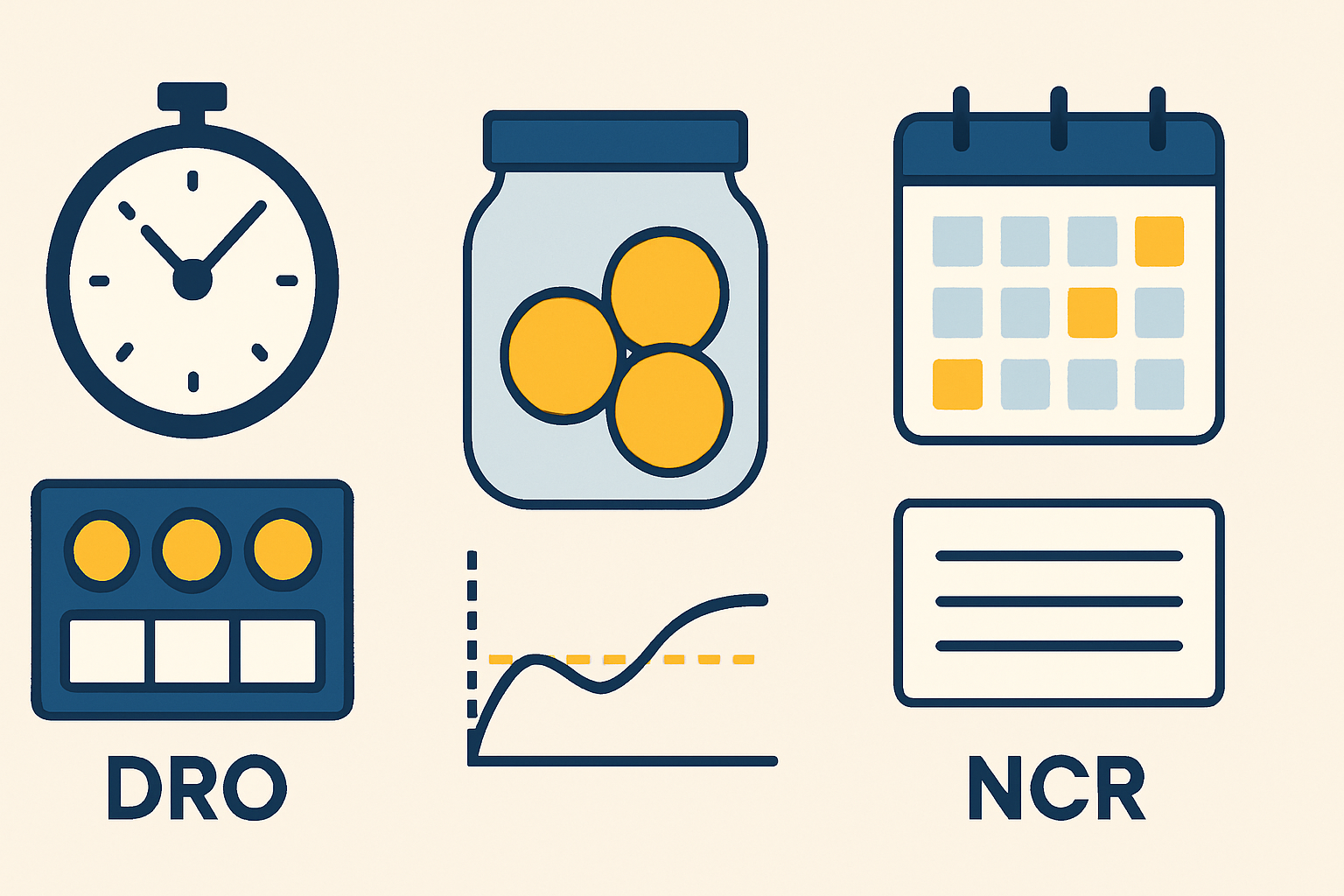
DRO delivers reinforcement contingent on the absence of the target behavior during a specified interval. This interval-based procedure reinforces any behavior except the target. DRO is particularly useful for behaviors maintained by automatic reinforcement where functional alternatives are challenging to identify.
Differential Reinforcement of Incompatible Behavior (DRI)
DRI reinforces a behavior that is physically incompatible with the target behavior. The alternative behavior makes it impossible to perform the problem behavior simultaneously. For instance, reinforcing hands in pockets is incompatible with hand flapping.
Differential Reinforcement of Low Rates (DRL)
DRL aims to decrease, not eliminate, a behavior by reinforcing lower rates of responding. There are two main types: spaced-responding DRL requires a minimum time between responses, while full-session DRL reinforces when total responses stay below a criterion for the entire session.
Applied Examples: From ABC Data to Intervention
These practical scenarios demonstrate how to select appropriate differential reinforcement procedures based on functional assessment data and behavioral analysis.
Example 1: Reducing Elopement (Function: Escape) with DRA
ABC Data: Antecedent – Difficult academic task; Behavior – Elopement from work area; Consequence – Task removal.
Intervention: Teach and reinforce functional communication response (e.g., “I need a break” card) while placing elopement on extinction. This is DRA because the break request serves the same escape function as elopement.
Example 2: Reducing Hand Mouthing (Function: Automatic) with DRO
ABC Data: Antecedent – Alone time; Behavior – Hand mouthing; Consequence – Sensory stimulation.
Intervention: Implement DRO 2-minute interval where reinforcement is delivered after each 2-minute period without mouthing. This approach is appropriate for automatically maintained behavior where identifying functional alternatives is challenging.
Example 3: Decreasing Classroom Calling Out with DRL
ABC Data: Antecedent – Teacher attention to other students; Behavior – Calling out answers; Consequence – Teacher response.
Intervention: Use spaced-responding DRL requiring at least 5 minutes between verbal responses. This reduces but doesn’t eliminate participation, maintaining academic engagement while decreasing disruption.
Common Exam Traps and How to Avoid Them
BCBA candidates frequently encounter these subtle distinctions in differential reinforcement questions.
Mistaking DRO for NCR (Noncontingent Reinforcement)
The critical difference lies in the contingency requirement. DRO delivers reinforcement contingent on the absence of target behavior, while NCR provides reinforcement noncontingently on a time-based schedule regardless of behavior.
Confusing DRA and DRI
Use this simple rule: If the behaviors can occur simultaneously (e.g., yelling and raising a hand), it’s DRA. If they cannot occur together (e.g., hitting and sitting on hands), it’s DRI. The physical incompatibility test clarifies this distinction.
Overlooking the Schedule of Reinforcement for the Alternative Behavior
A common implementation error involves insufficient reinforcement for the new behavior. The alternative behavior must receive rich, immediate reinforcement initially, often using a continuous reinforcement schedule before thinning.
Misapplying DRL When Elimination is the Goal
DRL is specifically designed for behaviors you want to reduce but not eliminate. If complete elimination is the objective, DRA, DRO, or DRI would be more appropriate choices.
Quick-Reference Implementation Checklist
Follow these steps to select and implement differential reinforcement effectively:
- Conduct functional assessment to identify behavior function
- Select appropriate DR procedure based on clinical goals
- Identify potent reinforcers through preference assessment
- Establish clear operational definitions for target and alternative behaviors
- Implement dense reinforcement schedule for alternative behavior initially
- Systematically thin reinforcement as behavior stabilizes
- Monitor treatment integrity and social validity
- Collect ongoing data to evaluate effectiveness
For more on data collection methods, see our guide on data collection in ABA.
Summary and Key Takeaways for Your Study
Differential reinforcement represents a cornerstone of ethical behavior reduction in applied behavior analysis. Mastering these procedures requires understanding both the technical definitions and their practical application.
Key distinctions to remember:
- DRA reinforces functionally equivalent alternatives
- DRO reinforces absence during intervals
- DRI reinforces physically incompatible behaviors
- DRL reduces but doesn’t eliminate behaviors
For authoritative information on behavior-analytic procedures, refer to the Behavior Analyst Certification Board resources and peer-reviewed literature on differential reinforcement applications.
Remember that successful implementation depends on accurate functional assessment, appropriate procedure selection, and systematic reinforcement thinning. These procedures exemplify the applied dimension of ABA by addressing socially significant behaviors through evidence-based methods.
For additional study resources on related topics, explore our guide on functional analysis versus descriptive assessment.


