
Understanding operant behavior is fundamental for any BCBA candidate. This core concept forms the backbone of applied behavior analysis and appears throughout the certification exam. Mastery of operant behavior means you can analyze why behaviors occur and design effective interventions.
Table of Contents
- What is Operant Behavior? A Definition for BCBA Candidates
- Operant Behavior in Practice: Worked ABA Examples
- Operant Behavior on the BCBA® Exam: What to Expect
- Quick-Study Checklist and Summary
What is Operant Behavior? A Definition for BCBA Candidates
Operant behavior refers to actions that operate on the environment to produce consequences. These behaviors are strengthened or weakened by what follows them. B.F. Skinner developed this concept, distinguishing it from reflexive, respondent behavior.
The key insight is simple: behavior that produces favorable outcomes becomes more likely to occur again. This principle drives most behavior change programs in ABA practice.
The Key Distinction: Operant vs. Respondent
Operant behavior is defined by its consequences, while respondent behavior is defined by its antecedents. Respondent behaviors are reflexive responses to stimuli, like salivating when smelling food. Operant behaviors are voluntary actions shaped by their outcomes.
Remember this exam tip: If you can identify the consequence maintaining the behavior, you’re likely dealing with operant behavior. For more on this distinction, see our guide on respondent vs operant behavior.
The Three-Term Contingency: The Engine of Operant Behavior
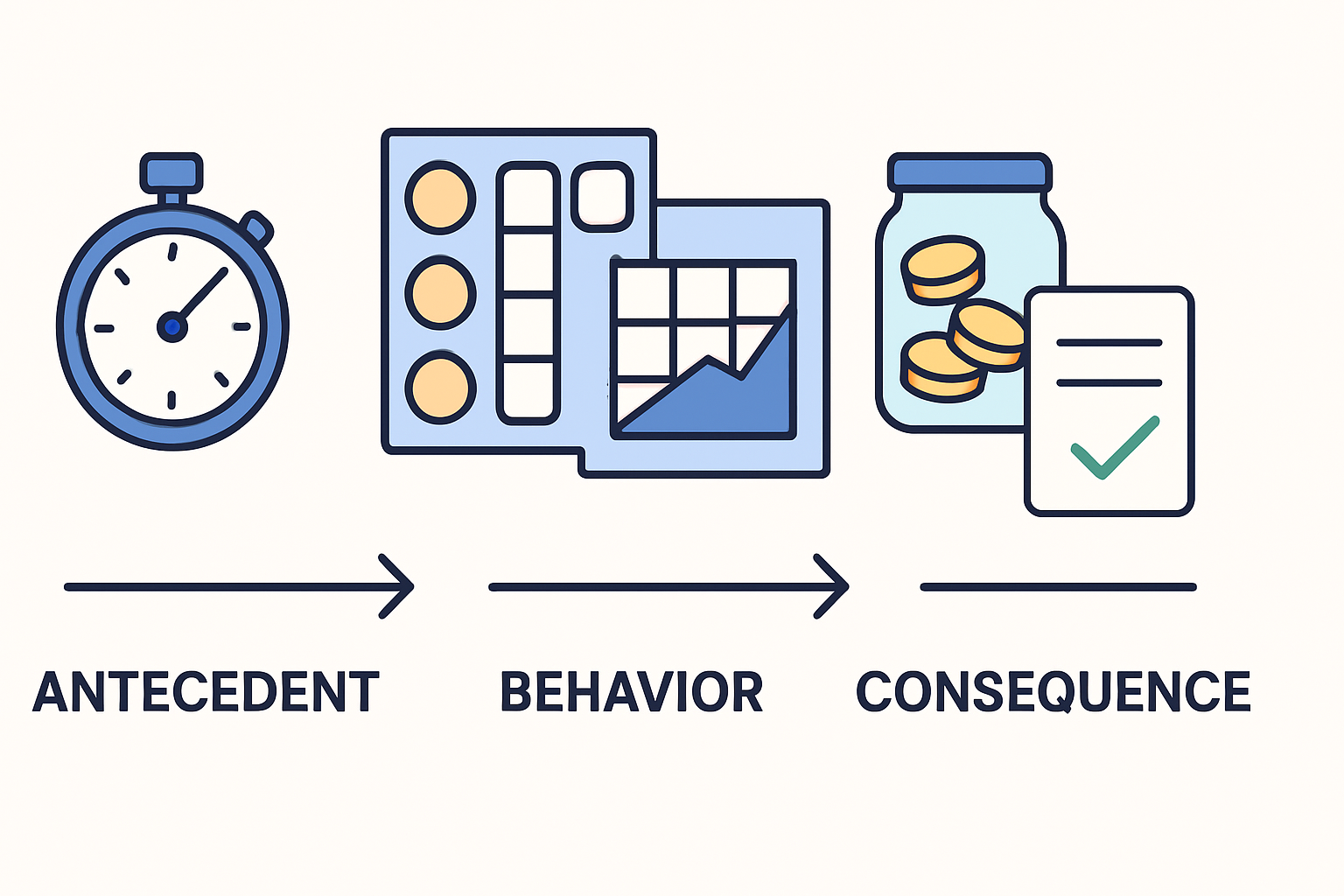
The three-term contingency (A-B-C) explains how operant behavior works:
- Antecedent: The environmental event that occurs before the behavior
- Behavior: The observable and measurable action
- Consequence: What follows the behavior, which affects future occurrences
For example: When a phone rings (antecedent), you answer it (behavior), and you connect with the caller (consequence). This consequence makes you more likely to answer future calls.
Operant Behavior in Practice: Worked ABA Examples
Real-world examples demonstrate how operant behavior analysis works in ABA settings. Each scenario includes the three-term contingency and hypothesized function.
Example 1: Escape-Maintained Behavior in a Learning Context
Scenario: During math instruction, a student pushes away their worksheet and says “I can’t do this.”
- Antecedent: Difficult math demand presented
- Behavior: Pushing worksheet away and vocal protest
- Consequence: Teacher removes the worksheet temporarily
- Function: Escape from academic demands
The behavior is maintained by negative reinforcement because it removes an aversive stimulus (the difficult task).
Example 2: Attention-Maintained Vocalization
Scenario: During independent work time, a learner repeatedly says “Look at me!” to the classroom aide.
- Antecedent: Low attention from staff during quiet work
- Behavior: Vocalization “Look at me!”
- Consequence: Aide turns and says “I see you working”
- Function: Access to social attention
This behavior demonstrates positive reinforcement through attention delivery. For more on reinforcement types, see our positive reinforcement guide.
Example 3: Tangible-Seeking Behavior via Manding
Scenario: A client hands a “want” picture card to their therapist while pointing to a preferred snack.
- Antecedent: Presence of preferred snack and picture exchange system
- Behavior: Handing “want” picture card
- Consequence: Receiving the preferred snack
- Function: Access to tangible items
This functional communication represents a mand (request) strengthened by receiving the desired item. Understanding verbal operants is crucial for BCBA exam success.
Operant Behavior on the BCBA® Exam: What to Expect
Exam questions test your ability to analyze behavior using operant principles. You’ll need to identify contingencies, functions, and appropriate interventions.
Questions often present brief scenarios and ask you to select the maintaining variable or predict what would happen if the contingency changed.
Common Exam Traps and How to Avoid Them
Watch for these common mistakes in operant behavior questions:
- Confusing topography with function: Two behaviors that look different can serve the same function
- Misidentifying the consequence: Focus on what immediately follows the behavior, not long-term outcomes
- Overcomparing to respondent conditioning: Remember that operant behavior is voluntary and consequence-driven
- Forgetting motivating operations: These alter the value of consequences and affect behavior probability
Always ask yourself: “What consequence is maintaining this behavior?” This question guides you to the correct analysis.
Linking to the Task List: Where You’ll See It
Operant behavior concepts appear throughout Section B (Concepts and Principles) of the BACB Task List:
- B-1: Define and provide examples of behavior, response, and response class
- B-4: Define and provide examples of positive and negative reinforcement contingencies
- B-5: Define and provide examples of positive and negative punishment contingencies
- B-9: Define and provide examples of operant extinction
These items require you to apply operant principles to real scenarios. For comprehensive exam preparation, review our BACB Task List guide.
Quick-Study Checklist and Summary
Use this checklist to ensure you’ve mastered operant behavior concepts:
- ✓ Define operant behavior as behavior controlled by its consequences
- ✓ Distinguish operant from respondent behavior based on what controls each
- ✓ Diagram the three-term contingency (A-B-C) for any given behavior
- ✓ Identify the four functions of behavior (SEAT: Sensory, Escape, Attention, Tangible)
- ✓ Recognize positive and negative reinforcement in practice examples
- ✓ Apply operant principles to predict behavior changes
- ✓ Avoid common exam traps like confusing form with function
Operant behavior remains the cornerstone of applied behavior analysis. Mastery of this concept enables you to analyze why behaviors occur and design effective interventions. Remember that behavior is lawful and predictable when you understand its maintaining contingencies.
For authoritative information on behavior analysis principles, consult the Behavior Analyst Certification Board resources and peer-reviewed journals like the Journal of Applied Behavior Analysis.


