

A CMO-R (Conditioned Motivating Operation – Reflexive) represents a critical concept in applied behavior analysis that often appears on the BCBA exam. This learned antecedent signals impending aversive events and evokes escape or avoidance behaviors. Understanding this reflexive motivating operation requires grasping both its conditioning history and its dual effects on behavior and reinforcement value.
Table of Contents
- CMO-R reflexive motivating operation: What is a CMO-R? Defining the Reflexive Conditioned
- CMO-R in Action: Applied Examples for the BCBA Exam
- CMO-R on the BCBA Exam: Relevance and Common Traps
- CMO-R Quick-Reference Checklist and Summary
CMO-R reflexive motivating operation: What is a CMO-R? Defining the Reflexive Conditioned
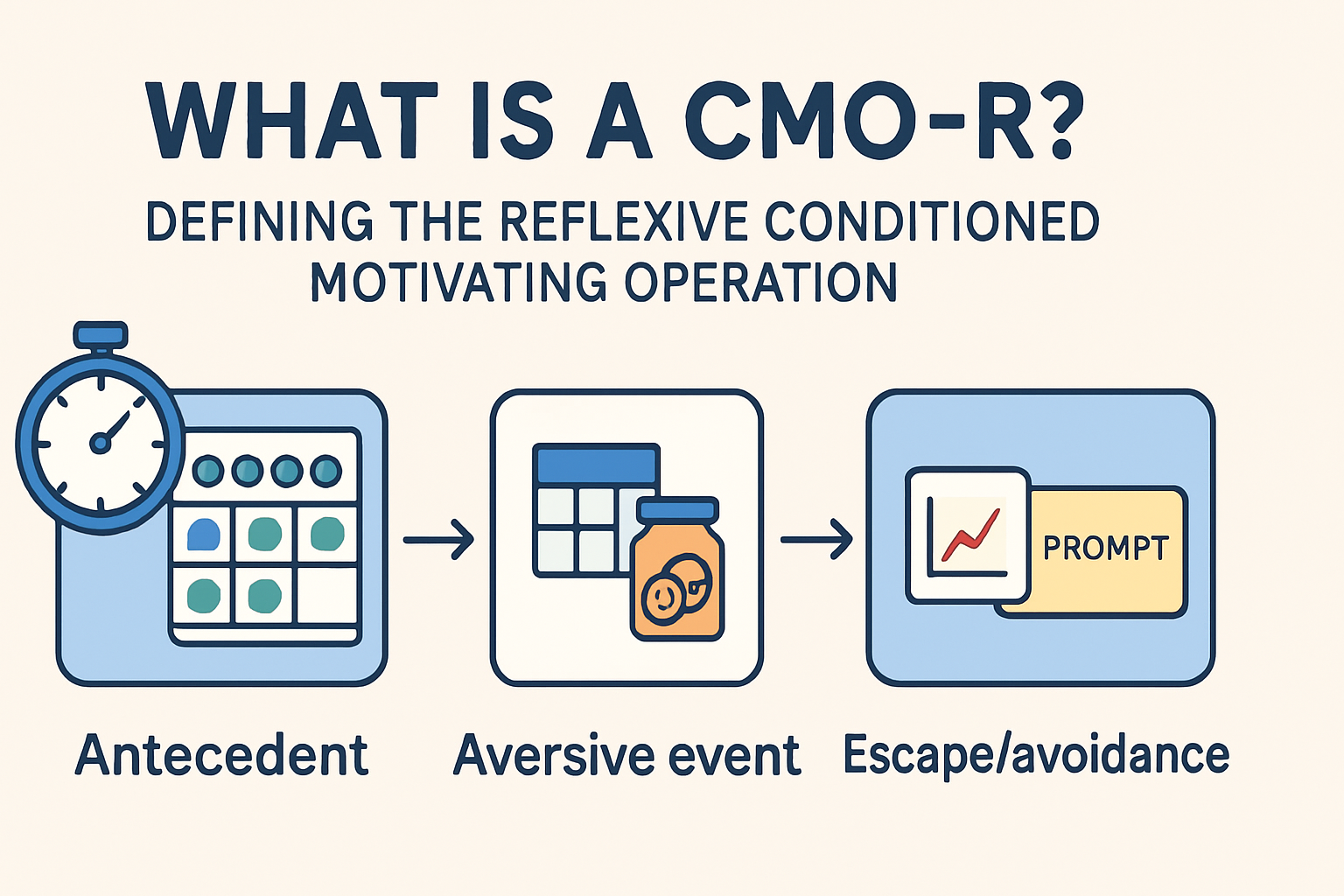
A CMO-R is a conditioned stimulus that acquires its motivating properties through pairing with an aversive event. Its onset establishes its own removal as a reinforcer, evoking escape behavior. The offset of a CMO-R abolishes the reinforcement value of escape, making it a temporary motivator.
The Core Mechanism: Aversive Stimulation and Escape
The conditioned motivating operation functions through a specific learning history. When a neutral stimulus repeatedly precedes an aversive event, it becomes a warning signal. This warning signal then evokes behaviors that have previously escaped or avoided the aversive event. The process involves two key effects: value-altering and behavior-altering.
The value-altering effect makes escape from the CMO-R reinforcing. The behavior-altering effect evokes escape behaviors that have been successful in the past. Both effects are temporary and depend on the presence of the conditioned stimulus.
CMO-R vs. Other Motivating Operations: A Critical Distinction
Understanding how CMO-R differs from other motivating operations is essential for accurate identification. Each type has distinct characteristics and functions in behavior analysis.
- CMO-R (Reflexive): Conditioned stimulus paired with aversive events; evokes escape from itself
- UMO (Unconditioned): Biologically relevant motivators like pain, hunger, or thirst
- CMO-T (Transitive): Related to another stimulus; establishes something else as reinforcing
- CMO-S (Surrogate): Substitutes for a UMO through pairing history
The unique warning signal nature of CMO-R sets it apart from other motivating operations. While UMOs are innate and CMO-Ts establish other reinforcers, CMO-R specifically signals impending aversive stimulation.
CMO-R in Action: Applied Examples for the BCBA Exam
Moving from theory to application, these concrete examples demonstrate how CMO-R appears in clinical and everyday scenarios. Each case includes ABC data and hypothesized function to illustrate the practical application of this concept.
Example 1: The School Bell and Elopement
A student engages in elopement when a specific transition bell rings. The pairing history involves the bell consistently preceding noisy, crowded hallway transitions. The ABC sequence shows the bell as antecedent, elopement as behavior, and escape from the hallway as consequence.
The conditioned stimulus (bell) becomes a CMO-R through repeated pairing with the aversive transition. Its onset establishes escape as reinforcing and evokes the elopement behavior that has successfully avoided crowded hallways in the past.
Example 2: The “Clean Up” Directive and Aggression
A parent’s verbal cue “Time to clean up” has been paired with lengthy, non-preferred task demands. The child responds with aggression when hearing this phrase. The aggression functions to escape the impending cleaning task.
This verbal antecedent becomes a CMO-R through its consistent association with aversive demands. The child’s aggressive behavior is evoked by the warning signal and reinforced by postponing or avoiding the cleaning task.
Example 3: Therapist’s Approach and Self-Injury
In a therapeutic setting, a therapist approaching with a specific data clipboard becomes a CMO-R. The clipboard has been paired with difficult demand sessions. The client engages in self-injurious behavior when seeing the clipboard approach.
The visual stimulus (clipboard) signals the start of aversive work sessions. Its presence establishes escape as reinforcing and evokes SIB that has successfully delayed session starts in the past. This demonstrates how specific environmental cues can acquire motivating properties through conditioning.
CMO-R on the BCBA Exam: Relevance and Common Traps
Understanding how CMO-R is tested on the BCBA exam helps avoid common errors and improves identification accuracy. This concept appears frequently in questions about antecedent variables and motivating operations.
Linking CMO-R to the Task List (Section B-12)
The CMO-R reflexive motivating operation directly relates to BACB Task List item B-12: ‘Define and provide examples of motivating operations.’ This item requires understanding all MO subtypes, including CMO-R as a key conditioned variant. Mastery of this concept demonstrates comprehensive knowledge of antecedent variables that influence behavior.
For additional study on related concepts, review our guide on motivating operations in ABA which covers the broader category of antecedents that alter reinforcement value.
Top 3 Exam Traps When Identifying CMO-R
Many candidates make predictable errors when identifying CMO-R on the BCBA exam. Recognizing these traps improves your chances of selecting the correct answer.
- Confusing CMO-R with Sd: A discriminative stimulus signals reinforcement availability, while a CMO-R signals aversive onset and evokes escape
- Mistaking it for a UMO: CMO-R is learned through conditioning, while UMOs are biologically innate motivators
- Overlooking the conditioning history: Failing to recognize the pairing between the stimulus and aversive event
To avoid confusing CMO-R with discriminative stimuli, study our comparison of SD vs MO differences which clarifies these distinct antecedent functions.
CMO-R Quick-Reference Checklist and Summary
This consolidated reference provides a practical tool for identifying CMO-R and summarizing key takeaways for your study notes.
Your CMO-R Identification Checklist
Use this systematic approach to determine if a stimulus functions as a CMO-R. Answering yes to all questions indicates a reflexive conditioned motivating operation.
- Is it a conditioned stimulus (learned, not innate)?
- Was it paired with an aversive event through conditioning history?
- Does its onset evoke behavior to escape or avoid it?
- Does its offset abolish the reinforcement value of escape?
- Is the evoked behavior specific to removing the stimulus itself?
Key Takeaways for Your Study Notes
These essential points summarize the most critical aspects of CMO-R for BCBA exam preparation and clinical application.
- CMO-R is a learned antecedent that signals impending aversive events
- It evokes escape or avoidance behaviors through its warning function
- The conditioning history involves pairing with aversive stimulation
- It’s a high-yield concept for the BCBA exam, particularly in Task List B-12
- Common exam traps include confusion with Sd and overlooking conditioning history
For comprehensive exam preparation, explore our BCBA exam prep guide which covers all essential content areas. Additionally, the BACB Task List provides the official framework for exam content.


