
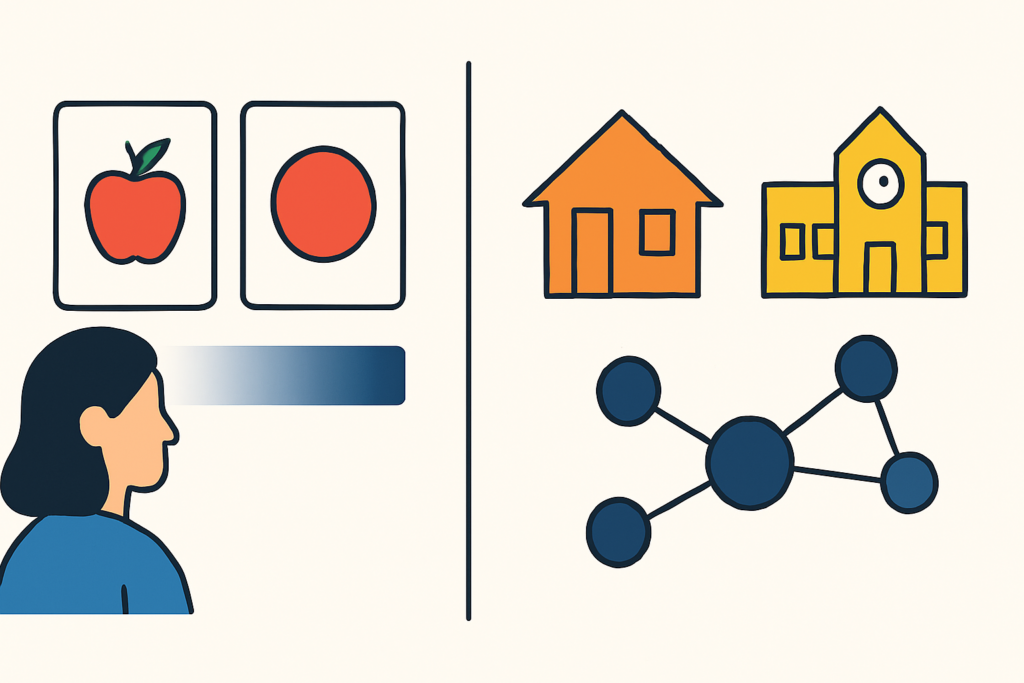
What is Stimulus Discrimination in Behavior Analysis?
In applied behavior analysis, stimulus discrimination refers to the process where a behavior occurs in the presence of specific antecedent stimuli and not in the presence of others. This fundamental concept helps learners respond appropriately to different environmental cues.
Table of Contents
- What is Stimulus Discrimination in Behavior Analysis?
- Stimulus Discrimination in Practice: Worked Examples
- Stimulus Discrimination on the BCBA® Exam
- Quick-Review Checklist for Stimulus Discrimination
Understanding this process is essential for designing effective interventions and analyzing behavior patterns.
Core Definition and Key Players: SD vs. SΔ
The discriminative stimulus (SD) signals that reinforcement is available for a particular behavior. In contrast, the S-delta (SΔ) indicates that reinforcement is not available for that same behavior.
Through differential reinforcement, learners develop stimulus control where their behavior comes under the influence of these discriminative stimuli.
- SD (Discriminative Stimulus): Signals reinforcement is available
- SΔ (S-delta): Signals reinforcement is NOT available
- Differential reinforcement: Key process for establishing discrimination
- Stimulus control: The end result of successful discrimination training
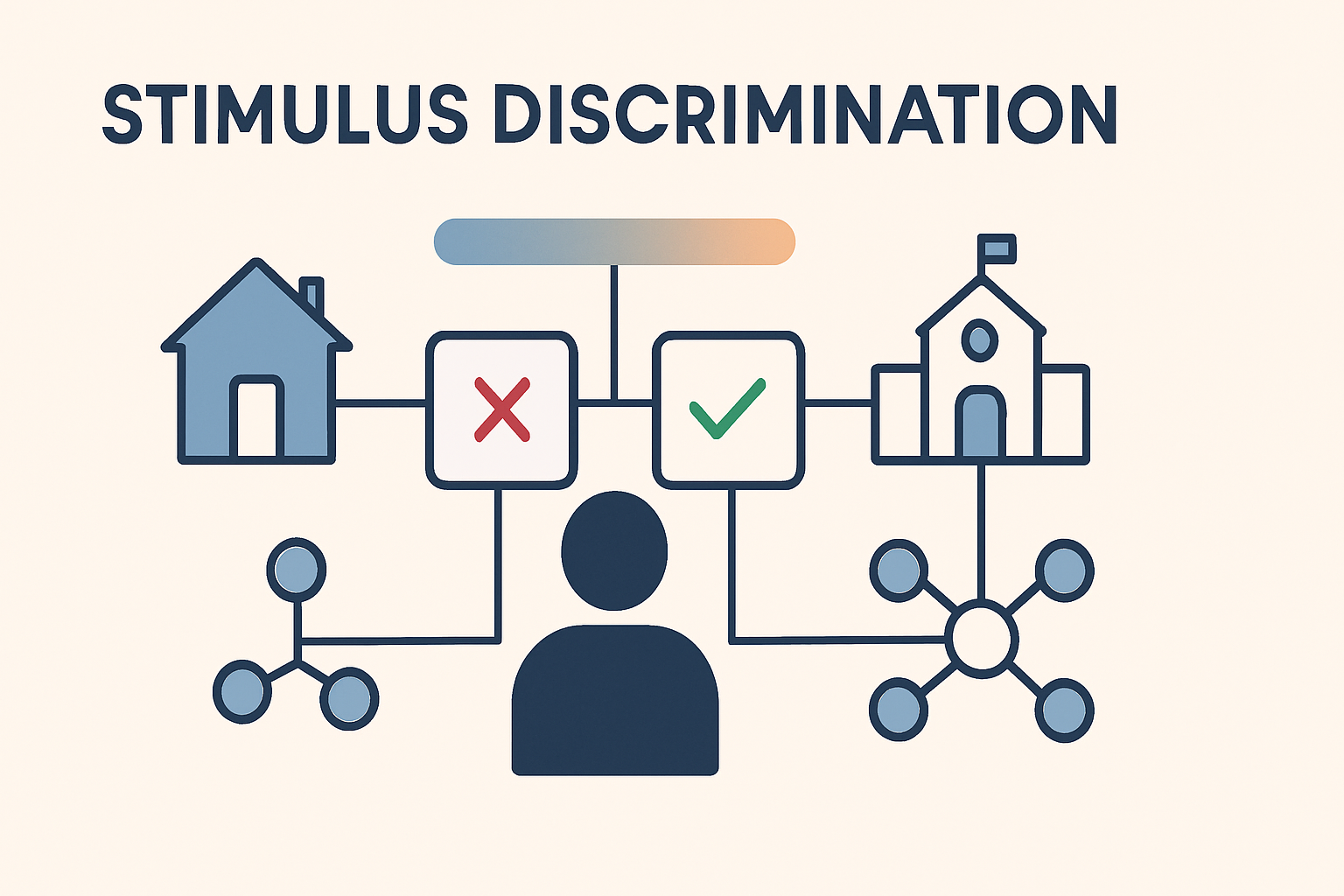
Stimulus Discrimination vs. Generalization: A Critical Contrast
While stimulus discrimination narrows responding to specific cues, stimulus generalization broadens responding across similar stimuli. These complementary processes work together in skill development.
- Discrimination: Responding ONLY to specific SDs
- Generalization: Responding to SIMILAR stimuli
- Training goal: Balance between discrimination and generalization
- Clinical application: Teach discrimination first, then promote generalization
Stimulus Discrimination in Practice: Worked Examples
Let’s examine three practical scenarios that demonstrate stimulus discrimination in action. Each example includes ABC data and hypothesized function to model exam-style thinking.
Example 1: Manding for a Preferred Item
A child learns to say ‘cookie’ only when the cookie jar is visible (SD) and not when the empty fruit bowl is present (SΔ). This demonstrates mand training with clear discriminative stimuli.
- Antecedent: Cookie jar visible on counter
- Behavior: Child says ‘cookie’
- Consequence: Receives cookie
- Function: Access to tangibles
- Discrimination: Child only mands when cookie jar present
Example 2: Raising a Hand in Class
A student raises their hand when the teacher is looking at the class and paused (SD), but not when the teacher is writing on the board with back turned (SΔ). This shows social discrimination in classroom settings.
- Antecedent: Teacher looking at class, paused speaking
- Behavior: Student raises hand
- Consequence: Teacher calls on student
- Function: Access to adult attention
- Discrimination: Student discriminates teacher’s availability
Example 3: Discriminating Between Work Tasks
A learner sorts blue blocks into a bin only when a blue card is on the table (SD) and ignores the task when a red card is present (SΔ). This demonstrates visual discrimination in structured teaching.
- Antecedent: Blue card on work table
- Behavior: Sorts blue blocks into bin
- Consequence: Praise and token delivery
- Function: Access to social reinforcement
- Discrimination: Learner responds to color cue
Stimulus Discrimination on the BCBA® Exam
Understanding stimulus discrimination is crucial for exam success. This concept appears across multiple domains and requires careful application to scenario-based questions.
Common Exam Traps and How to Avoid Them
Several common mistakes can trip up even well-prepared candidates. Being aware of these exam traps can improve your accuracy.
- Confusing SD with reinforcer: Remember SD signals availability, reinforcer follows behavior
- Misidentifying SΔ as AO: SΔ signals no reinforcement, AO affects value of reinforcement
- Overcomparing discrimination vs generalization: Focus on what the question asks specifically
- Ignoring context cues: Always consider the full antecedent condition
- Forgetting differential reinforcement: Discrimination requires differential consequences
Practice Applying the Concept
Test your understanding with these exam-style scenarios. Consider what constitutes the SD, SΔ, and whether discrimination training is occurring.
Scenario 1: During discrete trial training, a therapist presents a picture of a dog and says ‘What is this?’ When the child says ‘dog,’ they receive praise. When the therapist presents a picture of a cat and asks the same question, no praise is given for saying ‘dog.’ What is the SD in this scenario?
Scenario 2: A student completes math worksheets when the green light is on but engages in off-task behavior when the red light is on. The teacher only provides breaks after completed worksheets during green light periods. Is this an example of stimulus discrimination or stimulus generalization?
Quick-Review Checklist for Stimulus Discrimination
Use this checklist to assess your understanding and identify areas for further study before your exam.
- Define SD and SΔ accurately in your own words
- Identify examples of discrimination in everyday scenarios
- Differentiate discrimination from generalization clearly
- Recognize differential reinforcement as the mechanism
- Apply ABC analysis to discrimination scenarios
- Avoid common traps like confusing SD with reinforcer
- Practice with scenarios from mock exams and study guides
- Connect to related concepts like stimulus control and differential reinforcement
For further study on related concepts, explore the BACB Task List and research on stimulus control procedures. Remember that mastering stimulus discrimination requires both conceptual understanding and practical application across diverse scenarios.


