
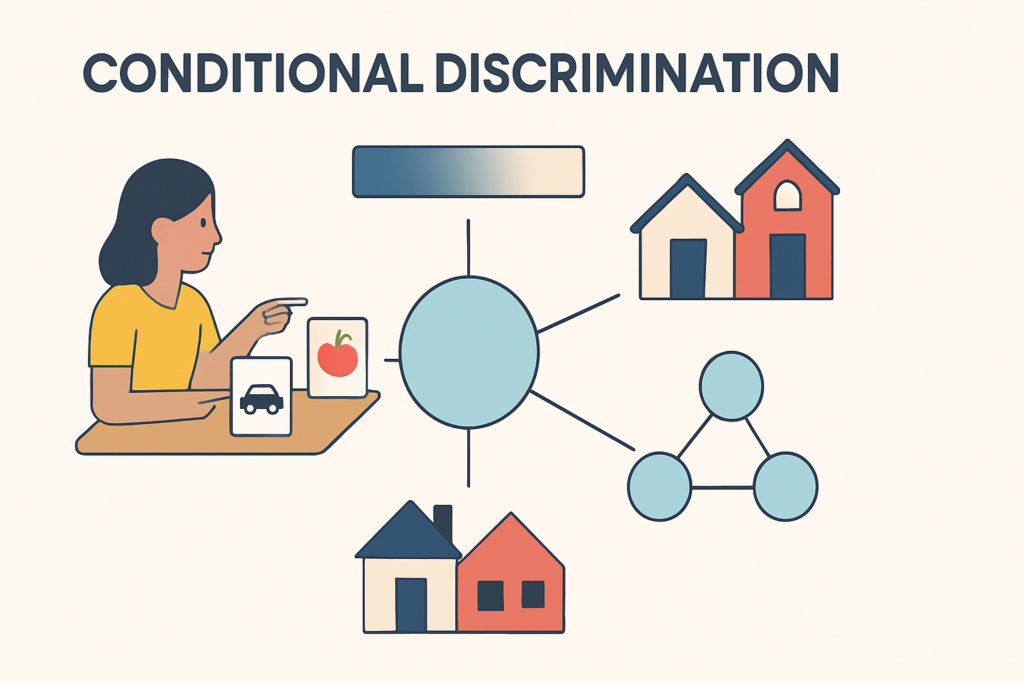
Understanding conditional discrimination is essential for behavior analysts working with complex learning skills. This concept represents a four-term contingency where the function of one stimulus depends on the presence of another. Mastering conditional discrimination ABA principles helps you design effective interventions and prepares you for exam questions that test your analytical skills.
Table of Contents
- Conditional Discrimination ABA: What is Conditional Discrimination in ABA?
- Conditional Discrimination in Action: Worked ABA Examples
- Conditional Discrimination on the BCBA Exam: Relevance and Traps
- Quick-Reference Checklist and Summary
conditional discrimination ABA: What is Conditional Discrimination in ABA?
Conditional discrimination occurs when the function of a discriminative stimulus (Sᴰ) changes based on the presence of another stimulus. Unlike simple discrimination with its three-term contingency (Sᴰ-R-Sᴿ), conditional discrimination involves four terms: the conditional stimulus, the discriminative stimulus, the response, and the consequence.
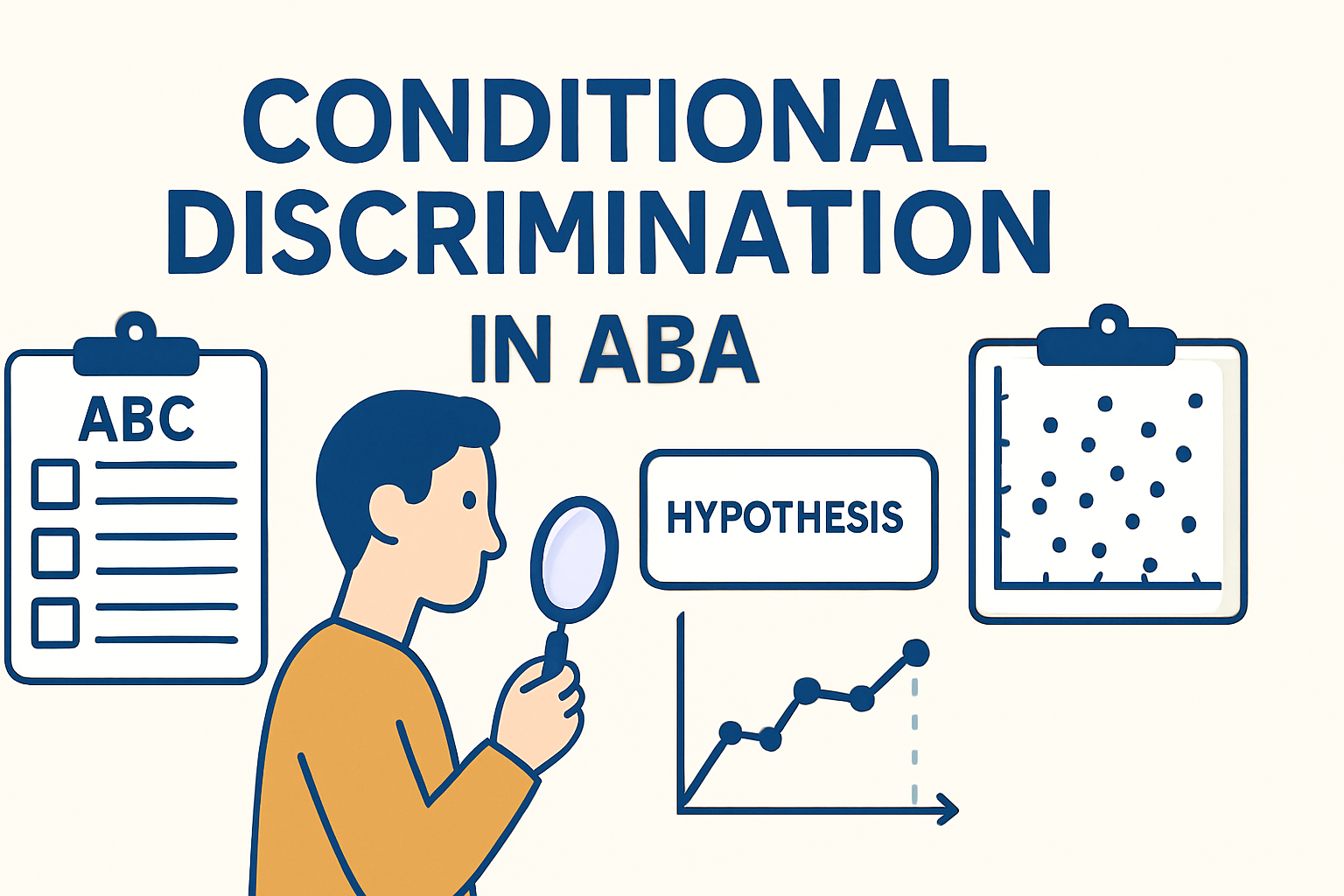
The Core Definition: Context is Key
In conditional discrimination, the effectiveness of an Sᴰ is conditional upon another stimulus. For example, a red light only means ‘stop’ when you’re driving a car. The red light’s function as an Sᴰ depends on the context of being in a vehicle. This represents a four-term contingency: conditional stimulus (driving context) + Sᴰ (red light) → response (braking) → consequence (avoiding collision).
Simple discrimination involves only three terms: Sᴰ (bell) → response (salivating) → consequence (food). The key difference is that in conditional discrimination, the Sᴰ’s function changes based on context, while in simple discrimination, the Sᴰ consistently evokes the same response.
Why It Matters for Complex Skills
Conditional discrimination enables advanced learning capabilities that go beyond basic stimulus-response relationships. It’s fundamental to many skills assessed in ABA therapy and tested on the BCBA exam.
- Receptive identification by feature, function, or class requires discriminating based on verbal instructions
- Social cue interpretation depends on contextual factors like facial expressions and tone
- Following multi-step instructions requires responding differently based on sequence context
- Matching-to-sample tasks where correct responses change based on sample stimuli
This concept directly relates to BCBA Task List item B-10: Define and provide examples of stimulus control. Understanding conditional discrimination helps you analyze how environmental variables influence behavior in complex ways.
Conditional Discrimination in Action: Worked ABA Examples
Let’s examine practical scenarios that demonstrate how conditional discrimination operates in ABA interventions. These examples include ABC data analysis and functional considerations you might encounter in clinical practice.
Example 1: Receptive Identification with Multiple Comparisons
A therapist presents a cup and spoon while saying, ‘Find the one you drink from.’ The learner must touch the cup. The conditional stimulus is the verbal instruction combined with the array. The cup only functions as the correct Sᴰ when paired with this specific instruction.
- Antecedent: Verbal instruction + array (conditional stimulus)
- Behavior: Touching the cup (correct discrimination)
- Consequence: Praise or token reinforcement
- Function: Access to social reinforcement or tangible rewards
If the therapist said ‘Find the one you eat with,’ the spoon would become the correct Sᴰ. This demonstrates how the verbal cue alters stimulus function within the same physical array.
Example 2: Discriminating Between ‘Show Me’ and ‘Give Me’
A learner must respond differently to the same object based on the directive. When told ‘Show me the ball,’ they point. When told ‘Give me the ball,’ they hand it over. The specific instruction serves as the conditional stimulus that determines the appropriate response to the ball.
- Conditional stimulus: ‘Show me’ vs. ‘Give me’ instruction
- Sᴰ: The ball (same physical object)
- Response: Pointing vs. handing (different behaviors)
- Potential function: Access to praise or avoidance of error correction
This example shows how verbal operants can establish conditional discrimination. The same physical stimulus requires different responses based on the instructional context.
Example 3: Matching-to-Sample with a Conditional Cue
In a matching task, the learner sees a red square sample. They must select the red comparison from choices including red circle, blue square, and blue circle. The sample stimulus serves as the conditional cue that determines which feature (color) is relevant for matching.
- Conditional stimulus: Red square sample
- Correct Sᴰ: Red circle (matching color, not shape)
- Incorrect options: Blue square (wrong color), blue circle (wrong both)
- Teaching procedure: Conditional discrimination training
This represents a classic conditional discrimination paradigm where the correct comparison changes based on the sample. It’s fundamental to many stimulus equivalence programs and complex learning tasks.
Conditional Discrimination on the BCBA Exam: Relevance and Traps
The BCBA exam frequently tests your ability to identify and analyze conditional discrimination scenarios. Understanding common question formats and pitfalls can significantly improve your exam performance.
How the Exam Tests This Concept
Exam questions typically present vignettes requiring you to identify whether a scenario demonstrates conditional or simple discrimination. You’ll need to analyze four-term contingencies and select appropriate teaching procedures.
- Vignette analysis: Identify conditional discrimination in clinical scenarios
- Procedure selection: Choose between conditional vs. simple discrimination training
- Stimulus control analysis: Determine which stimuli serve conditional functions
- Error pattern identification: Analyze why discrimination failures occur
These questions test your applied analytical skills beyond mere definition recall. You must demonstrate practical understanding of how conditional discrimination operates in real interventions.
Common Exam Traps and How to Avoid Them
Several predictable traps can confuse candidates on conditional discrimination questions. Recognizing these patterns helps you avoid costly mistakes.
- Confusing with stimulus generalization: Generalization involves responding similarly to different stimuli, while conditional discrimination requires different responses based on context
- Misidentifying the conditional stimulus: Carefully analyze which stimulus alters the Sᴰ’s function
- Over-applying to simple choice-making: Not all choice tasks involve conditional discrimination
- Ignoring the four-term requirement: Remember that conditional discrimination requires four terms, not three
When analyzing exam questions, ask yourself: ‘Does the Sᴰ’s function depend on another stimulus?’ If yes, you’re likely dealing with conditional discrimination. For more on related concepts, see our guide on stimulus equivalence.
Quick-Reference Checklist and Summary
Use this practical checklist to quickly analyze whether a scenario involves conditional discrimination. These questions align with how the BCBA exam presents discrimination analysis tasks.
Your Conditional Discrimination Checklist
- Four-term contingency? Check for conditional stimulus + Sᴰ + response + consequence
- Context-dependent Sᴰ function? Does the Sᴰ’s meaning change based on another stimulus?
- Required for skill? Is conditional discrimination necessary for the target behavior?
- Common procedures involved? Matching-to-sample, receptive ID by feature/function/class
- Multiple correct responses? Different responses to same Sᴰ based on context
- Teaching implications? Requires conditional discrimination training procedures
Key Takeaways for Your Study Notes
Conditional discrimination represents contextual control over behavior, where stimulus function depends on additional conditions. It’s essential for advanced learning skills and frequently tested through application questions on the BCBA exam.
- Master the four-term contingency structure: conditional stimulus → Sᴰ → response → consequence
- Recognize common applications: matching-to-sample, feature/function/class identification, social cue interpretation
- Differentiate from simple discrimination (three-term) and stimulus generalization
- Apply to exam vignettes by identifying contextual variables that alter stimulus function
- Consider teaching implications: Conditional discrimination requires specific training procedures
For additional exam preparation resources, explore our BCBA exam prep guide and BACB Task List study map. The official BACB Task List provides additional details on stimulus control concepts tested on the exam.


