

Graduated Guidance ABA: What is Graduated Guidance in ABA?
Graduated guidance is a response-prompting procedure where physical guidance is systematically faded within a single teaching trial. This technique emphasizes errorless learning by providing immediate support that gradually reduces as the learner demonstrates competence.
Table of Contents
- Graduated Guidance ABA: What is Graduated Guidance in ABA?
- Applying Graduated Guidance: Worked Examples
- Graduated Guidance on the BCBA Exam
- Implementation Checklist and Ethical Considerations
- References
The procedure typically involves moving through distinct levels of assistance: full physical guidance, partial guidance, shadowing, and finally independence. It’s particularly effective for teaching chained tasks where multiple steps must be completed in sequence.

Core Definition and Key Characteristics
Graduated guidance operates on the principle of within-trial fading, meaning the prompt intensity changes during the same instructional opportunity. The practitioner starts with the most intrusive level needed for success, then immediately reduces support based on the learner’s performance.
Key characteristics include using primarily physical prompts, maintaining hand positioning close to the learner (shadowing), and aiming for immediate correct responses. This approach minimizes errors and builds confidence through supported practice.
Graduated Guidance vs. Other Prompting Hierarchies
Unlike most-to-least prompting which changes prompt types across trials, graduated guidance adjusts the intensity of a single prompt type within a trial. Most-to-least might progress from physical to gestural prompts over multiple sessions, while graduated guidance fades physical support within one attempt.
Similarly, least-to-most prompting increases prompt intensity within a trial when errors occur, while graduated guidance starts with maximum support and systematically reduces it. The distinction lies in the direction of change and the timing of adjustments.
Applying Graduated Guidance: Worked Examples
Understanding graduated guidance requires seeing it in action. These examples demonstrate how the procedure unfolds in real teaching scenarios, complete with ABC data and hypothesized behavioral functions.
Example 1: Teaching Hand Washing (Adaptive Skills)
Consider teaching the step “applying soap” within a hand-washing chain. The antecedent is the instruction “Scrub your hands.” The behavior shows the client initiating movement toward the soap but stopping midway.
The graduated guidance sequence unfolds as follows: full physical guidance (hand-over-hand to pump soap), partial guidance (light touch at wrist), shadowing (hand near without contact), then independence. The initial stopping behavior likely functions as escape from task demands due to skill deficits.
Example 2: Assembling a Puzzle (Pre-Academic Skills)
For matching puzzle pieces, the discriminative stimulus is “Find its home.” The client picks up a piece and looks at the board but doesn’t attempt placement. This looking behavior may be automatically reinforced by visual stimulation.
The guidance progression includes hand-over-hand to the correct spot, light touch on elbow, pointing gesture toward the target location, then independent placement. Each reduction in support occurs as the client demonstrates increased accuracy in piece orientation.
Graduated Guidance on the BCBA Exam
Exam questions about graduated guidance test your ability to distinguish it from similar procedures and apply it appropriately in clinical scenarios. Understanding its unique characteristics is essential for BCBA exam success.
Linking to the BACB Task List
Graduated guidance connects directly to Section G-4: ‘Use positive and negative reinforcement procedures to strengthen behavior.’ The fading of prompts serves as negative reinforcement—removing assistance strengthens independent correct responding. This procedural element demonstrates how prompt removal can function as reinforcement when paired with skill acquisition.
For more on reinforcement procedures, see our guide on positive reinforcement in ABA.
Common Exam Traps and How to Avoid Them
Several patterns consistently appear in exam questions about graduated guidance. Recognizing these traps can prevent costly errors.
- Confusing with most-to-least prompting: Remember that graduated guidance changes intensity within a trial, while most-to-least changes prompt types across trials.
- Missing the physical guidance focus: The procedure primarily uses physical prompts that are faded, not switched to different prompt modalities.
- Overlooking within-trial fading: The key distinction is that adjustments happen during the same instructional opportunity, not across multiple attempts.
- Misidentifying shadowing: Shadowing involves maintaining proximity without contact, not simply reducing verbal cues.
Implementation Checklist and Ethical Considerations
Proper implementation of graduated guidance requires careful planning and attention to ethical principles. This checklist ensures you address all critical components while maintaining client dignity and respect.
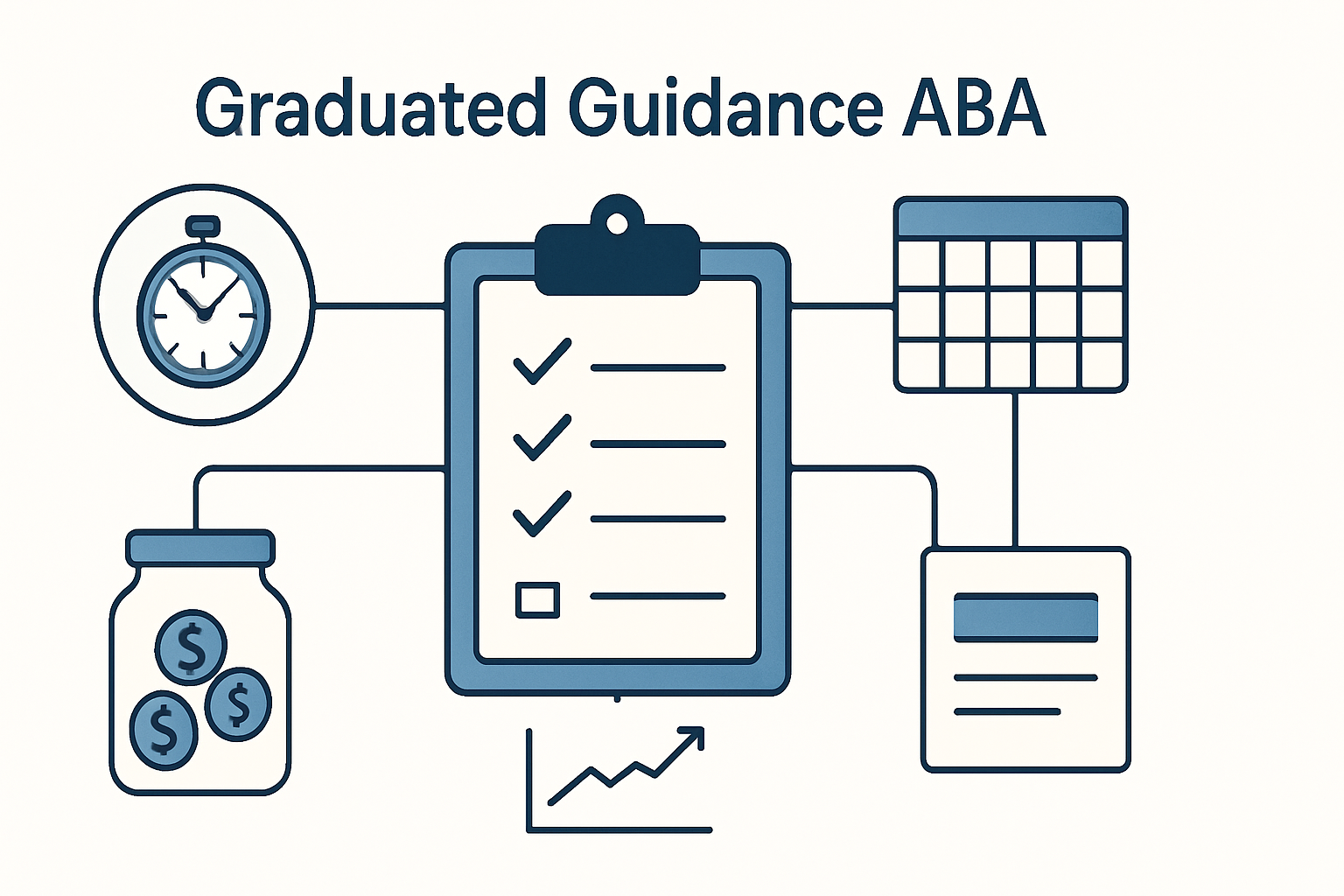
Your Graduated Guidance Implementation Checklist
- Complete task analysis of the target skill with clearly defined steps
- Establish baseline performance for each step to identify starting points
- Plan fading steps from full physical to partial to shadowing to independence
- Prepare data collection system to track prompt levels and independence
- Develop assent procedures for initiating and withdrawing physical guidance
- Schedule regular progress reviews to adjust fading pace as needed
Upholding Dignity and Assent During Physical Guidance
Physical guidance requires special ethical consideration. Always use the least intrusive prompt necessary for success and monitor continuously for signs of discomfort or withdrawal of assent. The BACB Ethics Code emphasizes respecting client autonomy and avoiding harmful procedures.
Strategies include providing clear explanations before physical contact, teaching alternative communication methods for indicating discomfort, and regularly checking in during guidance. For more on ethical implementation, explore our ethics in ABA practice guide.
Remember that graduated guidance should always prioritize the learner’s comfort and willingness to participate. When implemented thoughtfully, it becomes a powerful tool for building independence while maintaining respectful, compassionate care. For additional study resources, consider our BCBA mock exam preparation materials.


