

The Matching Law describes how organisms allocate their behavior between available alternatives based on the relative rates of reinforcement. This fundamental principle of behavioral choice is essential for BCBA candidates to understand, as it explains why individuals might engage in both appropriate and challenging behaviors when multiple options are available.
Table of Contents
- What is the Matching Law? Herrnstein’s Formula Explained
- The Matching Law in Applied Practice: ABA Examples
- Matching Law on the BCBA Exam: What to Expect
- Quick-Reference Checklist and Summary
What is the Matching Law? Herrnstein’s Formula Explained
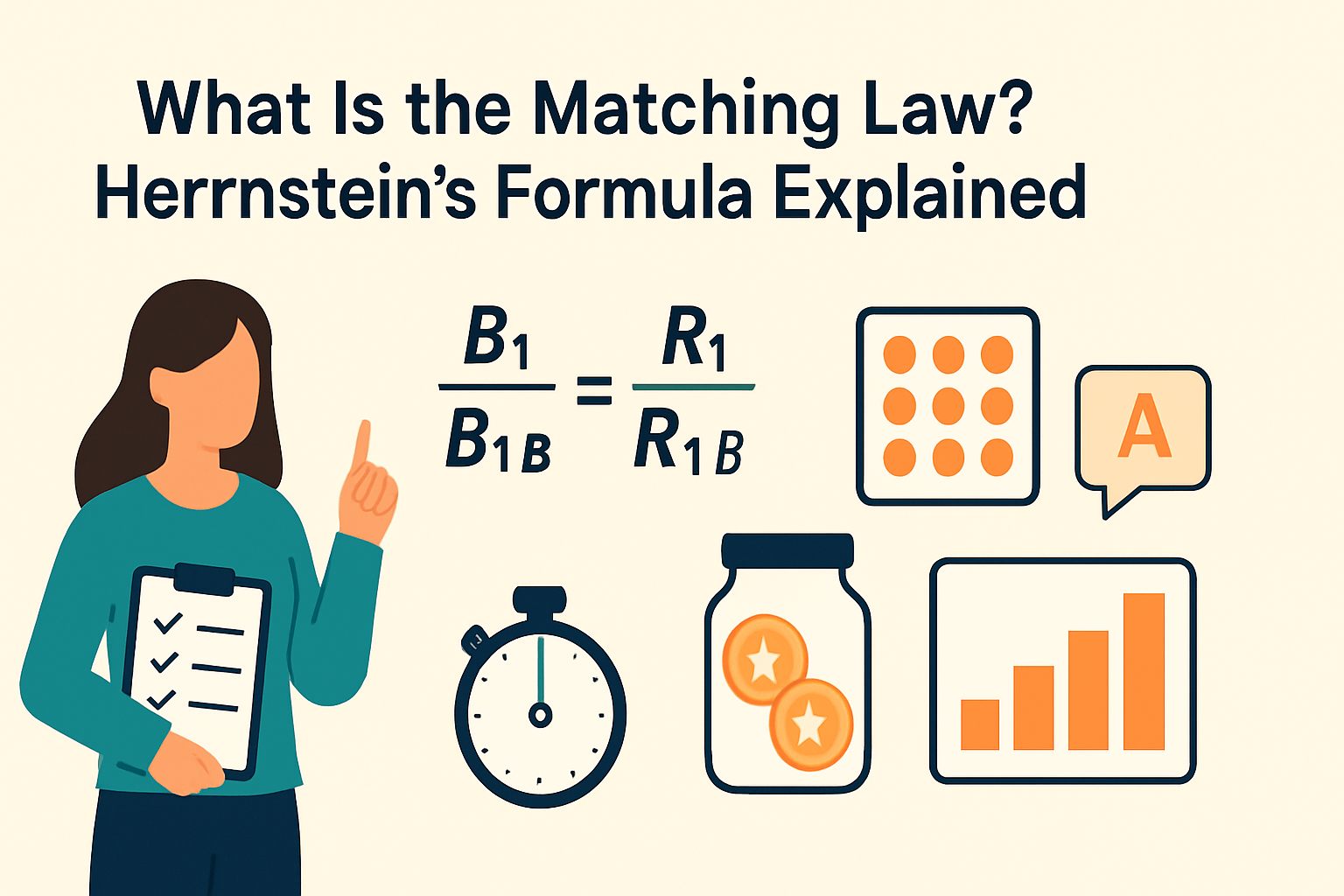
Developed by Richard Herrnstein, the Matching Law provides a mathematical framework for predicting behavioral allocation. The core principle states that the proportion of responses allocated to one alternative matches the proportion of reinforcement obtained from that alternative.
From Behavioral Choice to a Mathematical Equation
The basic matching equation is expressed as: B1/B2 = R1/R2. In this formula, B1 and B2 represent response rates for two behaviors, while R1 and R2 represent reinforcement rates for those behaviors. This relationship occurs under concurrent schedules of reinforcement, where two or more reinforcement schedules are simultaneously available.
The generalized matching equation includes additional parameters: log(B1/B2) = a log(R1/R2) + log b. Here, a represents sensitivity to reinforcement differences, and log b represents bias toward one alternative. Understanding these parameters helps explain deviations from perfect matching.
Matching vs. Maximizing: A Critical Distinction
A common misconception is that organisms always maximize their overall reinforcement rate. However, the Matching Law describes what organisms actually do, not what would be optimal. Several factors prevent perfect maximizing:
- Switching costs: Changing between alternatives requires time and effort
- Imperfect discrimination: Organisms may not perfectly track reinforcement ratios
- Response biases: Innate preferences for certain types of responses
- Reinforcement delay: Immediate but smaller reinforcers may be preferred
The Matching Law in Applied Practice: ABA Examples
In applied settings, the Matching Law helps explain why challenging behaviors persist even when appropriate alternatives are available. By analyzing reinforcement ratios, behavior analysts can design more effective interventions.
Example 1: Classroom Engagement vs. Disruption
Consider a student who can either complete worksheets (appropriate behavior) or call out during instruction (disruptive behavior). If the teacher provides attention for both behaviors but at different rates, the student’s behavior allocation will match these reinforcement ratios.
ABC data might show: Worksheet completion receives teacher praise on a VR-5 schedule, while calling out receives attention on a VR-2 schedule. According to the Matching Law, the student will allocate approximately 2.5 times more responses to calling out than worksheet completion. This pattern suggests the function is access to adult attention.
Example 2: Manding for Two Different Items
A client can mand for either toys or snacks during a session. Both mands are reinforced, but the reinforcement schedules differ. Toys are delivered on a VR-3 schedule, while snacks are delivered on a VR-6 schedule.
According to the matching equation, the client should mand for toys twice as often as for snacks. If data show different allocation patterns, this might indicate response bias or undermatching. Understanding this relationship helps clinicians design balanced reinforcement systems that promote varied communication.
Example 3: Undermatching and Overmatching
Deviations from perfect matching provide valuable diagnostic information. Undermatching occurs when behavior allocation is less extreme than reinforcement ratios would predict, often due to poor discrimination or frequent switching. Overmatching occurs when allocation is more extreme than predicted, often indicating strong bias or preference.
On the BCBA exam, you might encounter graphs showing these deviations. Recognizing them helps identify whether interventions should focus on improving discrimination, adjusting reinforcement schedules, or addressing response biases.

Matching Law on the BCBA Exam: What to Expect
The Matching Law appears in multiple exam domains, particularly those related to behavioral principles and intervention design. Understanding this concept helps with both direct questions and applied scenarios.
Common Exam Traps and How to Avoid Them
Several common mistakes can trip up even well-prepared candidates. Watch for these traps:
- Confusing matching with reinforcement schedules alone: Remember that matching requires concurrent operants, not just any schedule
- Forgetting the quantitative relationship: The Matching Law is mathematical, not just descriptive
- Misidentifying the reinforcer: Ensure you correctly identify what maintains each behavior
- Over-applying to all choice behavior: Matching applies specifically to concurrent schedules, not all choice situations
- Ignoring bias and sensitivity parameters: The generalized equation includes these important factors
Practice Applying the Concept
Try these exam-style scenarios to test your understanding:
Scenario 1: A client engages in hand-flapping (B1) and appropriate toy play (B2). Hand-flapping produces automatic reinforcement approximately every 30 seconds, while toy play produces social praise on a VR-10 schedule. According to the Matching Law, what behavioral allocation would you predict?
Scenario 2: Data show a student spends 75% of time on-task and 25% off-task. Reinforcement records show the teacher provides attention for on-task behavior on a VI-2 schedule and for off-task behavior on a VI-6 schedule. Is this matching, undermatching, or overmatching?
These scenarios test your ability to apply the matching equation and interpret real-world data. For more practice with behavioral principles, explore our guide on radical behaviorism core concepts.
Quick-Reference Checklist and Summary
Use this checklist to ensure you’ve mastered the Matching Law for your exam:
- Memorize the basic equation: B1/B2 = R1/R2
- Understand concurrent schedules: Two or more reinforcement schedules available simultaneously
- Recognize applied examples: Classroom behaviors, communication, self-stimulation
- Identify deviations: Undermatching, overmatching, and bias
- Apply to intervention design: Adjust reinforcement ratios to change behavior allocation
- Avoid common traps: Don’t confuse with single schedules or optimal maximizing
The Matching Law provides a powerful framework for understanding behavioral choice in applied settings. By mastering both the mathematical relationship and its practical applications, you’ll be better prepared for exam questions and real-world clinical decisions. For additional study resources on related topics, check our guide to compound schedules of reinforcement for precise definitions.
Remember that the Matching Law isn’t just theoretical—it directly informs how we design interventions, allocate reinforcement, and understand why challenging behaviors persist. When you encounter choice scenarios on the exam or in practice, consider the relative reinforcement rates driving behavior allocation.



