
Understanding the SD meaning in ABA is fundamental for both effective practice and BCBA exam success. A Discriminative Stimulus (SD) represents a critical component of stimulus control that signals when reinforcement is available for specific behaviors. This guide breaks down the precise definition, provides practical examples, and highlights common exam traps to help you master this essential concept.
Table of Contents
- SD meaning ABA: What is an SD? The Core Definition and Mechanism
- SD in Practice: Worked Examples from Simple to Complex
- SDs on the BCBA Exam: Relevance and Common Traps
- Quick-Reference Checklist and Summary
SD meaning ABA: What is an SD? The Core Definition and Mechanism
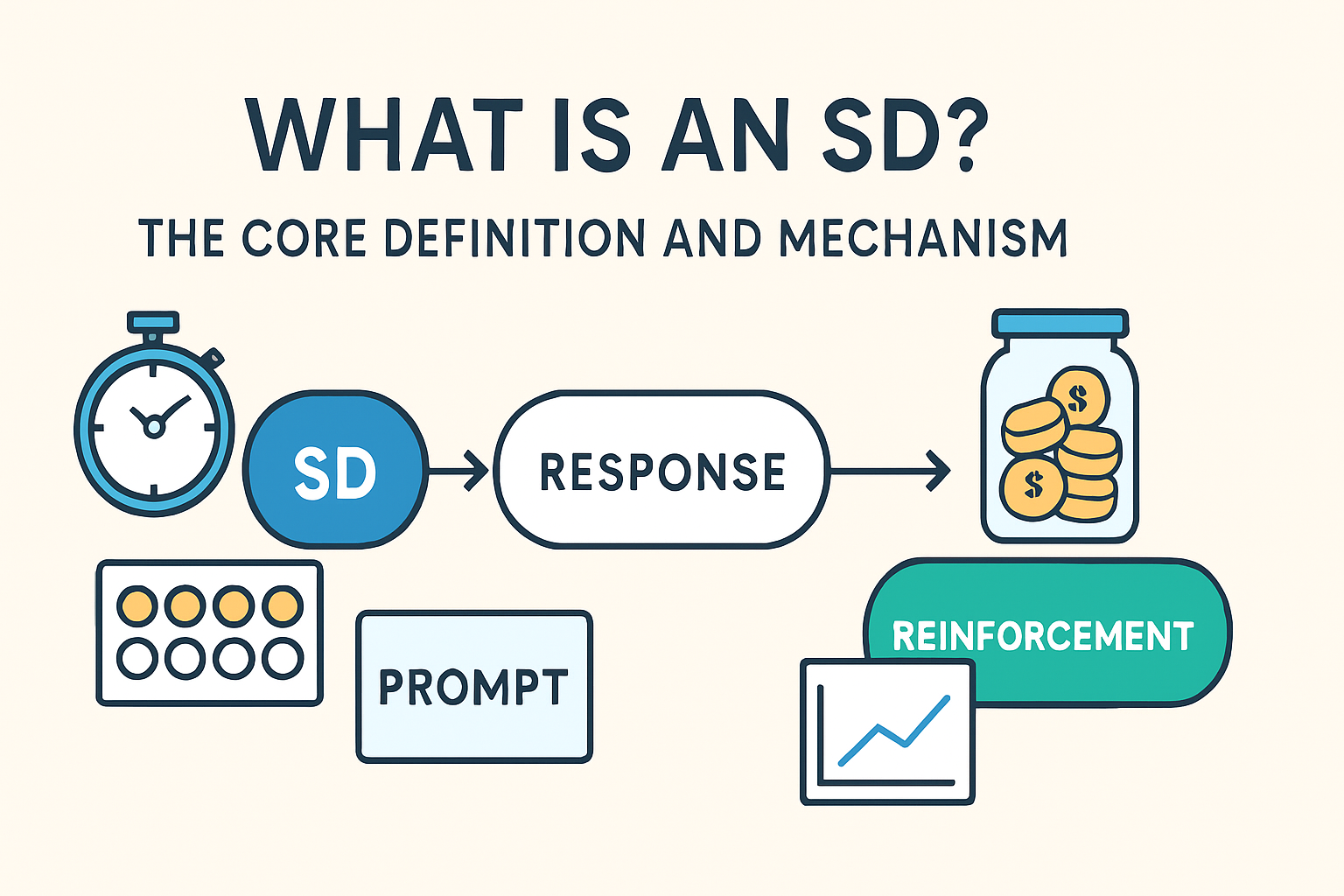
At its core, an SD is an antecedent stimulus that signals the availability of reinforcement for a particular behavior. The textbook definition states: ‘A stimulus in the presence of which a given behavior has been reinforced and in the absence of which that behavior has not been reinforced.’ This establishes the foundation for understanding how environmental cues influence behavior.
The Textbook Definition: SD in the Three-Term Contingency
An SD operates within the three-term contingency framework: Antecedent-Behavior-Consequence. The antecedent (SD) sets the occasion, the behavior occurs, and the consequence (reinforcement) follows. This relationship creates stimulus control, where behavior becomes more likely in the presence of specific cues.
For example, when a teacher says ‘Sit down’ (SD), and the student sits (behavior), receiving praise (reinforcement), the verbal instruction becomes an SD for sitting behavior. The key is the history of reinforcement that establishes this relationship.
SD vs. MO: A Critical Distinction for the Exam
One of the most important distinctions is between SDs and Motivating Operations (MOs). While both are antecedents, they serve different functions. An SD signals that reinforcement is available for a specific behavior. In contrast, an MO alters the value of a reinforcer and changes the frequency of behavior that has been reinforced by that stimulus.
For instance, food deprivation (an MO) increases the value of food as a reinforcer, while the sight of a vending machine (an SD) signals that pressing buttons will produce food. Understanding this distinction is crucial for accurate behavior analysis and exam success.
SD in Practice: Worked Examples from Simple to Complex
Let’s examine practical applications of SDs across different scenarios. These examples demonstrate how discriminative stimuli operate in real-world settings and help build your analytical skills.
Example 1: The Classroom Instruction SD
Consider this common classroom scenario: The teacher says, ‘Take out your math book’ (SD). The student opens their backpack and retrieves the math book (behavior). The teacher provides verbal praise, ‘Great job getting ready!’ (positive reinforcement).
In this ABC analysis, the verbal instruction serves as the discriminative stimulus because it signals that the specific behavior of taking out the math book will be reinforced. The student has learned through previous experiences that following this instruction leads to teacher approval.
Example 2: The Environmental Cue SD
Non-verbal stimuli can also function as SDs. A client’s visual schedule shows a picture of ‘snack time’ (SD). The client walks to the snack table (behavior). The caregiver provides a preferred snack (positive reinforcement).
This example demonstrates that visual stimuli can establish stimulus control. The picture on the schedule signals that going to the snack area will be reinforced with food. This is particularly important in applied behavior analysis programs that use visual supports.
Example 3: The Conditional Discriminative Stimulus
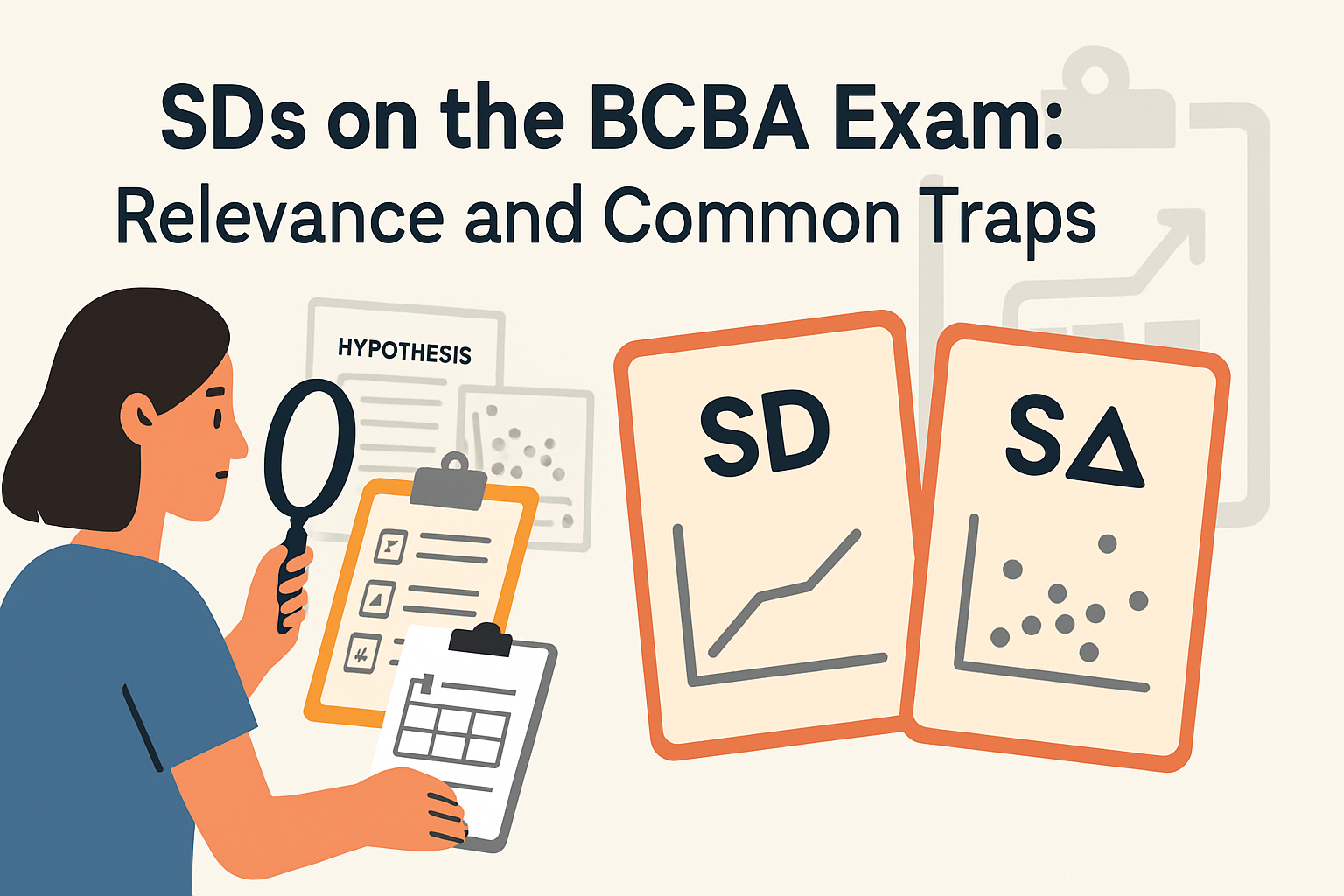
More complex scenarios involve conditional discrimination. A green card on the student’s desk (SD1) signals that raising a hand (behavior) will be reinforced with teacher attention. However, a red card (S-delta) signals that hand-raising will not be reinforced.
This demonstrates stimulus discrimination training, where behavior is reinforced in the presence of one stimulus but not another. The student learns to discriminate between conditions, responding appropriately based on the environmental cue. For more on related concepts, see our guide on stimulus equivalence.
SDs on the BCBA Exam: Relevance and Common Traps
Understanding SDs is directly tested on the BCBA exam under specific task list items. Recognizing how questions assess this knowledge helps you prepare effectively and avoid common mistakes.
Linking to the Task List: Stimulus Control (B-10)
SD concepts fall under Task List Section B-10: Define and provide examples of stimulus control. Related items include B-11 (Define and provide examples of discrimination and generalization) and B-12 (Use stimulus equivalence procedures). These sections require you to identify, analyze, and apply stimulus control principles.
Exam questions often present scenarios where you must distinguish between different types of antecedents or analyze how stimulus control has been established. For comprehensive exam preparation, review our Task List study guide.
Top 3 Exam Traps When Identifying an SD
Avoid these common errors that trip up many candidates:
- Confusing SDs with prompts: Prompts are supplemental stimuli that help evoke correct responses during teaching, while SDs signal natural reinforcement availability.
- Misidentifying MOs as SDs: Remember that MOs alter reinforcer value, while SDs signal reinforcement availability for specific behaviors.
- Overlooking reinforcement history: An SD requires that the behavior has been reinforced in its presence and not reinforced in its absence.
Quick-Reference Checklist and Summary
Use this practical checklist to quickly identify SDs in practice scenarios and exam questions. These questions help you systematically analyze whether a stimulus functions as a discriminative stimulus.
Your SD Identification Checklist
- Is the stimulus an antecedent to the behavior?
- Does it signal that reinforcement is currently available for a specific behavior?
- Does that behavior have a reinforcement history in the presence of this stimulus?
- Is the stimulus distinct from an MO (which changes value rather than availability)?
- Would the behavior be less likely if this stimulus were absent?
Key Takeaways for Your Study Notes
SDs are antecedent stimuli that signal ‘reinforcement is available here and now.’ They are defined by a history of differential reinforcement where behavior is reinforced in their presence but not in their absence. Mastering the SD vs. MO distinction is essential for both clinical practice and exam success.
Remember that SDs establish stimulus control, making behaviors more likely under specific conditions. For additional study on related concepts, explore our resource on SD vs. MO differences. The BACB’s official Task List provides the authoritative framework for all exam content.
By understanding the precise SD meaning in ABA, analyzing practical examples, and recognizing common exam traps, you’ll build a solid foundation for both clinical competency and examination success. This knowledge forms the basis for effective intervention planning and accurate behavior analysis.



