

Understanding stimulus equivalence is essential for behavior analysts working with language development and symbolic behavior. This stimulus equivalence ABA concept explains how individuals form relationships between stimuli without direct training. Mastery of this topic helps clinicians design more effective teaching programs and prepares candidates for related questions on the BCBA certification assessment.
Table of Contents
- stimulus equivalence ABA: What Is Stimulus Equivalence?
- Practical ABA Examples of Stimulus Equivalence
- BCBA Exam Relevance
- Common Exam Traps and Mistakes
- Quick Reference Checklist
- Theoretical Foundations and Research
- Clinical Applications and Considerations
- Final Summary and Key Takeaways
stimulus equivalence ABA: What Is Stimulus Equivalence?
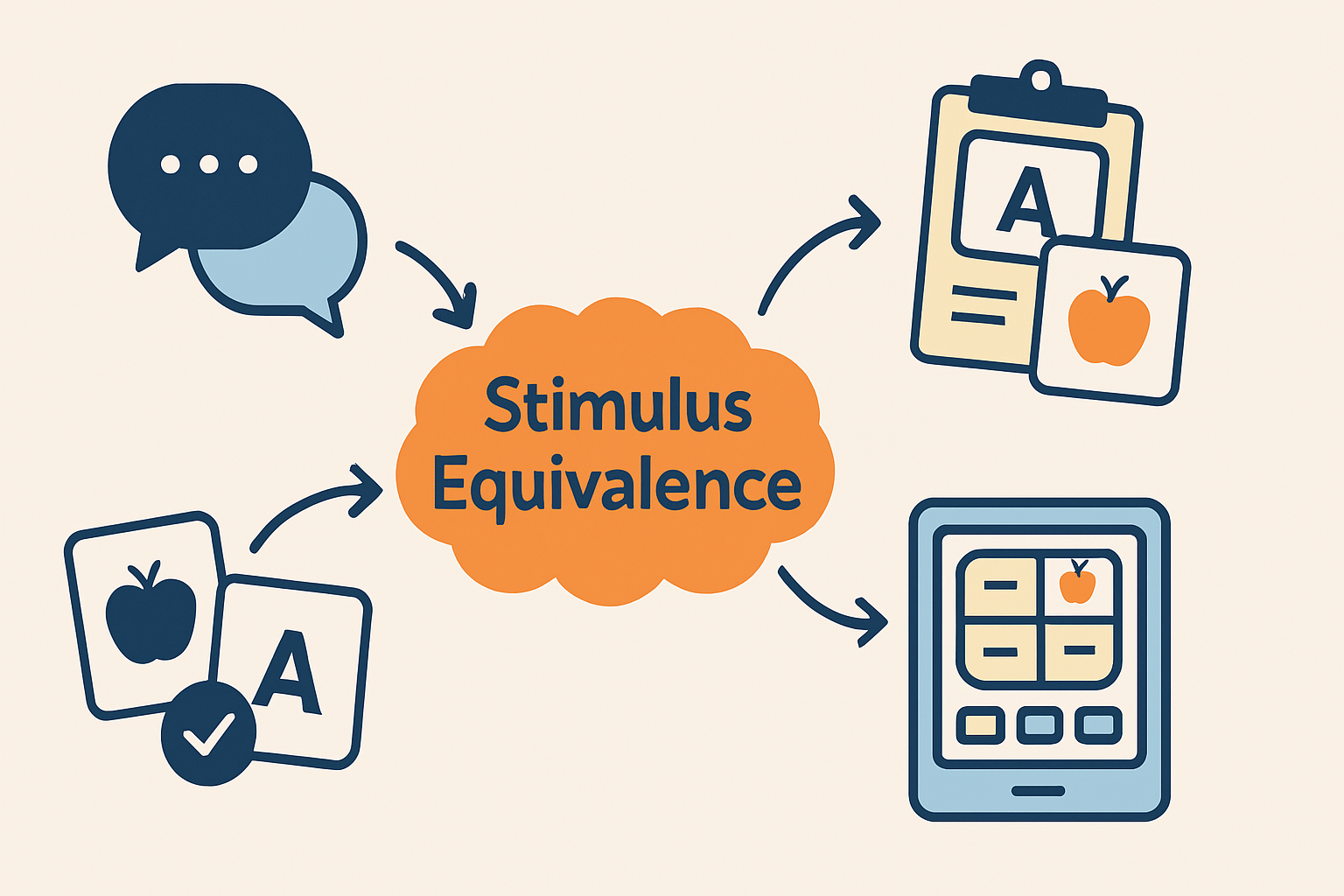
Stimulus equivalence refers to the emergence of untrained relationships between stimuli after teaching a limited set of conditional discriminations. This phenomenon demonstrates that derived relational responding occurs when individuals respond to stimuli as equivalent without explicit instruction.
The concept rests on three defining properties that must all be demonstrated:
- Reflexivity: A stimulus matches itself (A=A)
- Symmetry: If A=B, then B=A
- Transitivity: If A=B and B=C, then A=C
Practical ABA Examples of Stimulus Equivalence
Real-world applications help clarify this abstract concept. Here are three common scenarios where stimulus equivalence appears in practice.
Example 1: Teaching Money Relationships
When teaching coin values, you might directly train that a picture of a quarter equals the written word “quarter.” If the learner then demonstrates that the written word “quarter” equals the picture without additional training, symmetry has emerged. When they also match the picture to the spoken word “quarter,” you’ve observed transitivity.
Example 2: Language Development
Consider teaching a child with autism to match a picture of a dog to the spoken word “dog.” If they later point to the picture when hearing “dog” and say “dog” when shown the picture, multiple equivalence relations have formed. This demonstrates how stimulus equivalence supports expressive and receptive language development.
Example 3: Safety Skills Training
Teaching safety signs involves creating equivalence classes. A red octagon (stimulus A) equals “stop” (stimulus B). The word “stop” (B) equals halting movement (stimulus C). Through derived relations, the red octagon alone should control stopping behavior without direct training between A and C.
BCBA Exam Relevance
Stimulus equivalence questions appear in multiple exam content areas. Understanding this topic helps with several task list items and prepares you for scenario-based questions.
- Questions often test your ability to identify equivalence properties in described scenarios
- You may need to distinguish stimulus equivalence from other conditional discrimination types
- Exam items frequently involve analyzing whether derived relations have emerged
- Understanding this concept supports questions about verbal behavior and language development
For comprehensive exam preparation, review our guide on stimulus equivalence BCBA exam content which covers additional testing strategies.
Common Exam Traps and Mistakes
Many candidates struggle with specific aspects of stimulus equivalence. Recognizing these pitfalls improves your exam performance.
- Confusing symmetry with transitivity: Remember symmetry involves reversing a trained relation (A=B becomes B=A), while transitivity connects across stimuli (A=B and B=C yields A=C)
- Overlooking reflexivity: This basic property (A=A) must be demonstrated for true equivalence
- Mistaking simple discrimination for equivalence: Equivalence requires derived relations, not just trained matching
- Forgetting all three properties are required: True stimulus equivalence demands reflexivity, symmetry, AND transitivity
Quick Reference Checklist
Use this checklist to evaluate whether stimulus equivalence has occurred in any scenario:
- ✓ Check for reflexivity: Does the stimulus match itself?
- ✓ Test for symmetry: If A was trained to B, does B now equal A without training?
- ✓ Verify transitivity: If A=B and B=C, does A=C emerge?
- ✓ Confirm derived relations: Are untrained relationships demonstrated?
- ✓ Ensure all three properties are present for true equivalence
Theoretical Foundations and Research
Stimulus equivalence research originates from relational frame theory (RFT), which extends Skinner’s analysis of verbal behavior. This theoretical perspective explains how arbitrary applicable relational responding underlies much human learning.
Key researchers including Murray Sidman demonstrated that equivalence classes could form through limited training. Their work showed that derived stimulus relations could emerge without direct reinforcement of every relationship. This has profound implications for understanding symbolic behavior and language acquisition.
For more on behavioral theory foundations, see our article on radical behaviorism core concepts.
Clinical Applications and Considerations
Applied behavior analysts use stimulus equivalence principles to enhance teaching efficiency. By strategically teaching some relations, you can promote the emergence of others.
- Design instruction to maximize derived relational responding
- Use equivalence-based instruction for concept formation
- Apply these principles to teach academic concepts and social skills
- Consider individual learning histories when implementing equivalence training
The BACB Ethics Code requires using evidence-based procedures, making understanding of stimulus equivalence research essential for ethical practice.
Final Summary and Key Takeaways
Stimulus equivalence represents a fundamental process in human learning and language development. This phenomenon demonstrates how derived relational responding allows individuals to form connections between stimuli without direct training.
Remember these essential points:
- True equivalence requires demonstration of reflexivity, symmetry, and transitivity
- This concept has practical applications in language teaching, academic instruction, and safety training
- BCBA exam questions often test your ability to identify equivalence properties in scenarios
- Avoid common mistakes like confusing symmetry with transitivity or overlooking reflexivity
- Use the quick checklist to systematically evaluate whether stimulus equivalence has occurred
For additional study resources, explore our BCBA exam preparation guide which includes strategies for mastering complex concepts like stimulus equivalence.


