What is the Matching Law? Core Principle for BCBAs
The Matching Law is a fundamental principle in behavior analysis that describes how organisms allocate their behavior across available options. Developed by Richard Herrnstein in 1961, this principle states that the proportion of responses directed toward an alternative matches the proportion of reinforcement obtained from that alternative. For BCBA candidates, understanding this concept is crucial for analyzing choice behavior and designing effective interventions.
At its core, the Matching Law explains why individuals distribute their responses the way they do in environments with multiple reinforcement sources. This principle has profound implications for understanding concurrent operants and predicting how changes in reinforcement schedules will affect behavioral allocation.
Herrnstein’s Equation and the Concept of Allocation
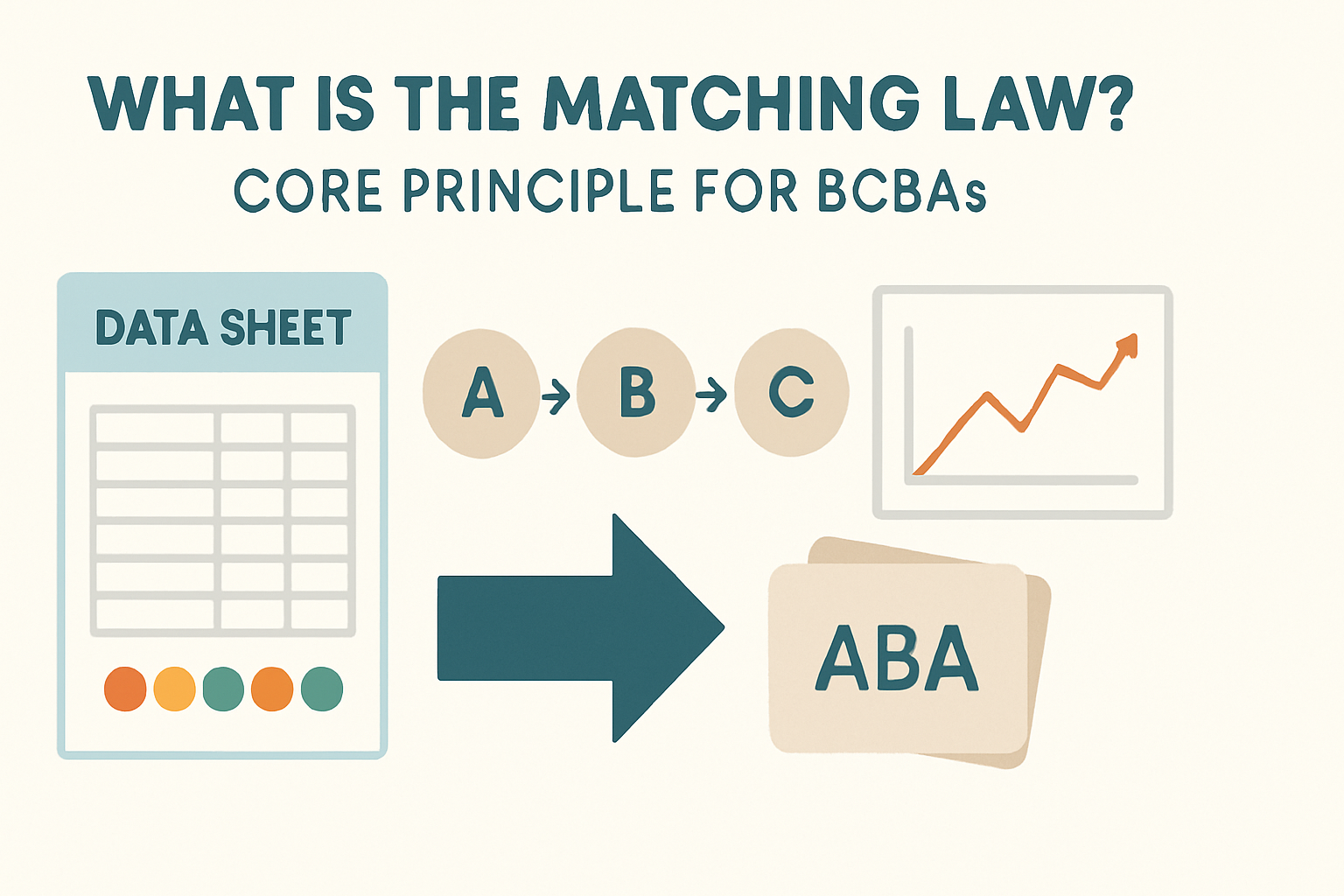
The basic matching equation is expressed as B1/B2 = R1/R2, where B represents behavior rates and R represents reinforcement rates for two alternatives. This mathematical relationship shows that response allocation directly corresponds to reinforcement allocation. The equation operates under concurrent schedules of reinforcement, where two or more response options are simultaneously available.
Consider a practical example: if a student receives attention 80% of the time for raising their hand and 20% for calling out, the Matching Law predicts they’ll allocate approximately 80% of their responses to hand-raising and 20% to calling out. This proportional relationship forms the basis for understanding how behavioral choices emerge in natural environments.
Beyond Perfect Matching: Bias and Sensitivity
Real-world data rarely show perfect matching, leading to the development of the generalized matching equation: log(B1/B2) = s log(R1/R2) + log b. This expanded model introduces two critical parameters that every BCBA should understand.
The sensitivity parameter (s) indicates how closely behavior tracks changes in reinforcement. Values less than 1 suggest undermatching, while values greater than 1 indicate overmatching. The bias parameter (b) represents systematic preference for one alternative independent of reinforcement rates, often reflecting factors like response effort or stimulus preference.
Applying the Matching Law: ABA Examples and Analysis
Moving from theory to practice, the Matching Law provides powerful tools for analyzing clinical scenarios and designing interventions. By examining how behavioral allocation responds to reinforcement contingencies, practitioners can develop more effective treatment plans.
Example 1: Classroom Engagement vs. Disruption
Consider a student who can access teacher attention through two channels: raising their hand (appropriate behavior) or calling out/disrupting (problem behavior). Data collection reveals the student receives attention for hand-raising 30% of opportunities but receives immediate peer attention for disruption 70% of opportunities.
The Matching Law predicts the student will allocate approximately 70% of their responses to disruption and 30% to appropriate hand-raising. The intervention strategy involves manipulating reinforcement schedules: systematically thinning reinforcement for disruption while enriching and making immediate reinforcement for hand-raising. This approach directly applies the principle by changing the reinforcement ratios to shift behavioral allocation.
Example 2: Choice Between Two Communication Modalities
A client with communication needs can mand using PECS (Picture Exchange Communication System) or vocal approximations. PECS requires less effort but results in slower reinforcement delivery, while vocal approximations require more effort but produce faster results.
Analysis shows the client uses PECS 40% of opportunities and vocal approximations 60%, despite PECS having a higher reinforcement rate. This demonstrates response bias toward the less effortful option. The intervention involves shaping behavior through differential reinforcement, gradually increasing reinforcement immediacy for vocal approximations while maintaining functional communication through PECS.
Matching Law on the BCBA Exam: What to Expect and Avoid
The Matching Law appears regularly on the BCBA exam, often in scenarios testing application rather than rote memorization. Understanding common question formats and traps is essential for exam success.

Common Exam Traps and Misconceptions
Several misconceptions regularly trip up candidates. First, confusing the Matching Law with behavioral contrast or response momentum is common. While related, these are distinct concepts with different predictive functions.
Another frequent error involves assuming the Matching Law only applies to identical reinforcers. In reality, it describes allocation across different reinforcement types and qualities. Candidates also often misinterpret the principle as predicting which single behavior will occur, rather than understanding it describes proportional allocation across options.
Finally, misidentifying bias versus sensitivity in given scenarios represents a significant exam trap. Remember that bias reflects consistent preference independent of reinforcement rates, while sensitivity indicates how behavior tracks reinforcement changes.
Sample Practice Prompt and Rationale
Consider this exam-style question: ‘A client engages in two behaviors to access attention: appropriate requests (Behavior A) and aggression (Behavior B). Data show Behavior A occurs 25% of opportunities and receives reinforcement 75% of the time, while Behavior B occurs 75% of opportunities and receives reinforcement 25% of the time. This pattern BEST illustrates:’
The correct answer is ‘bias toward Behavior B.’ The rationale: The response allocation doesn’t match the reinforcement allocation, indicating systematic preference for one alternative. This represents bias rather than matching or sensitivity issues. Common distractors include ‘perfect matching’ (incorrect because allocation doesn’t match) and ‘undermatching’ (incorrect because the pattern shows systematic deviation).
Quick-Reference Checklist for Practitioners
Use this actionable checklist for both clinical application and exam preparation:
- Identify concurrent operants – Determine what response options are simultaneously available to the individual
- Collect allocation data – Measure both response rates and reinforcement rates for each alternative
- Calculate proportions – Compare B1/B2 with R1/R2 to assess matching or deviation
- Analyze for bias – Look for consistent preference patterns independent of reinforcement
- Assess sensitivity – Determine how closely behavior tracks reinforcement changes
- Design interventions – Manipulate reinforcement schedules to shift allocation toward target behaviors
- Monitor changes – Track how behavioral allocation responds to intervention modifications
Final Summary and Next Steps
The Matching Law provides a powerful framework for understanding choice behavior in applied settings. By mastering Herrnstein’s equations and their practical applications, BCBA candidates can better analyze complex behavioral patterns and design more effective interventions.
For further study, review the Behavior Analyst Certification Board task list items related to choice and concurrent schedules. Additional resources on operant conditioning principles and schedules of reinforcement provide essential context for understanding matching applications.
Remember that successful application requires careful data collection and analysis. The Matching Law isn’t just theoretical—it’s a practical tool for predicting and influencing behavioral allocation in real-world settings. As you prepare for the BCBA exam, focus on applying these principles to diverse scenarios and recognizing the patterns that indicate matching, bias, or sensitivity issues.