
Echoic behavior is often treated as one of the simplest verbal operants in ABA. For many BCBA candidates, it feels straightforward: a learner repeats what they hear, point made, move on. However, this oversimplified view is exactly why echoic-related questions quietly become easy-to-miss points on the BCBA® exam.
The exam is not testing whether you can recognize repetition. It is testing whether you understand when repetition is functionally relevant — and when it is not.
Why Repetition Alone Is Not the Point
In ABA, repetition is a form, not a function. Echoic behavior is defined by a specific controlling relation: a verbal stimulus evokes a vocal response with point-to-point correspondence and formal similarity, maintained by generalized conditioned reinforcement.
What matters for exam purposes is not whether repetition occurs, but why it occurs and how it is maintained.
Many incorrect answer choices rely on a subtle trap: they describe repetition clearly, but the maintaining variables no longer support labeling the response as echoic.
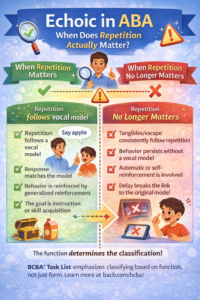
When Repetition Does Matter: True Echoic Control
Repetition matters when the response is under this control, meaning:
-
A vocal model immediately precedes the response
-
The response matches the model with point-to-point correspondence
-
The behavior is reinforced by generalized social reinforcement
-
The function is instructional or skill acquisition, not access to specific outcomes
For example, when an instructor says “say apple” and the learner repeats “apple,” the repetition itself is the defining feature. In these cases, echoic behavior often serves as a foundational operant, supporting the later development of mands, tacts, or intraverbals.
When Repetition Does Not Matter
Repetition stops mattering when other controlling variables replace the echoic relation.
Common exam-relevant examples include:
-
Repetition that consistently produces access to tangibles or escape
-
Responses that persist without a vocal model
-
Speech maintained by automatic reinforcement
-
Delayed repetition disconnected from the original verbal stimulus
In these cases, labeling the behavior as echoic is incorrect, even if the response sounds identical to a previous model. The function has shifted, and repetition alone no longer defines the operant.
This is where many candidates go wrong: they recognize repetition and stop analyzing.
Echoic vs. Other Verbal Operants: A Common Exam Confusion
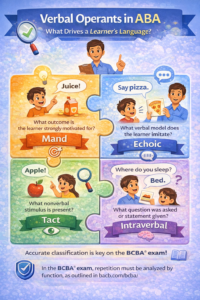
BCBA exam questions frequently require you to reclassify repetition based on function.
For example:
-
Repetition that directly results in access to an item may function as a mand
-
Repetition that labels an object in the presence of that object may function as a tact
If the question stem emphasizes consequences, motivation, or environmental change, the correct answer is rarely “echoic,” even when repetition is present.
A High-Frequency Exam Trap
One of the most common traps is assuming that echoic behavior remains echoic simply because the response topography looks the same.
On the BCBA® exam:
-
Echoic is defined by controlling relations, not by how the response sounds
-
Repetition can be present across multiple operants, but only one function is correct
When in doubt, ask: Is this response still controlled by a vocal model and generalized reinforcement? If not, repetition no longer matters.
Key Terms to Review for Echoic Questions
To answer echoic-related questions accurately, BCBA candidates should review:
-
Point-to-point correspondence
-
Formal similarity
-
Generalized conditioned reinforcement
-
Controlling variables vs. response form
Most mistakes occur when candidates focus on surface features instead of behavioral function.
Why This Matters on the BCBA® Exam
The BCBA exam does not reward recognizing repetition. It rewards functional analysis of verbal behavior.
Echoic behavior matters only when repetition is the defining controlling variable. When other variables take over, repetition becomes irrelevant to classification — and that distinction is exactly what the exam is designed to test.



