
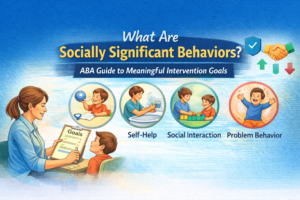
In Applied Behavior Analysis (ABA), socially significant behaviors are actions that have meaningful impact on a learner’s ability to function, communicate, and interact in daily life. These behaviors are not selected because they are easy to measure, or because they are interesting to researchers, but because changing them improves a person’s quality of life, increases independence, enhances social relationships, or reduces harm.
Behavior analysts emphasize socially significant behaviors because the ultimate goal of ABA is not just to change behavior in a lab or clinic, but to enable individuals — especially those with developmental disabilities — to thrive in natural environments, at home, at school, and in the community.
https://www.bacb.com/ethics/faq/socially-significant-behavior/ (bacb.com)
In the context of the BCBA exam, understanding socially significant behavior is essential because it links directly to ethical practice, programming decisions, and prioritization of intervention goals. The Behavior Analyst Certification Board (BACB®) defines socially significant behavior as behavior that affects the person’s daily life, health, safety, independence, or interactions in socially meaningful ways.
https://www.psychologytoday.com/us/basics/behavior-analysis/socially-significant-behavior (psychologytoday.com)
The Definition and Scope: What Counts as Socially Significant
A behavior is socially significant when its change:
-
Improves the learner’s ability to participate meaningfully in family, school, or community life
-
Increases independence in self‑care or daily living
-
Reduces risk, injury, or barriers to access
-
Enhances communication — verbal or nonverbal
For example, teaching a non‑verbal individual to request items (manding) is socially significant because it reduces frustration and increases access to community participation. Addressing aggression is socially significant because it improves safety and social acceptance.
A widely quoted description of socially significant behavior in ABA practice can be found in this practical guide:
https://autismawarenesscentre.com/socially-significant-behaviors/ (autismawarenesscentre.com)
In contrast, behaviors that are not socially significant are those that have little or no observable impact on quality of life. Changing such behaviors may be academically interesting, but ethically and clinically unnecessary if they do not improve everyday functioning.
Why Social Significance Is Central to ABA
The very core of Applied Behavior Analysis is not simply to change behavior, but to change meaningful behavior. Social significance aligns ABA with client‑centered intervention, ensuring that behavior change produces real‑world benefits. This is why many BCBA task list items emphasize socially significant outcomes as essential in program development and ethical practice.
Key reasons socially significant behaviors matter:
-
Client and caregiver priorities
Interventions should align with what families and clients see as important. -
Functional outcomes
Improvements should translate into better daily functioning, not only better scores on a test. -
Generalization and maintenance
Socially significant skills are more likely to maintain and generalize because they matter in the learner’s environment. -
Ethical practice
The BACB Code of Ethics emphasizes interventions that benefit the client and do no harm, which directly ties to social significance.
https://www.bacb.com/ethics/code/ (bacb.com)
Examples of Socially Significant Behaviors
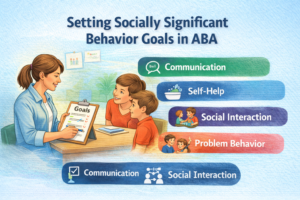
Below are common categories of socially significant behaviors frequently targeted in ABA practice:
1. Communication Skills
Teaching requests (mands), self‑initiations, conversational skills, or functional communication for individuals with limited language.
Reliable overview of communication goals:
https://autismparentingmagazine.com/functional-communication-training/ (autismparentingmagazine.com)
2. Self‑Help & Daily Living Skills
Toileting, dressing, feeding, hygiene, and other skills that increase independence and reduce caregiver burden. A table of self‑help skill targets in ABA:
https://behaviorbabe.com/self-help-skills-aba/ (behaviorbabe.com)
3. Social Interaction & Play
Permission‑based play skills, turn taking, reciprocal conversation, and social routines that support peer interaction. Social play objectives are described here:
https://autismclassroomresources.com/social-skills-aba/ (autismclassroomresources.com)
4. Reducing Problem Behavior
Behaviors that place an individual or others at risk, such as aggression, self‑injury, property destruction, or severe tantrums. These reductions are socially significant because they improve safety and access. Reducing problematic behavior without losing dignity is discussed here:
https://challengingbehavior.org/ (challengingbehavior.org)
5. Academic Skills That Support Real‑Life Success
Functional academic goals like reading signs, counting money, telling time — skills that directly support independence. A guide on ABA and academic readiness:
https://autismhelper.com/aba-academic-skills/ (autismhelper.com)
These categories illustrate how socially significant behaviors extend well beyond token behaviors into skills that transform independence, communication, and community participation.
The BCBA Exam and Socially Significant Behavior
When preparing for the BCBA exam, you will encounter questions about:
-
Defining socially significant behavior versus trivial or non‑functional targets
-
Prioritizing intervention goals based on client needs
-
Demonstrating ethical decision‑making through socially meaningful outcomes
-
Aligning assessment data with socially significant intervention plans
One classic exam angle is distinguishing criterion‑referenced goals (meaningful life outcomes) from norm‑referenced assessments that compare scores to a population. The exam often tests whether candidates can justify interventions based on functional significance, not statistical significance.
A study guide that links ABA assessment and goal selection with socially significant outcomes:
https://www.abainternational.org/events/annual‑conference/proceedings.aspx (abainternational.org)
How to Identify Socially Significant Targets
Behavior analysts use several tools and criteria to determine whether a behavior is socially significant:
-
Caregiver/Client Preference Assessment
What do parents, guardians, or the learner express as important? -
Functional Assessment
Does changing the behavior improve access to environments and roles the learner values? -
Contextual Fit
Will the skill support participation in school, work, or community activities? -
Risk‑Benefit Analysis
Does increasing or decreasing the behavior reduce harm and increase the learner’s autonomy?
Assessment tools such as the Functional Behavior Assessment (FBA) or skill inventories like VB‑MAPP can inform these decisions. An overview of FBA in ABA:
https://www.bacb.com/bcba/functional‑behavior‑assessment/ (bacb.com)
Examples of Goal Statements for Socially Significant Behaviors
To align with best practice and exam expectations, goals should be observable, measurable, and socially meaningful. Examples include:
-
Communication Goal: “Within 3 months, learner will independently use functional mands to request preferred items during 4 consecutive sessions across three settings.”
-
Self‑Help Goal: “Learner will independently complete a five‑step toileting routine with 90% accuracy across seven consecutive days.”
-
Social Interaction Goal: “Learner will initiate peer play interactions during free play for at least 2 minutes in 4 out of 5 weekly opportunities.”
-
Safety Goal: “Learner will reduce instances of self‑injury to zero across 10 sessions, as measured by direct observation data.”
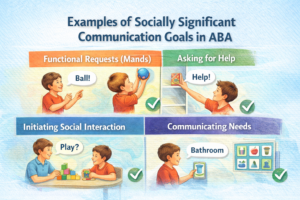
These examples illustrate how socially significant targets translate into data‑driven, meaningful behavioral outcomes.
Social Significance and Ethical ABA Practice
The BACB Code of Ethics underscores that behavior analysts must prioritize client well‑being, dignity, and beneficial outcomes. Changing behaviors that are not socially significant — that is, behaviors with no real impact on quality of life — can constitute misuse of resources or unethical practice. Ethical growth plans should always tie back to socially meaningful outcomes.
https://www.bacb.com/ethics/code/ (bacb.com)
Conclusion: The Heart of ABA Is Meaningful Change
Understanding socially significant behaviors is not optional for behavior analysts — it’s fundamental. From goal selection to data tracking, from ethical practice to BCBA exam success, focusing on behaviors that truly matter distinguishes top‑quality ABA programs.
Socially significant behaviors are those that improve lives, enhance independence, reduce risk, and foster inclusion. Prioritizing them is both good science and good ethics.
A closing professional reference on socially significant behavior:
https://www.appliedbehavioranalysisedu.org/socially-significant-behavior/ (appliedbehavioranalysisedu.org)



