

Experimental design is one of the most heavily tested and most confusing topics on the BCBA® exam.
Many candidates can name different designs but struggle to identify them in exam questions, explain why a design demonstrates experimental control, or choose the best design for a given clinical situation.
This guide explains experimental design for the BCBA exam using clear language, task-list logic, and exam-style thinking. You will learn what experimental design means in ABA, the core logic behind it, common single-subject designs, and how these concepts appear on the exam. Most experimental design concepts tested on the BCBA® exam come directly from Applied Behavior Analysis by Cooper, Heron, and Heward.
Use this article to study, review before test day, and build confidence when experimental design questions appear.
What Is Experimental Design in ABA for the BCBA Exam?
Definition (BCBA task-list style)
Experimental design refers to the systematic arrangement of conditions that allows a practitioner to demonstrate a functional relationship between an independent variable (intervention) and a dependent variable (behavior).
In simpler terms:
-
You change something on purpose (intervention)
-
You measure behavior repeatedly
-
You show that behavior changes because of the intervention, not by accident.
Why Experimental Design Is Heavily Tested on the BCBA Exam
The BACB emphasizes experimental design because ABA is a scientific discipline. You are expected to show that your interventions work using data, not opinions.
The design allows you to:
-
Demonstrate experimental control
-
Rule out alternative explanations
-
Make ethical, data-based decisions
-
Defend treatment effectiveness
Many exam questions indirectly test by asking:
-
Which design best demonstrates a functional relation?
-
Which design is most appropriate for this client?
-
Which feature shows experimental control?
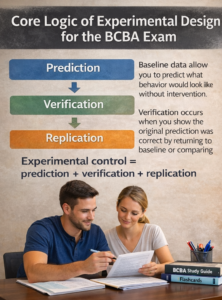
Core Logic of Experimental Design for the BCBA Exam: Prediction, Verification, and Replication
These three concepts appear repeatedly on the BCBA exam.
Prediction
Baseline data allow you to predict what behavior would look like without intervention.
If behavior changes without a change in conditions, prediction is weak.
Verification
Verification occurs when you show that the original prediction was correct by returning to baseline or comparing conditions.
Replication
Replication strengthens experimental control by showing that the behavior changes again when the intervention is reintroduced or staggered.
If you remember nothing else, remember this:
Experimental control = prediction + verification + replication
Independent vs Dependent Variables in BCBA Experimental Design
Independent Variable (IV)
-
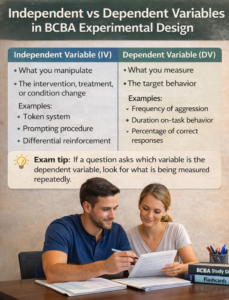
What you manipulate
-
The intervention, treatment, or condition change
Examples:
-
Token system
-
Prompting procedure
-
Differential reinforcement
Dependent Variable (DV)
-
What you measure
-
The target behavior
Examples:
-
Frequency of aggression
-
Duration of on-task behavior
-
Percentage of correct responses
Exam tip:
If a question asks which variable is the dependent variable, look for what is being measured repeatedly.
Single-Subject Experimental Designs on the BCBA Exam
Most BCBA exam questions focus on single-subject designs, not group designs.
Reversal Design (ABAB) on the BCBA Exam
Structure:
A → B → A → B
-
A = baseline
-
B = intervention
Why it demonstrates control:
-
Clear verification and replication
Exam considerations:
-
Not appropriate if behavior change is irreversible
-
Ethical concerns if removing treatment causes harm
Multiple Baseline Design
Behavior change is demonstrated by staggering intervention across:
-
Behaviors
-
Settings
-
Participants
Why it demonstrates control:
-
Behavior changes only when intervention is introduced
Exam considerations:
-
Useful when reversal is unethical
-
Requires stable baselines
Alternating TreatmentsDesign
Two or more interventions are alternated rapidly to compare effects.
Why it demonstrates control:
-
Immediate differentiation between conditions
Exam considerations:
-
Requires distinct conditions
-
Carryover effects may weaken results
Changing Criterion Design
Behavior changes gradually as the criterion changes.
Why it demonstrates control:
-
Behavior follows stepwise criterion shifts
Exam considerations:
-
Works best for behaviors that change incrementally
-
No reversal needed
Demonstrating Experimental Design on the BCBA Exam
On the BCBA exam, experimental control means:
-
The intervention, not chance, caused behavior change
Look for these indicators:
-
Consistent changes following condition changes
-
Replication of effects
-
Clear separation between phases
Trick answers often include:
-
Correlation without manipulation
-
Anecdotal reports
-
Single data points
Common Experimental Design Exam Traps
Trap 1: Descriptive vs Experimental
If the scenario only describes behavior without manipulating variables, it is not experimental.
Trap 2: Labels Without Logic
Ignore the design name and ask:
-
Is there prediction?
-
Is there verification?
-
Is there replication?
Trap 3: Ethical Constraints Ignored
If removing treatment would cause harm, reversal designs are not appropriate—even if they are powerful.
How Experimental Design Appears on the BCBA Exam
You may see questions that ask:
-
Which design best demonstrates a functional relationship?
-
Which design should be used for this scenario?
-
Which feature strengthens experimental control?
-
Which variable is the dependent variable?
Key phrases to notice:
-
“Demonstrate experimental control”
-
“Functional relation”
-
“Staggered introduction”
-
“Return to baseline”
Quick Study Checklist
Before the exam, make sure you can:
-
Define experimental design in ABA
-
Explain prediction, verification, and replication
-
Identify IVs and DVs
-
Distinguish common single-subject designs
-
Choose an appropriate design for a given scenario
-
Recognize when experimental control is weak or absent
Final Thoughts
Experimental design is not just an exam topic—it is the foundation of applied behavior analysis.
When you understand how designs demonstrate functional relationships, BCBA® exam questions become clearer and less intimidating. You stop memorizing labels and start analyzing logic.
Master experimental design, and you will not only improve your exam performance—you will become a stronger, more ethical behavior analyst.



