
A Behavior Intervention Plan (BIP) is a core concept on the BCBA® exam and a critical tool in applied behavior analysis. BCBAs use a Behavior Intervention Plan to reduce problem behavior and increase appropriate behavior based on behavioral function, not intuition or punishment. Behavior Intervention Plans are grounded in the principles of Applied Behavior Analysis (ABA) and rely on systematic assessment and reinforcement-based strategies.
What Is a Behavior Intervention Plan (BIP) in ABA?
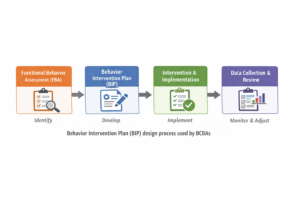
Definition (task-list style):
A Behavior Intervention Plan (BIP) is a written plan that describes how to reduce problem behavior and increase appropriate behavior by using strategies that are based on the function of the behavior.
Key points to remember:
-
A BIP is not a list of punishments
-
A BIP is not based on opinions or preferences
-
A BIP must be linked to a Functional Behavior Assessment (FBA)
👉 BCBA® exam rule:
If the plan is not function-based, it is not an effective BIP.
Step 1: Identify the Function of Behavior
Every effective BIP starts with the function.
BCBAs do not design interventions first and guess later. They use an FBA to determine why the behavior occurs.
Common behavior functions:
-
Social attention
-
Access to tangibles or activities
-
Escape or avoidance
-
Automatic reinforcement
📌 Exam tip:
If a question says a BCBA created a BIP without identifying the function, that plan is incorrect.
Step 2: Defining Target Behavior in a Behavior Intervention Plan (BIP)
In an effective BIP, the target behavior must be:
-
Observable
-
Measurable
-
Objective
❌ Poor behavior definitions:
-
“Noncompliance”
-
“Disruptive behavior”
-
“Aggression”
✅ Strong behavior definitions:
-
“Throws materials more than 30 cm from the desk”
-
“Leaves the assigned area for more than 5 seconds without permission”
👉 BCBA® exam focus:
Choose the option with the most precise behavior definition.
Step 3: Function-Based Strategies in a Behavior Intervention Plan
This is where many ineffective BIPs fail.
Intervention strategies must match the function of behavior.
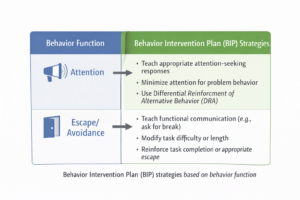
If the behavior is maintained by attention:
-
Teach appropriate attention-seeking responses
-
Use differential reinforcement of alternative behavior (DRA)
-
Minimize attention following problem behavior
If the behavior is maintained by escape:
-
Teach functional communication (e.g., asking for a break)
-
Modify task difficulty or task length
-
Reinforce task completion or appropriate escape
📌 Exam tip:
If the function is escape and the intervention provides attention, the answer is wrong.
Step 4: Include a Replacement Behavior
Every effective BIP answers this question:
“What should the learner do instead?”
A replacement behavior should be:
-
Functionally equivalent
-
Easier to perform than the problem behavior
-
Socially appropriate
Examples:
-
Requesting a break instead of tantrums
-
Raising a hand instead of shouting
-
Asking for help instead of leaving the area
👉 BCBA® exam rule:
A BIP that reduces problem behavior without teaching a replacement behavior is incomplete.
Step 5: Using Differential Reinforcement in a Behavior Intervention Plan (BIP)
Most effective BIPs rely on differential reinforcement rather than punishment.
Common procedures include:
-
DRA (Differential Reinforcement of Alternative Behavior)
-
DRO (Differential Reinforcement of Other Behavior)
-
DRL (Differential Reinforcement of Lower Rates)
Example:
-
Reinforce task completion
-
Withhold reinforcement for problem behavior
-
Gradually thin the reinforcement schedule
📌 Exam tip:
When asked to choose the best intervention, select the option that is reinforcement-based and function-matched.
Step 6: Plan Consequences Carefully
In ABA, consequences are used to teach, not to control.
Effective BIPs prioritize:
-
Reinforcement strategies
-
Antecedent modifications
-
Skill acquisition
Punishment procedures:
-
Are not first-line interventions
-
Require ethical justification
-
Often appear as distractor answers on the exam
👉 BCBA® exam pattern:
The least intrusive, reinforcement-based option is usually correct.
Step 7: Ensure the BIP Is Easy to Implement
A BIP that cannot be implemented with fidelity is not effective.
A strong BIP:
-
Uses clear, step-by-step instructions
-
Can be implemented by RBTs, teachers, and caregivers
-
Includes data collection and progress monitoring
📌 Exam tip:
Answers that mention staff training, treatment integrity, or data-based decisions are often stronger.
How Behavior Intervention Plans (BIPs) Appear on the BCBA® Exam
On the exam, BIPs usually appear in scenario-based questions.
You will be asked to:
-
Identify missing BIP components
-
Select the most appropriate intervention
-
Evaluate whether a plan matches the behavior function
Ask yourself three questions:
-
What is the function of the behavior?
-
Does the intervention match that function?
-
Does the plan reinforce a replacement behavior?
If all three are true, you are likely choosing the correct answer.
Quick Study Checklist: BIPs
Before the exam, make sure you can:
-
Define a Behavior Intervention Plan in your own words
-
Explain why BIPs must be function-based
-
Identify replacement behaviors in a plan
-
Choose function-matched reinforcement strategies
-
Recognize incomplete or ineffective BIPs
Final Thoughts
Behavior Intervention Plans are not paperwork exercises. They are a direct application of behavioral principles.
For the BCBA® exam, BIPs test whether you truly understand:
-
Why behavior occurs
-
How intervention changes future behavior
-
How reinforcement replaces problem behavior functions
An effective Behavior Intervention Plan (BIP) reflects a BCBA’s ability to apply functional assessment, reinforcement, and skill-building in real situations
When you approach BIPs through function, reinforcement, and skill building, both exam questions and real-world cases become much easier to analyze.



