Punishment is one of the most sensitive and frequently misunderstood concepts in applied behavior analysis (ABA). Many people associate punishment with harsh or harmful practices, but in ABA, punishment has a precise behavioral definition that focuses on its effect on behavior, not on intent or severity. This distinction is especially important for students preparing for the BCBA® exam.
For BCBA® candidates, punishment is an important exam topic—not because it is commonly recommended, but because understanding when behavior decreases, why it decreases, and how punishment differs from reinforcement is essential for ethical and effective practice. These distinctions are emphasized in the BCBA® Task List and professional standards published by the Behavior Analyst Certification Board (BACB) at https://www.bacb.com.
Many students first encounter punishment as a concept while studying reinforcement topics through structured prep resources such as https://bcbamockexam.com and comprehensive review content like https://bcbamockexam.com/exam-study-materials/. While reinforcement focuses on increasing behavior, punishment is defined by a decrease in behavior—an area where exam questions often include subtle traps and misleading language.
This guide explains punishment in ABA using clear definitions, practical examples, and ethical considerations grounded in established ABA literature, including Applied Behavior Analysis by Cooper, Heron, and Heward, as well as best-practice discussions shared by organizations such as the Association for Behavior Analysis International at https://www.abainternational.org. The goal is to help you identify punishment procedures accurately on the BCBA® exam and understand their limited and cautious role in behavior intervention.
What Is Punishment in ABA?
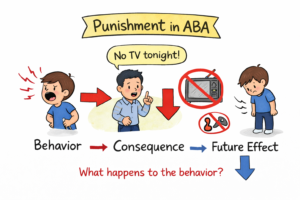
Punishment occurs when a behavior decreases because a consequence follows the behavior.
ABA defines punishment by its effect on behavior, not by whether the consequence seems harsh or unpleasant.
If a behavior becomes less likely in the future as a result of a consequence, punishment has occurred. If the behavior does not decrease, then punishment has not taken place.
Definition (task-list style):
Punishment occurs when a behavior decreases in frequency because it is followed by a consequence.
Basic Pattern of Punishment in ABA
Punishment follows the same operant learning framework as reinforcement but produces the opposite effect on behavior.
A behavior occurs. A consequence follows the behavior. Over time, the behavior occurs less often in similar situations.
ABA focuses on observing this change in behavior over time rather than labeling consequences as good or bad.
Types of Punishment in ABA
Positive Punishment
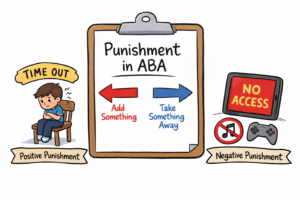
Positive punishment occurs when a behavior decreases because something is added after the behavior.
The term positive means that a stimulus is added, not that the procedure is beneficial or recommended.
Example:
A student talks out of turn in class. The teacher assigns an extra worksheet. Over time, talking out of turn decreases.
The added worksheet functions as positive punishment because it reduces the future likelihood of the behavior.
Negative Punishment
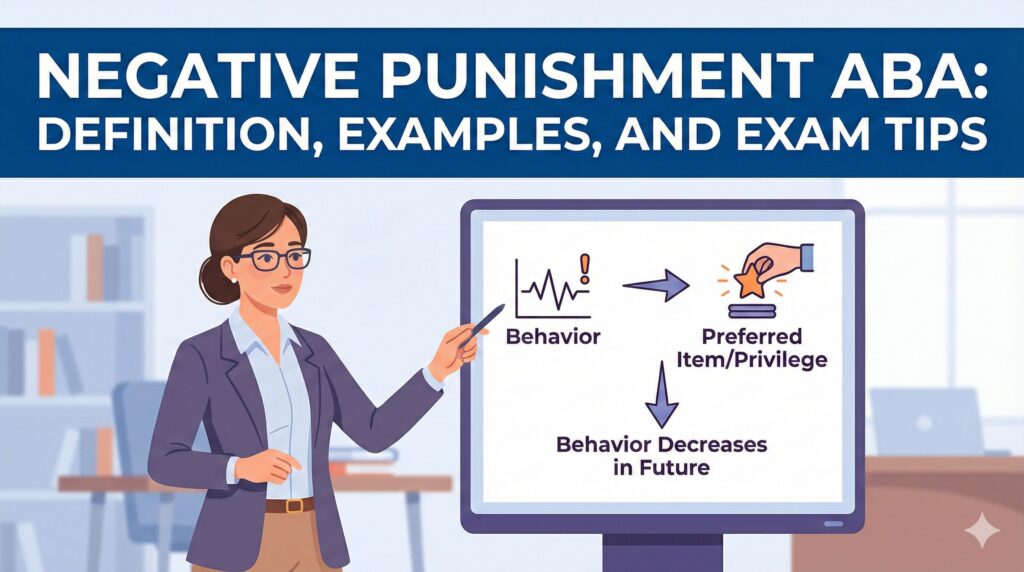
Negative punishment occurs when a behavior decreases because something is removed following the behavior.
Negative means that a stimulus is taken away.
Example:
A child hits a peer. The teacher removes access to a preferred toy for five minutes. Over time, hitting decreases.
The loss of the toy functions as negative punishment because the behavior becomes less likely in the future.
Punishment vs Reinforcement
A common exam trap is confusing punishment with negative reinforcement.
Reinforcement always increases behavior, while punishment always decreases behavior.
Positive and negative describe whether something is added or removed, not whether behavior goes up or down.
For BCBA® exam questions, always ask:
What happens to the behavior over time?
If the behavior increases, reinforcement is involved.
If the behavior decreases, punishment is involved.
Everyday Examples of Punishment
Punishment procedures can appear in everyday situations, even outside of formal behavior programs.
Positive punishment example
A driver speeds and receives a traffic ticket. Speeding decreases in the future.
The ticket functions as positive punishment because it is added and reduces the behavior.
Negative punishment example
A teenager breaks curfew and loses phone privileges for the weekend. Breaking curfew decreases.
The removal of phone access functions as negative punishment.
BCBA-style exam example
A client throws materials during instruction. When this occurs, the therapist removes access to the token board for two minutes. Over time, material throwing decreases.
The removal of tokens functions as negative punishment.
Ethical Considerations in the Use of Punishment
Although punishment can reduce behavior, it carries ethical concerns and potential side effects.
Possible risks include emotional responses, avoidance of staff, aggression, and failure to teach appropriate replacement behaviors.
For this reason, ABA prioritizes reinforcement-based interventions whenever possible.
Ethical guidelines emphasize that punishment should only be considered when:
Reinforcement-based strategies have been attempted and documented.
The target behavior poses significant risk to the individual or others.
The procedure is carefully monitored and approved through appropriate ethical review.
Punishment in Treatment Planning
In practice, punishment should never be used in isolation.
Effective behavior plans pair any behavior reduction strategy with reinforcement for appropriate alternative behaviors.
This ensures that the individual learns what to do instead of simply learning what not to do.
Most modern ABA programs rely primarily on differential reinforcement, skill teaching, and environmental modification rather than punishment procedures.
How Punishment in ABA Appears on the Exam
Exam questions often test your ability to identify punishment accurately, not to recommend it.
Look for language indicating that a behavior decreases following a consequence.
Be cautious of distractor answers that confuse punishment with extinction or negative reinforcement.
Quick Study Checklist
Before the exam, make sure you can:
Define punishment in behavioral terms.
Distinguish positive punishment from negative punishment.
Differentiate punishment from reinforcement.
Identify punishment examples in exam-style scenarios.
Explain why reinforcement-based approaches are preferred ethically.
Final Thoughts
Punishment in ABA is defined by its effect on behavior, not by intent or appearance. While it can reduce behavior, it must be approached with caution and strong ethical safeguards.
For BCBA® candidates, understanding punishment is essential for accurate behavior analysis, ethical decision-making, and exam success.
By mastering this concept, you strengthen your ability to design intervention plans that prioritize skill development, dignity, and long-term positive outcomes.