Positive Punishment ABA: Definition, Examples and Exam Tips
Positive punishment is one of the most confusing and emotionally loaded concepts in ABA therapy. Many people hear “punishment” and think of being harsh, mean, or unethical. In applied behavior analysis, positive punishment means adding something after a behavior to decrease the likelihood of that same behavior happening again.
In ABA, we talk about reinforcements and punishments as tools within operant conditioning (often associated with B.F. Skinner). The goal is not to “be strict,” but to use data-based decisions to increase desired behaviors and decrease undesired behaviors, especially when an unwanted behavior is unsafe or disruptive.
For a broader overview of how punishment fits into treatment, you can also read “Punishment in ABA: Ethical Use, Side Effects, and How It’s Tested on the BCBA® Exam” here:
https://bcbamockexam.com/punishment-in-aba-ethics-side-effects-bcba-exam/
You don’t have to like punishment to understand it. For the BCBA® exam and real practice, you need to:
-
Define positive punishment clearly
-
Tell it apart from negative punishment and reinforcement
-
Recognize common positive punishment procedures (e.g., overcorrection, response blocking)
-
Understand the side effects and ethical concerns
-
Choose reinforcement-based alternatives when possible
This guide explains positive punishment in ABA using simple language, everyday examples, and BCBA® exam tips. You can use it to study, write clearer behavior plans, and discuss reinforcements and punishments with families and teams.
What Is Positive Punishment in ABA?
Definition (task-list style)
Positive punishment occurs when a behavior decreases because a stimulus is added immediately after the behavior.
-
Positive = something is added after the behavior
-
Punishment = the behavior occurs less often in the future
In many examples, what’s added is an aversive stimulus (or an unpleasant stimulus)—but the key is always the effect: behavior to decrease must actually go down over time. If the behavior does not decrease over time, it is not positive punishment, even if the consequence sounds intense.
In ABA, we define consequences by their effect on behavior—not by how they look or how we feel about them.
Basic pattern in operant conditioning
In operant conditioning, the sequence for positive punishment looks like this:
-
A behavior occurring in the moment (the response)
-
Something aversive, effortful, or unpleasant is added right after
-
Next time, the behavior is less likely to occur in similar situations
ABA cares less about whether the consequence seems “fair” and more about whether the procedure actually reduces the behavior, while keeping safety, dignity, and ethics front and center.
For official exam information and task list details, you can always check the BACB website:
https://www.bacb.com/
Positive Punishment vs Negative Punishment
Positive and negative punishment both decrease behavior. They differ in what happens to the stimulus.
Positive punishment
-
You add a stimulus after the behavior.
-
Behavior decreases in the future.
Example: A student speaks out without raising their hand. The teacher gives a strong warning in front of the class. Over time, the student calls out less often.
Negative punishment
-
You remove a stimulus after the behavior.
-
Behavior decreases in the future.
Example (classic exam style): A child throws a tantrum after being told “no,” and the caregiver removes access to a tablet for 10 minutes (response cost). If tantrums decrease over time, that consequence functioned as a form of negative punishment.
For a focused comparison of these two types of punishment, you can also see:
https://bcbamockexam.com/positive-vs-negative-punishment-aba/
For BCBA® exam questions, always ask:
“What is happening to the behavior over time?”
If the behavior decreases, you are dealing with punishment (positive or negative).
If the behavior increases, you are dealing with reinforcement (positive or negative).
Then ask:
-
“Was something added or removed after the behavior?”
-
Added → positive
-
Removed → negative
-
Positive Punishment vs Positive Reinforcement
Positive punishment and positive reinforcement both add something after behavior—but they have opposite effects.
Positive reinforcement
-
Add a stimulus after behavior.
-
Behavior increases in the future.
Positive punishment
-
Add a stimulus after behavior.
-
Behavior decreases in the future.
This is why “positive” does not mean “good.” It only means “added.” In exam language, always look for whether the consequence increased good behavior (reinforcement) or decreased an unwanted response (punishment).
Example comparison:
-
Positive reinforcement: Child completes a worksheet → gets a sticker → worksheet completion increases (more desired behaviors).
-
Positive punishment: A child hits another child → must do an effortful restitution task (e.g., cleaning the play area) → hitting decreases.
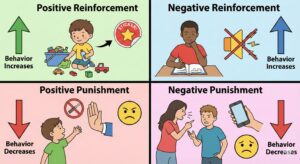
Where Positive and Negative Reinforcement Fit (Quick Contrast)
Many learners mix punishment up with reinforcement, so it helps to anchor both sets:
-
Positive and negative reinforcement increase behavior (add something or remove something to strengthen responding).
-
Positive and negative punishment decrease behavior (add something or remove something to weaken responding).
Everyday Examples of Positive Punishment
These only count as positive punishment if behavior decreases over time.
1) Touching a hot stove (simple operant example)
-
Behavior: A person tries to touch a hot stove burner.
-
Consequence: Immediate pain (an unpleasant stimulus) is added.
-
Future effect: The person is less likely to touch the burner again (decrease the likelihood of that response).
This example is commonly used to show how an added aversive consequence can reduce the future probability of a behavior.

2) Reprimand after unsafe behavior
-
Behavior: Child runs into the street.
-
Consequence: Caregiver delivers a serious, firm reprimand paired with immediate guidance back to the sidewalk.
-
Future effect: Street-running decreases in similar situations.
3) Response blocking for self-injury
-
Behavior: Client attempts to hit their head with their hand.
-
Consequence: Staff quickly blocks the movement by gently catching the arm before contact, then redirects to an alternative response.
-
Future effect: Frequency of head-hitting attempts decreases.
If the blocking reduces the behavior over time, it can function as positive punishment—often paired with differential reinforcement for safer alternatives.
4) Overcorrection after property destruction
-
Behavior: Student crumples and throws papers on the floor.
-
Consequence: Teacher calmly requires picking up papers (restoration) and practicing the correct response (positive practice).
-
Future effect: Paper-throwing decreases across the week.
5) BCBA-style exam example
When less intrusive strategies do not work, the BCBA and team use a brief overcorrection procedure. Each time the student writes on a desk, they must clean that desk and two nearby desks. After that, they practice writing correctly on paper.
-
Target behavior: Writing on desks with markers.
-
Consequence: Added cleaning and practice tasks.
-
Future effect: Writing on desks decreases.
Common Types of Positive Punishment in ABA
In modern ethical practice, positive punishment is typically considered only after reinforcement-based strategies have been attempted and documented. Common procedures include:
-
Reprimands (brief, specific verbal statements after behavior)
-
Response blocking (interrupting the response)
-
Overcorrection (restitution + positive practice)
-
Contingent exercise (effortful response after behavior)
-
Aversive stimulation (highly restricted/controversial in many contexts)
Important: Just because an exam question includes a procedure does not mean it’s recommended. “Least restrictive, reinforcement-first” thinking is usually what the test wants.
Side Effects and Limitations of Positive Punishment
Yes, punishment can be effective at reducing behavior—but effectiveness is not the only consideration. Side effects can include:
-
Emotional responding (crying, fear, anxiety)
-
Escape and avoidance of the person, setting, or tasks
-
Increased aggression or other problem behaviors
-
Only temporary suppression, especially without reinforcement for alternatives
Limitations:
-
Doesn’t teach a replacement behavior by itself
-
Can harm rapport and motivation
-
Requires careful, consistent implementation and monitoring
Using Positive Punishment in ABA Treatment Planning (Ethical Focus)
If positive punishment is considered, it should be clinically justified, carefully supervised, and paired with teaching. In many cases, the best practice is punishment with positive reinforcement for an appropriate alternative response (plus skill-building and environmental supports).
Key components include:
-
Clear functional assessment
-
Strong reinforcement for alternative behaviors (DRA/DRI/DRO as appropriate)
-
Clear definitions, procedures, and data collection
-
Informed consent and oversight
-
Continuous monitoring (target behavior + side effects), then fading ASAP
If you’re building broader study plans around these concepts, you can explore more BCBA® exam materials here:
https://bcbamockexam.com/exam-study-materials/
How Positive Punishment Appears on the BCBA® Exam
Look for these patterns:
-
Behavior decreases after something is added
-
Comparisons with positive and negative reinforcement and positive and negative punishment
-
Tricky wording that distracts from the core question: did the consequence increase or decrease behavior?
Always return to: What happened to the behavior over time?
If you want full-length practice with exam-style questions, try a free mock exam here:
https://bcbamockexam.com/free-bcba-mock-exam/
Final Thoughts
Positive punishment in ABA is a technical term, not a value judgment. It describes one way that consequences can reduce an unwanted behavior by adding a stimulus after the response.
For ethical, effective practice, BCBAs generally:
-
Use reinforcement first
-
Treat punishment as a last-resort tool
-
Pair any punishment procedure with strong reinforcement for alternative behavior
-
Monitor data and side effects carefully
When you understand how positive punishment works in operant conditioning, you can answer BCBA® exam questions more reliably—and design safer, more humane behavior plans.
Ready to test what you just learned?
Put it into practice with a free, full-length BCBA mock exam — real exam-style questions, instant scoring, and answer explanations.