Positive Reinforcement in ABA: Definition & Examples
Positive reinforcement is one of the core tools in ABA and one of the easiest to misunderstand.
Many people hear “reinforcement” and think “rewards” or “bribery.” Parents might call it rewarding good behavior. In applied behavior analysis, positive reinforcement has a clear, evidence-based meaning: you increase the likelihood a behavior occurs by adding something after it happens.
This guide explains positive reinforcement in ABA using simple language and real-world examples. You will see the types of positive reinforcement, common reinforcement strategies, and BCBA® exam tips, and you can explore more ABA terms in our blog archive under ABA Terms. You can use it to improve programs, study for the exam, and explain reinforcement and punishment to families.
What Is Positive Reinforcement in ABA?
Definition (task-list style)
Positive reinforcement occurs when a behavior increases because the learner receives something pleasant or valuable right after it.
-
Positive = something is added.
-
Reinforcement = the behavior occurs more often in the future.
For a more general psychology explanation of positive reinforcement, you can also read the overview on Verywell Mind, then come back here for ABA-specific applications.
If the behavior does not become more likely, then it is not positive reinforcement, even if you gave a sticker, snack, or verbal praise. In good positive reinforcement ABA programs, we always check whether the behavior actually changes.
Basic pattern in operant conditioning
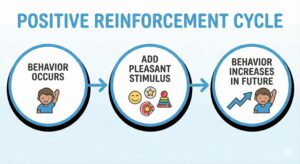
In operant conditioning, the sequence looks like this:
-
A behavior occurs.
-
The person gets something (attention, preferred activity, token, or item).
-
Next time, the behavior is more likely to occur in similar situations.
ABA cares less about whether the consequence looks nice and more about whether the behavior actually increases a desired behavior you want to see again.
Positive Reinforcement vs Negative Reinforcement in ABA
Both positive and negative reinforcement are types of reinforcement. Both can increase a desired behavior or, if used poorly, can strengthen unwanted behavior.
Positive reinforcement
You add a stimulus after the behavior.
-
Example: Child finishes homework → gets 10 minutes of tablet time → homework completion increases.
Negative reinforcement
You remove or reduce an aversive stimulus after the behavior.
-
Example: Child asks for a break with a card → difficult task stops → use of the break card increases.
For BCBA® exam questions, always ask:
“What is happening to the behavior over time?”
-
If the behavior increases, you are dealing with reinforcement (positive or negative).
-
If the behavior decreases, you are dealing with punishment (positive or negative).
This simple check works across many types of reinforcement and punishment questions.
Everyday Examples of Positive Reinforcement in ABA
Here are simple positive reinforcement examples you can adapt for sessions, parent training, or BCBA® exam questions.
1. Token board for classwork
-
Behavior: Student completes a math problem.
-
Consequence: Teacher adds a token to the student’s board. When the board is full, the student exchanges tokens for a preferred activity.
-
Future effect: Student completes more problems independently.
Tokens are tangible reinforcers. They act as conditioned reinforcers that bridge time between the response and bigger rewards.

2. Social praise for greeting peers
-
Behavior: Learner says “Hi” when a classmate enters the room.
-
Consequence: Teacher smiles and gives specific verbal praise (“Nice job saying hi to Jason!”).
-
Future effect: Rate of spontaneous greetings increases.
Here, social reinforcers such as attention and praise become a powerful way to increase positive behavior in social-skills programs.

3. Choice time after chores
-
Behavior: Teen finishes a household chore on the first request.
-
Consequence: Caregiver gives 15 minutes of choice time (music, phone, or game).
-
Future effect: Teen is more likely to complete chores quickly without arguing.
This example fits many exam stems that show how appropriate responses contact more reinforcement while problem behavior contacts less.
4. BCBA-style exam example
A child often throws materials during table work. The BCBA designs a reinforcement strategy. When the child keeps materials on the table and completes three tasks, the therapist gives access to a 30-second clip of a favorite video.
-
Target behavior: Completing three tasks with materials on the table.
-
Consequence: Access to the video.
-
Future effect: Task completion streaks increase; throwing materials decreases.
→ The video clip functions as positive reinforcement for appropriate task behavior. The procedure increases the likelihood that task behavior will occur again.
Types of Positive Reinforcement in ABA
In practice, you can use many types of positive reinforcement.
Social reinforcement
Smiles, thumbs-up, high-fives, verbal praise, short chats.
-
Easy to deliver.
-
Great for generalization and long-term maintenance of positive behavior.
Tangible reinforcement
Snacks, toys, stickers, tokens, preferred items.
-
Useful at the start of teaching or when you want to increase a desired behavior quickly.
Activity or sensory reinforcement
Games, outside time, music, sensory activities, videos.
-
Often more natural and easier to fade into everyday, real-world routines.
Natural reinforcers
Consequences that happen naturally after the response:
-
Finishing homework → more free time
-
Greeting a peer → friend smiles and talks
These natural reinforcers help skills last when formal programs end.
Token systems and group contingencies
Tokens, points, or checkmarks that lead to a bigger backup reinforcer.
-
Helpful for classrooms or group settings where you want longer periods of behavior occurring before reinforcement.
In good ABA programs, positive reinforcement strategies often start with more artificial rewards like chips and stickers. Over time they move toward natural reinforcers, social attention, and other outcomes that fit everyday life.
Using Positive Reinforcement in ABA Treatment Planning
When you design an intervention, positive reinforcement in ABA should look structured and intentional, not random.
1. Define the target behavior
Be specific:
-
“Raises hand before speaking” instead of “behaves in class.”
-
“Asks for help with a break card” instead of “doesn’t tantrum.”
2. Choose meaningful reinforcers
Conduct a simple preference assessment so you know what is actually reinforcing. What works for one learner may not work for another.
3. Set clear reinforcement rules
Examples:
-
“After every 3 correct answers, provide 30 seconds of tablet time.”
-
“Praise the use of the new response each time.”
This clarity makes positive reinforcement an effective tool, not a vague “reward system.”
4. Use differential reinforcement to replace problem behaviors
Reinforce alternative behaviors (asking for help, using a break card) instead of tantrums or elopement. This way you use positive reinforcement ABA strategies to shift behavior from unwanted behavior to safer, more functional responses.
5. Fade prompts and thin reinforcement schedules
Over time, move from continuous reinforcement to intermittent schedules. Use more natural consequences so skills last longer.
6. Train caregivers and staff
Explain that positive reinforcement is a powerful tool, not bribery. Share how it fits within B.F. Skinner’s work on operant conditioning and why it remains an evidence-based approach in modern ABA.
How Positive Reinforcement in ABA Appears on the BCBA® Exam
Look for these patterns in BCBA® exam questions about positive reinforcement and types of reinforcement:
-
The stem says a behavior “occurs more often when…” or “increases over time after…” something is given.
-
The consequence includes praise, tokens, snacks, attention, access to preferred activities, or other positive outcomes.
-
The item may compare positive reinforcement vs negative reinforcement, or ask you to pick the best reinforcement and punishment procedure for a plan.
-
Trick answers might label a procedure as “punishment” or “bribery” when the behavior is actually increasing.
When in doubt, ignore the labels and ask:
“Did adding this consequence increase the likelihood of the response in the future?”
If yes → you are looking at positive reinforcement.
If you want to practice spotting positive reinforcement in real BCBA®-style questions, try our free full-length BCBA® mock exam here: Free BCBA® Mock Exam.
Quick Study Checklist for Positive Reinforcement ABA Concepts
Before the exam, make sure you can:
-
Give the definition of positive reinforcement in your own words.
-
Distinguish positive reinforcement vs negative reinforcement and vs punishment.
-
List several types of positive reinforcement (social, tangible, activity, token, natural reinforcers).
-
Create at least three everyday positive reinforcement examples that increase behaviors you want.
-
Explain how positive reinforcement can help replace problem behaviors with safer, more effective responses.
These skills will help you answer BCBA® task-list items and design real-world behavior plans.
Final Thoughts on Positive Reinforcement ABA Practice
Positive reinforcement in ABA is not about giving endless candy or running a sticker store. It is a structured, scientifically tested way to change behavior.
By arranging consequences carefully, you help positive behaviors happen more often and make problem behaviors less effective. Used well, positive reinforcement can shift classroom routines, family life, and clinical programs.
Once you understand how reinforcement and punishment work together, you can create teaching programs, support families, and answer BCBA® exam questions with more confidence.
If you’re preparing for the BCBA® exam and want structured practice with reinforcement and punishment questions, you can find more resources at BCBA Mock Exam.