Graphing and Visual Analysis in ABA: Level, Trend, Variability and Common BCBA® Exam Errors
By BCBA Mock Exam
Introduction
Graphs are the primary way BCBAs make decisions—and the BCBA® exam expects you to be fluent in reading them.
On test day, you won’t be asked to do complex statistics. Instead, you’ll be asked to:
-
Visually inspect data and decide if an intervention is working
-
Identify changes in level, trend, and variability
-
Interpret phase changes and overlapping data points
-
Avoid common errors when drawing conclusions from graphs
In this article, we’ll walk through:
-
What level, trend, and variability mean in ABA
-
How to visually analyze graphs step by step
-
Common BCBA® exam traps related to graphs
-
Mini exam-style questions with explanations so you can practice.
1. Why Graphing and Visual Analysis in ABA Matter on the BCBA® Exam
Graphs are central to applied behavior analysis because they allow you to:
-
Make data-based decisions
-
Judge whether an intervention is effective
-
Communicate progress to caregivers, teams, and stakeholders
For the BCBA® exam, you need to:
-
Understand how to read line graphs (the most common format)
-
Analyze phase changes (baseline vs treatment)
-
Use visual analysis to determine whether behavior improved, worsened, or stayed the same
The exam often gives you:
-
Graphs with labels like A (baseline) and B, C (intervention phases)
-
Written descriptions of data patterns instead of pictures
And then asks you to identify what changed: level, trend, variability, or all three.
2. The Three Core Features: Level, Trend, Variability
When you analyze any time-series graph in ABA, you should automatically scan for three features:
-
Level – How high or low the data points are overall in a phase.
-
Trend – The direction and rate of change in the data over time (increasing, decreasing, or flat).
-
Variability – How much the data points bounce around within a phase.
The BCBA® exam will often describe changes in these features across phases and ask you to:
-
Identify what changed
-
Decide whether the change is big enough to suggest the intervention had an effect.
3. Understanding Level
Level refers to the mean or typical value of the data points in a phase.
Think of it as the “height” of the data path:
-
Are most points near 2 responses per hour?
-
Around 10 aggressive episodes per week?
-
Close to 90% correct responding?
Signs of a level change:
-
The data path shifts up or down when you move from one phase to another.
-
Example: Baseline points cluster around 2–3 per day; treatment points cluster around 7–8 per day (increase in level).
Exam tip: When the question says “an immediate increase in responding after intervention began,” it is usually referring to a change in level, especially if the jump happens right after the phase change line.
4. Understanding Trend
Trend is the overall direction of the data path within a phase.
Common trend directions:
-
Ascending trend – Data are increasing over time.
-
Descending trend – Data are decreasing over time.
-
Flat or zero trend – Data are relatively stable (little to no upward or downward movement).
Why trend matters:
-
A strong, stable descending trend in problem behavior during treatment suggests improvement.
-
An ascending trend in correct responding during skill acquisition suggests learning.
Exam tip: If baseline already has a strong improving trend before intervention, it becomes harder to argue that the intervention caused additional improvement. The exam may ask you to recognize this and respond cautiously.
5. Understanding Variability
Variability refers to how much data points differ from each other within a phase.
Low variability:
-
Data points cluster tightly around a certain value.
-
Example: Correct responding each session is between 80–85%.
High variability:
-
Data points bounce around widely.
-
Example: Problem behavior ranges from 1 to 10 episodes across baseline days.
Why variability matters:
-
High variability makes it harder to see clear effects of an intervention.
-
The BCBA® exam expects you to be more cautious about conclusions when data are very variable.
Exam tip: If a question asks why you should continue baseline before introducing treatment, one reason might be to see if variability stabilizes so that you can better detect real changes later.
6. Phase Changes, Overlap, and Data Paths
Visual analysis usually involves comparing phases (e.g., A = baseline, B = treatment).
Key concepts to watch for:
Phase change lines
-
Vertical lines that show when the condition changed (e.g., from baseline to intervention).
-
Look for immediate changes in level or trend after these lines.
Overlap
-
Occurs when data points in one phase share the same range as points in another phase.
-
Example: Baseline data = 3–5; Treatment data = 4–6 → considerable overlap.
-
Less overlap generally means stronger evidence the intervention had an effect.
Data paths
-
The line connecting data points within a phase.
-
Gaps in the data path may indicate missing data or planned breaks.
Exam tip: Many exam questions describe overlap: “Most treatment data points fall below the lowest baseline point” or “Data from phases A and B overlap completely.” This language is your cue to think about the strength of the effect.
7. Immediacy of Change — and the Full Set of Visual-Analysis Features
Quick answer: when a graph shows problem behavior dropping sharply right after the intervention begins, the feature you are analyzing is the immediacy of the change — not level, trend, or variability. Immediacy asks: how quickly did behavior change once the phase line was crossed?
Immediacy of change compares the last few data points of one phase with the first few data points of the next phase. A large, fast change at the phase line is strong evidence the intervention—not some slow outside influence—caused the effect. A change that only appears many sessions later is weaker evidence, because other variables had time to act.
Although level, trend, and variability are the three features you evaluate within a single phase, a complete visual analysis actually weighs six features across the whole graph:
- Level — the general height or position of the data points on the y-axis (the average value).
- Trend — the overall direction of the data path (ascending, descending, or flat).
- Variability — how much the data points bounce around within a phase.
- Immediacy of the change — how fast behavior changes at the phase-change line.
- Overlap — how much the data ranges of two phases share values (less overlap = stronger effect).
- Consistency of effects — whether similar conditions produce similar patterns each time they appear.
On the exam, the trap is choosing “trend” or “level” when the question is really about how quickly the change happened. If the stem stresses “immediately,” “right after,” or “as soon as treatment started,” the answer is immediacy of change.
Reading trend direction: ascending, descending, stable, or variable
When a question asks what type of trend a data path shows, match the line to one of these:
- Ascending (increasing) — the data path slopes upward over time.
- Descending (decreasing) — the data path slopes downward over time.
- Stable / flat (no trend) — the path is essentially horizontal; there is zero celeration.
- Variable — the points bounce up and down with no consistent direction; this describes variability, not a true trend.
A common multiple-choice item shows a roughly horizontal path and asks “ascending, variable, stable, or descending?” — the answer is stable (no trend). Reserve “variable” for data with no consistent direction and a wide spread.
8. A Step-by-Step Visual Analysis Routine for Exam Questions
When a graph (or description of data) appears on the exam, use a simple routine:
Step 1 – Identify phases
-
Label baseline vs intervention phases (A, B, C, etc.).
Step 2 – Check level
-
Compare the average or typical heights of data in each phase.
Step 3 – Check trend
-
Is each phase increasing, decreasing, or flat?
-
Does the trend change direction after the intervention starts?
Step 4 – Check variability
-
Are data points stable or highly scattered within each phase?
Step 5 – Look at overlap
-
Do treatment data points mostly fall above/below baseline points?
Step 6 – Combine the information
-
Stable baseline + clear change in level/trend + low overlap = stronger evidence of an effect.
-
High variability + overlapping data + pre-existing trend = weaker evidence.
This simple sequence can help you answer most visual analysis questions systematically instead of guessing.
8. Common BCBA® Exam Errors and Traps in Visual Analysis
Here are some patterns the exam likes to test:
Error 1 – Overinterpreting a single data point
One unusually high or low session does not prove an intervention worked or failed. Look for patterns over time, not single points.
Error 2 – Ignoring baseline trend
If baseline is already improving, you must be cautious about crediting the intervention.
Error 3 – Ignoring variability
Drawing strong conclusions from very variable data is risky.
Error 4 – Treating overlapping data as strong evidence
If treatment and baseline data completely overlap, it’s hard to argue your intervention had a meaningful effect.
Error 5 – Misreading axes or labels
Be sure you know what the x-axis (time, sessions, days) and y-axis (rate, percentage, duration, etc.) represent. Some exam items may hide important clues in the graph labels.
Error 6 – Forgetting clinical significance
Even if data show some improvement, ask: “Is this change meaningful for the client?” The exam may present scenarios where small, noisy changes should not be treated as major successes.
9. Mini BCBA® Exam–Style Questions (With Explanations)
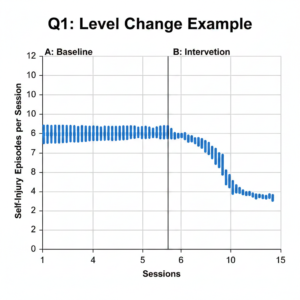
Question 1 – Level Change
In baseline, a client’s self-injury occurs between 8–10 times per session. After an intervention is introduced, self-injury drops immediately to 2–3 times per session and remains in that range across several sessions.
Which feature BEST describes this change? A. Decreased variability B. Decreased trend C. Decrease in level D. Increased overlap
Correct Answer: C – Decrease in level Explanation: There is an immediate drop in the typical height of data points when treatment begins, which is a clear level change.
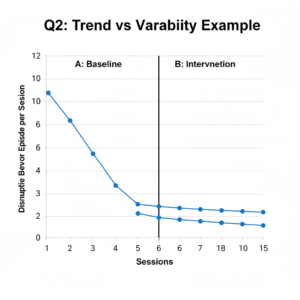
Question 2 – Trend vs Variability
Across a 10-session baseline, disruptive behavior shows a strong downward pattern, with each session slightly lower than the previous one and very little bounce in the data.
Which description is MOST accurate? A. Decreasing trend with low variability B. Decreasing trend with high variability C. Increasing trend with low variability D. No trend with high variability
Correct Answer: A Explanation: Data points are steadily decreasing (descending trend) and show little scatter (low variability).
Question 3 – Overlap
In baseline, task completion percentages range from 10–30%. During treatment, task completion ranges from 12–28%. The BCBA wants to judge treatment effects based on visual analysis.
What is the MOST accurate conclusion? A. There is strong evidence that treatment greatly improved behavior B. There is complete separation between baseline and treatment data C. There is substantial overlap between baseline and treatment phases, making it difficult to conclude there was a strong effect D. Graph shows a clear increasing trend with no variability
Correct Answer: C Explanation: Treatment data fall within the same range as baseline data (10–30% vs 12–28%), indicating substantial overlap and weak evidence of change.
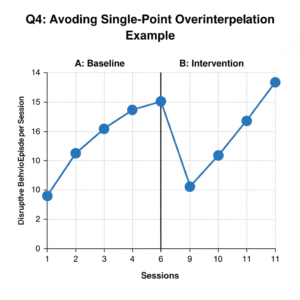
Question 4 – Avoiding Single-Point Overinterpretation
A BCBA implements a new token system. On the first day of treatment, disruptive behavior drops from 12 episodes in the last baseline session to 4 episodes. Over the next five treatment sessions, disruptive behavior climbs back up to 10–12 episodes.
What is the BEST interpretation? A. The intervention is clearly effective based on the first treatment data point B. The intervention shows no clear effect, because behavior quickly returned to baseline levels C. The baseline data were not valid and should be discarded D. The graph proves the behavior is automatically reinforced
Correct Answer: B Explanation: One improved data point followed by a return to baseline levels does not show a consistent treatment effect. You should be cautious and consider adjusting the plan.
10. Key Takeaways
-
Visual analysis focuses on level, trend, and variability within and across phases.
-
Strong evidence of treatment effects usually includes:
-
Stable baseline
-
Clear, consistent change in level and/or trend
-
Reduced overlap between baseline and treatment data
-
Consideration of variability
-
-
Avoid common exam errors:
-
Overinterpreting single data points
-
Ignoring baseline trends and variability
-
Treating overlapping data as strong evidence of change
-
On the BCBA® exam, whenever you see a graph or a description of data over time, slow down and ask yourself: What changed in level, trend, and variability—and is that change convincing enough to support the conclusion the question is asking about?
Ready to test what you just learned?
Put it into practice with a free, full-length BCBA mock exam — real exam-style questions, instant scoring, and answer explanations.
Practice Questions: Reading ABA Graphs (with answers)
Exam-style visual analysis questions on level, trend, and variability. Try each before checking the answer.
1. A data path is essentially horizontal across ten sessions. Which trend best describes it?
A) Flat / no trend B) Increasing trend C) Decreasing trend D) Variable trend
Answer: A. A horizontal path has zero celeration, so there is no trend — the behavior is stable in level.
2. If visual inspection does not show a clear reduction in behavior, what is the next step?
A) Stop the intervention B) Create data that shows a reduction C) Use further analysis strategies D) Ignore the data
Answer: C. Apply further analysis strategies. You never fabricate data or abandon a plan based on one ambiguous look.
3. A line graph shows highly variable data in baseline. What should be done before intervention?
A) Begin intervention immediately B) Continue baseline until data stabilize C) Average the data D) Change the dependent variable
Answer: B. A stable baseline is needed to detect a clear intervention effect, so continue baseline until variability decreases.
4. Baseline on-task behavior ranged 20–60% with high variability; in treatment it rose to 70–90% with an upward trend and lower variability. What should the RBT report?
A) On-task behavior increased in level, the trend shifted upward, and variability decreased B) The plan was successful C) The client liked the intervention D) No meaningful difference
Answer: A. Report objective, measurable change in level, trend, and variability — not subjective conclusions.
5. What does high variability suggest about a client’s responding?
Answer: The behavior is inconsistent and not yet under good control. Identify and address sources of variability before drawing conclusions about an intervention.
References
- Cooper, J. O., Heron, T. E., & Heward, W. L. (2020). Applied Behavior Analysis (3rd ed.) — visual analysis of graphed data.
- Behavior Analyst Certification Board. BACB.com — 6th Edition Task List.