Verbal Operants (Mand, Tact, Echoic, Intraverbal): A Practical Guide for Exam and Clinical Use
By BCBA Mock Exam
Introduction
Verbal Operants (Mand, Tact, Echoic, Intraverbal) are a foundational ABA topic that keeps showing up on the BCBA® exam and in real clinical work.
If you only memorize the definitions of mand, tact, echoic, and intraverbal, exam questions can still feel tricky—especially when they hide the terms inside long vignettes.
In practice, understanding verbal operants helps you:
-
Design language programs that are function-based, not just label-based
-
Analyze why a learner can label pictures but can’t answer questions
-
Build communication that actually works in everyday life
In this article, we’ll walk through:
-
What verbal behavior is in Skinner’s framework
-
Clear, functional definitions of mand, tact, echoic, and intraverbal
-
Everyday and clinical examples
-
How the BCBA® exam tests verbal operants (and where it tries to trick you)
-
Mini exam-style questions with explanations so you can self-check your understanding.
1. What Is Verbal Behavior (and Why Do We Care)?
Skinner did not define verbal behavior by its form (spoken words, signs, device responses) but by its function and the way it is reinforced.
Key idea:
-
Verbal behavior is behavior that is reinforced through the mediation of another person.
-
That means someone else responds to your behavior in a way that affects whether you keep doing it.
Instead of just saying “language,” Skinner broke verbal behavior into verbal operants—categories based on:
-
The antecedents (what happens before the response)
-
The type of response (what the learner does)
-
The consequences (what reinforces the response)
On the BCBA® exam, you’re expected to:
-
Recognize which verbal operant a response exemplifies in a vignette
-
Design or choose teaching procedures that correctly target specific verbal operants
-
Avoid treating all language as the same, regardless of function.
2. Overview of the Four Core Verbal Operants (Mand, Tact, Echoic, Intraverbal)
The exam (and most clinical practice) focuses heavily on four basic verbal operants:
-
Mand – Asking/requesting based on motivation
-
Tact – Labeling or commenting based on contact with the environment
-
Echoic – Repeating what someone else says
-
Intraverbal – Talking that is controlled by other verbal behavior (questions, fill-ins, conversations), without point-to-point correspondence
Each operant has its own antecedent and reinforcer pattern. That functional pattern is what the BCBA® exam cares about. For both exam prep and clinical programming, understanding Verbal Operants (Mand, Tact, Echoic, Intraverbal) helps you see that not all “language” is the same.
3. Mand: Asking for What You Want
Definition:
-
A mand is a verbal operant controlled by a motivating operation (MO) and specific reinforcement.
-
In simple terms: it is a request. The learner is asking for what they want or need in that moment.
Antecedent:
-
A motivating operation (deprivation, discomfort, desire) and often a relevant stimulus context.
-
Example: Thirst (MO for water) + seeing a water bottle.
Response:
-
The learner says, signs, points, or uses a device to “mand” for the item/activity (e.g., “Water,” “Drink,” tapping the water icon).
Consequence:
-
The learner gets specific reinforcement related to the mand (water, snack, break, help, etc.).

Examples:
-
A child says “Cookie” when they’re hungry and gets a cookie.
-
A student signs “BREAK” and the teacher gives a brief break from work.
-
A client says “Help, please” and the therapist assists with a task.
Clinical and exam notes:
-
Mands are often the most critical operant for functional communication.
-
On the exam, look for:
-
Clear motivation (wants an item, escape, attention)
-
Specific reinforcement (gets that item or outcome after the response).
-
4. Tact: Labeling the World
Definition:
-
A tact is a verbal operant controlled by nonverbal stimuli (things you see, hear, smell, feel) and reinforced by generalized or social reinforcement.
-
In simple terms: it is a label or comment about the environment.
Antecedent:
-
Nonverbal stimulus in the environment (object, event, feature).
-
Example: Seeing a dog, hearing a siren, feeling rain.
Response:
-
The learner names or describes what they sense (e.g., “Dog,” “It’s raining,” “That’s loud”).
Consequence:
-
Generalized or social reinforcement (praise, attention, acknowledgment), not direct access to the item.
-
Example: Adult says, “Yes, that’s a dog!” or smiles and responds.

Examples:
-
A child sees a fire truck and says, “Fire truck!”
-
A student looks out the window and says, “It’s snowing.”
Clinical and exam notes:
-
Tacts expand vocabulary and the ability to describe the environment.
-
On exam questions, if the learner labels something present and gets praise or attention as the consequence, you’re likely looking at a tact.
5. Echoic: Repeating What You Hear
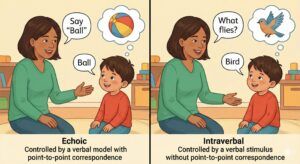
Definition:
-
An echoic is a verbal operant controlled by a verbal SD (someone else’s vocal behavior) with point-to-point correspondence and formal similarity between the stimulus and response.
-
In simple terms: repeating what someone else says.
Antecedent:
-
Someone else’s vocalization (e.g., therapist says “ball”).
Response:
-
Learner repeats with similar sounds (e.g., “ball”).
Consequence:
-
Usually generalized or social reinforcement (praise, tokens, access to next trial), not necessarily access to the item.
Examples:
-
Therapist: “Say ‘more’.” Learner: “More.”
-
Parent: “Hi!” Child: “Hi!”
Clinical and exam notes:
-
Echoics are often used early in language training to build vocal repertoires.
-
Echoic does not depend on motivation for a specific item; it depends on the verbal model.
-
On exam items, look for verbal SD, immediate imitation, and reinforcement that is not the specific item requested.
6. Intraverbal: Talking About Things That Aren’t Present
Definition:
-
An intraverbal is a verbal operant controlled by other verbal stimuli, without point-to-point correspondence between the SD and the response.
-
In simple terms: answering questions, fill-ins, and conversational responses where your words don’t exactly match the prior words.
Antecedent:
-
Verbal SD from another person (questions, statements, part of a song, etc.).
-
Example: “What do you eat?” “Ready, set…” “Twinkle, twinkle, little ___.”
Response:
-
A related but not identical verbal response (“pizza,” “go,” “star”).
Consequence:
-
Generalized/social reinforcement (praise, continuing the conversation, attention).
Examples:
-
Adult: “What’s your name?” Child: “Lily.”
-
Peer: “What’s your favorite animal?” Child: “Horse.”
-
Adult: “What do you do with a toothbrush?” Child: “Brush teeth.”
Clinical and exam notes:
-
Intraverbals are critical for conversation, academics, and social interaction.
-
On the exam, intraverbals are often contrasted with tacts:
-
Tact: “What is this?” (object present) → “Dog.”
-
Intraverbal: “What animal barks?” (no dog present) → “Dog.”
-
7. Comparing the Four Operants: Quick Functional Summary
One very exam-friendly way to remember verbal operants is to focus on MO/SD and type of reinforcement.
Think in this format for each vignette:
-
What is controlling the response? (MO, nonverbal stimulus, verbal SD?)
-
What consequence follows? (Specific item, social praise, continuation of conversation?)
Quick comparison:
-
Mand
-
Controlled by: MO (want/need something)
-
Reinforcer: Specific item/activity that was requested (e.g., cookie, break, help)
-
-
Tact
-
Controlled by: Nonverbal stimuli in the environment (things you see, hear, etc.)
-
Reinforcer: Generalized/social (praise, acknowledgment)
-
-
Echoic
-
Controlled by: Verbal SD (model) with point-to-point correspondence and formal similarity
-
Reinforcer: Generalized/social
-
-
Intraverbal
-
Controlled by: Verbal SD (questions, comments) without point-to-point correspondence
-
Reinforcer: Generalized/social (conversation, attention)
-
On the BCBA® exam, if you can reliably answer those two questions for each scenario, you’ll usually identify the correct operant.
8. How Verbal Operants Show Up on the BCBA® Exam
Many BCBA® items use Verbal Operants (Mand, Tact, Echoic, Intraverbal) in scenario form, without naming them directly.
Common question patterns include:
-
Definition/matching items
-
“Which of the following is the best example of a mand?”
-
“Which verbal operant is controlled by a motivating operation and specific reinforcement?”
-
-
Vignette-based identification
-
The stem describes a learner’s behavior in detail without using the word “mand” or “tact,” and you must label the operant.
-
-
Program design
-
Choosing teaching procedures that correctly target mands vs tacts vs intraverbals.
-
Example: selecting natural environment teaching with MO manipulation for mand training.
-
-
Error analysis
-
Identifying when a BCBA is unintentionally teaching tacts when they think they’re teaching mands, or focusing too heavily on echoics.
-
-
Functional communication training (FCT)
-
Many FCT programs teach mands (requests) to replace problem behavior.
-
The exam may ask which operant is being strengthened when teaching a specific FCR.
-
9. Common BCBA® Exam Traps with Verbal Operants
Trap 1 – Calling everything a tact
-
If the response is controlled by an MO and specific reinforcement (getting the item), it’s a mand, even if it looks like a label.
-
Example: Child says “cookie” while reaching to get one, and receives a cookie → mand.
Trap 2 – Ignoring the role of the MO
-
If there is no clear motivation to get something specific, the response may not be a mand.
Trap 3 – Confusing intraverbals with tacts
-
If the object is not present, and the response is controlled by a verbal question or statement, it’s likely an intraverbal.
Trap 4 – Assuming imitation is always echoic
-
Echoic requires vocal-verbal behavior with point-to-point correspondence and formal similarity.
-
Imitating motor actions is motor imitation, not echoic.
Trap 5 – Over-focusing on topography instead of function
-
The same word (“water”) can be a mand, tact, echoic, or intraverbal depending on the antecedents and consequences.
-
The exam will reward answers that focus on function, not just what the response sounds like.
10. Mini BCBA® Exam–Style Questions (With Explanations)
Question 1 – Mand or Tact? A child reaches toward a shelf and says “Car!” while looking at a toy car that is out of reach. The therapist hands the child the toy car.
This is BEST described as which verbal operant? A. Mand B. Tact C. Echoic D. Intraverbal
Correct Answer: A – Mand Explanation: The child wants the car (MO present) and receives the specific item as reinforcement.
Question 2 – Tact A teacher holds up a picture of a cat and asks, “What is this?” The child looks at the picture and says, “Cat.” The teacher says, “Yes, that’s right!”
This is MOST clearly an example of: A. Mand B. Tact C. Echoic D. Intraverbal
Correct Answer: B – Tact Explanation: The response is controlled by a nonverbal stimulus (the picture), and reinforcement is social praise.
Question 3 – Echoic A therapist says, “Say ‘banana.’” The learner repeats, “Banana,” and receives a token.
This is BEST described as: A. Mand B. Tact C. Echoic D. Intraverbal
Correct Answer: C – Echoic Explanation: The response is controlled by a verbal model with point-to-point correspondence and formal similarity.
Question 4 – Intraverbal A therapist asks, “What do you eat for breakfast?” The learner says, “Eggs and toast,” and the therapist responds, “Nice choice.”
This is BEST described as: A. Mand B. Tact C. Echoic D. Intraverbal
Correct Answer: D – Intraverbal Explanation: The antecedent is a verbal SD and the response does not match the therapist’s words point by point; the items are not present.
11. Key Takeaways
When you classify responses as Verbal Operants (Mand, Tact, Echoic, Intraverbal) based on function, BCBA® exam questions become much easier to decode.
-
Verbal operants are defined by function, not by how they look or sound.
-
Mand: Controlled by MOs, reinforced by specific items/activities.
-
Tact: Controlled by nonverbal stimuli, reinforced by generalized/social reinforcement.
-
Echoic: Controlled by verbal models with point-to-point correspondence and formal similarity.
-
Intraverbal: Controlled by verbal stimuli without point-to-point correspondence, key for conversation and answering questions.
On the BCBA® exam, always ask:
-
What is controlling the response? (MO, nonverbal stimulus, verbal SD?)
-
What consequence follows? (Specific item vs generalized/social reinforcement?)
When you think this way, verbal operant questions become far more straightforward—both on the test and when designing functional communication programs in your clinical work.