Extinction ABA is a core concept on the BCBA® exam. You’ll see it in questions about reducing problem behavior, understanding side effects, and evaluating why an intervention works—or fails.
At the same time, extinction ABA questions are easy to miss, because the exam often hides the term inside long vignettes without ever saying the word “extinction.”
In this guide, you’ll review:
-
What extinction is (operant extinction in behavior analysis)
-
What it is not (punishment, ignoring, or response blocking)
-
Function-based procedures for attention, escape, tangible, and automatic behaviors
-
Extinction bursts, spontaneous recovery, and side effects
-
How BCBA® questions try to trick you
For more context on reinforcement procedures, you can also read our articles “Positive Reinforcement in ABA: Definition & Examples” (https://bcbamockexam.com/positive-reinforcement-aba-definition-examples/) and “Differential Reinforcement in ABA: DRA, DRO, DRI, DRL, DRH” (https://bcbamockexam.com/differential-reinforcement-aba-dra-dro-dri-drl-drh/).
For official task-list and exam updates, always check the BACB® website: https://www.bacb.com/
1. What Extinction Means in Behavior Analysis
In applied behavior analysis, extinction means withholding the reinforcer that has historically maintained a behavior.
A behavior that used to contact reinforcement no longer produces that consequence. Over time, the behavior decreases.
Key points:
-
The behavior had a clear history of reinforcement
-
You identify the maintaining reinforcer
-
You stop delivering that specific reinforcer after the behavior
Examples:
-
A child whines for candy in a store. The parent stops giving candy when whining occurs. Whining gradually decreases.
-
A student calls out for attention. The teacher no longer responds to call-outs, but responds quickly to hand-raising. Call-outs decrease over time.
On the BCBA® exam, look for a broken response–reinforcer relation, not just “ignoring” in general.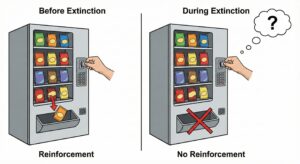
2. How Extinction ABA Differs from Other Processes
The exam loves to test fine distinctions.
Extinction vs forgetting
-
Forgetting: Behavior decreases simply because it is not practiced.
-
Extinction: Behavior is emitted, but no longer produces the reinforcer.
Extinction vs satiation
-
Satiation: The reinforcer loses effectiveness because the person has had a lot of it.
-
Extinction: The reinforcer is no longer delivered after the behavior.
Extinction vs response blocking
-
Response blocking: Physically preventing the response from occurring (e.g., blocking head-hitting).
-
Extinction: The response can occur, but the usual reinforcer is withheld.
Blocking might act like punishment or even be reinforcing; by itself, it is not extinction.
3. Extinction, Punishment, and NCR: What It Is Not
Extinction ABA procedures are often confused with other strategies that also reduce behavior.
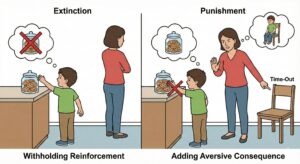
Extinction vs punishment
-
Extinction: No longer delivering the maintaining reinforcer after the response
-
Punishment: Adding or removing a stimulus after behavior so that it decreases (e.g., reprimands, token loss)
Example:
If yelling used to get adult attention and you now stop providing attention for yelling → extinction of attention-maintained behavior.
If you instead remove tokens after yelling → response cost (punishment), not extinction.
Extinction vs noncontingent reinforcement (NCR)
-
NCR: Delivering the reinforcer on a time-based schedule, independent of behavior
-
Extinction: Withholding that reinforcer when the problem behavior occurs
Many treatment plans combine NCR + extinction: free access to the reinforcer on a schedule, but no access when the problem behavior happens.
Exam cue:
If the reinforcer still follows the problem behavior, it is not extinction, even if NCR or punishment is also in place.
For a broader comparison of reinforcement vs punishment procedures, see our article “Punishment in ABA: Ethical Use, Side Effects, and BCBA® Exam Tips” on BCBA Mock Exam.
4. Function-Based Extinction Procedures
Extinction must match the function of the behavior. BCBA® questions often describe this indirectly.
-
Attention-maintained behavior
-
Extinction: Withhold attention that followed the behavior (often looks like planned ignoring).
-
-
Escape-maintained behavior
-
Extinction: Do not allow escape from tasks when the behavior occurs (while still considering safety and ethics).
-
-
Tangible-maintained behavior
-
Extinction: Do not provide the item or activity when the problem behavior occurs.
-
-
Automatically reinforced behavior
-
Extinction: Block or mask the sensory consequences (sensory extinction), such as padding a helmet to reduce sensory feedback.
-
In extinction ABA questions, ask yourself: “What consequence used to maintain this response, and is that consequence still delivered?”
5. Bursts, Recovery, and Side Effects
Extinction rarely produces a smooth decline.
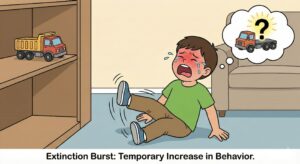
Extinction burst
-
A temporary increase in frequency, intensity, or duration of the behavior right after extinction is introduced.
Response variability
-
The learner may try different forms or intensities of the behavior to get the old reinforcer.
Spontaneous recovery
-
After the behavior has decreased, it may reappear briefly after a break, then decrease again with continued extinction.
Other possible side effects:
-
Aggression or escalation
-
Strong emotional responding (crying, tantrums)
Exam tip:
When a vignette shows an initial spike in behavior after a well-designed extinction plan starts, the best answer is often to continue the procedure (with appropriate safety and reinforcement for alternatives), not to abandon it.
6. How BCBA® Exam Questions Try to Trick You: Extinction ABA
You’ll see extinction in:
-
Straight definition questions
-
Function-based treatment selection
-
Side-effect data interpretation
-
“Find the error in this plan” items
Common traps:
-
Calling planned ignoring “extinction” when the behavior is escape-maintained and work is still removed
-
Labeling response blocking as extinction when the reinforcer is unchanged
-
Treating any decrease in behavior as “must be extinction,” even when punishment or NCR is actually in effect
Strategy for extinction ABA vignettes:
-
Identify the maintaining reinforcer (attention, escape, tangibles, automatic).
-
Check whether that reinforcer is still delivered after the behavior.
-
Look for bursts, variability, or recovery patterns that fit extinction.
-
Consider safety and ethics (Is it okay to withhold the reinforcer in this context?).
If you want to apply these concepts under exam-style conditions, you can try our free full-length BCBA® mock exam and explore more study guides on BCBA Mock Exam.
Key Takeaways Extinction ABA
-
Extinction means withholding the reinforcer that previously maintained a behavior so that the behavior decreases over time.
-
It is function-based and must match attention, escape, tangible, or automatic reinforcement.
-
It is not the same as punishment, generic “ignoring,” response blocking, or simply reducing the quality of reinforcement.
-
Expect extinction bursts, response variability, and possible spontaneous recovery.
-
On the BCBA® exam, always track: Which reinforcer maintained the behavior, and is that reinforcer still available after the response?
With a clear understanding of extinction in ABA, both exam questions and real-world treatment planning become much easier to navigate.