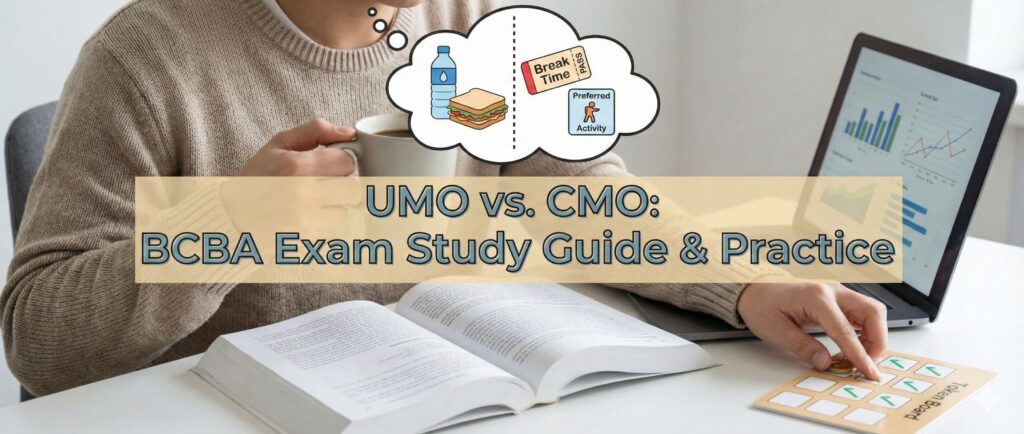
If you’re preparing for the BCBA® exam, you’ll see motivating operations ABA questions everywhere: task-list items, mock exam vignettes, and treatment-planning scenarios. Many of those items quietly test whether you can tell the difference between unconditioned motivating operations (UMOs) and conditioned motivating operations (CMOs).
On the exam, motivating operations ABA questions often ask things like:
-
Is this deprivation an MO or an SD?
-
Is this a UMO or a CMO?
-
Which type of CMO (CMO-S, CMO-R, CMO-T) is operating here?
In this post, you’ll get:
-
A quick refresher on motivating operations in ABA
-
Clear definitions of UMOs and CMOs
-
Simple examples of CMO-S, CMO-R, and CMO-T
-
Common BCBA® exam traps
-
A few practice questions with explanations
For related concepts, you can also review:
-
Positive reinforcement in ABA: https://bcbamockexam.com/positive-reinforcement-aba-definition-examples/
-
Differential reinforcement in ABA: https://bcbamockexam.com/differential-reinforcement-aba-dra-dro-dri-drl-drh/
Motivating Operations: EO, AO, and the CMO Types
A motivating operation (MO) changes (a) the value of a consequence and (b) the current frequency of behavior linked to it.
- Establishing operation (EO): increases the value of a reinforcer (e.g., deprivation).
- Abolishing operation (AO): decreases the value of a reinforcer (e.g., satiation).
- Unconditioned MO (UMO): value-altering effect is innate (food, water, sleep, temperature, pain).
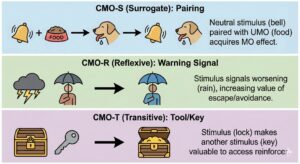
- Conditioned MO (CMO): value-altering effect is learned. Three types:
- CMO-S (surrogate): a stimulus paired with an MO takes on that MO’s value-altering effects.
- CMO-R (reflexive): a stimulus that signals worsening/improving conditions and establishes its own removal as reinforcement (e.g., a warning of an aversive event).
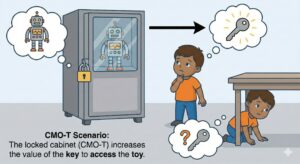
- CMO-T (transitive): a stimulus that establishes another stimulus as a reinforcer (e.g., needing a key makes the key valuable to open a locked box).
Exam tip: an MO changes how much you want something; a discriminative stimulus signals availability of reinforcement.
1. What Are Motivating Operations in ABA?
A motivating operation (MO) in ABA:
-
Changes how valuable a consequence is right now (value-altering effect), and
-
Changes how likely you are to do behavior that has produced that consequence in the past (behavior-altering effect).
In simple terms: an MO changes how much you “want” something at the moment, and how strongly you work to get it (or avoid it).
EO and AO Within Motivating Operations ABA
Two main MO effects show up in motivating operations ABA questions:
-
Establishing operation (EO): increases the value of a reinforcer and evokes behavior
-
Example: hunger makes food more valuable; food-seeking goes up.
-
-
Abolishing operation (AO): decreases the value of a reinforcer and abates behavior
-
Example: being very full makes food less valuable; food-seeking goes down.
-
From there, the exam asks whether the MO is unconditioned (UMO) or conditioned (CMO).
2. Unconditioned Motivating Operations (UMOs)
Unconditioned motivating operations have value-altering effects that do not require learning. They are biologically based.
Common UMOs and what they affect:
-
Food deprivation → increases value of food
-
Water deprivation → increases value of water
-
Sleep deprivation → increases value of sleep or rest
-
Activity deprivation → increases value of movement and play
-
Extreme temperature (too hot / too cold) → increases value of cooling or warming
-
Pain or intense discomfort → increases value of pain reduction or escape
On BCBA® exam questions about motivating operations ABA, UMOs usually involve basic bodily states and do not mention learning history or pairing.
UMO Exam Clues
You are probably looking at a UMO when the stem says things like:
-
“The client has not eaten since last night…”
-
“The learner has been awake for many hours…”
-
“The child has been outside in the heat for a long time…”
If it is clearly a biological state that would affect almost anyone in the same way, think UMO.
3. Conditioned Motivating Operations (CMOs)
Conditioned motivating operations are learned. Their value-altering effects come from the person’s history with the environment, not just biology.
Key points about CMOs:
-
They do not have built-in biological value.
-
They gain MO effects through pairing with other MOs or contingencies.
-
They depend on learning history.
The task list highlights three types used in motivating operations ABA items:
-
CMO-S (surrogate)
-
CMO-R (reflexive)
-
CMO-T (transitive)
CMO-S, CMO-R, CMO-T – Simple Definitions
CMO-S (surrogate):
-
A neutral stimulus is repeatedly paired with an existing MO.
-
It starts to “stand in for” that MO and has similar effects.
-
Example: a certain smell is always present when you are very hungry before snack; later the smell alone increases food-seeking.
CMO-R (reflexive):
-
A stimulus signals that things are about to get worse (or better).
-
It increases the value of escape/avoidance (or approach) and evokes related behavior.
-
Example: a specific ringtone always comes right before hard, non-preferred work; over time the ringtone itself evokes escape behavior.
CMO-T (transitive):
-
A situation makes some other stimulus into a reinforcer because it is needed as a tool to get what you want.
-
Example: a locked cabinet with games inside makes the key more valuable and evokes behavior that gets the key.
To check official wording around motivating operations in ABA, always refer back to the BACB® website:
https://www.bacb.com/
4. UMOs vs CMOs in Motivating Operations ABA Questions
Here is a quick comparison you can use on exam day:
-
UMOs
-
No learning required
-
Biological (hunger, thirst, pain, sleep, temperature)
-
Change value of unconditioned reinforcers
-
-
CMOs
-
Learning required
-
Based on pairing, warnings, or tools needed
-
Change value of conditioned reinforcers or other stimuli
-
Shortcut for motivating operations ABA items:
-
Clearly biological and universal → likely UMO.
-
Depends on pairing, warnings, or “tool to get something” → likely CMO (S, R, or T).
For how MOs interact with other behavior-change tools, see:
-
Extinction in ABA: https://bcbamockexam.com/extinction-aba-definition-exam/
-
Punishment in ABA: https://bcbamockexam.com/punishment-in-aba-ethics-side-effects-bcba-exam/
Common Exam Traps With Motivating Operations ABA
Watch for these patterns:
-
Calling basic deprivation (food, water, sleep) “conditioned” → it’s still a UMO.
-
Ignoring phrases like “after repeated pairings” or “over time this signal…” → these usually point to a CMO.
-
Mixing up SDs and MOs:
-
SD = signals that reinforcement is available.
-
MO = changes how much the reinforcer is currently worth.
-
5. Quick Practice Questions (With Explanations)
Question 1 – UMO or CMO?
A client has not had anything to drink all morning. During therapy, they are much more likely to ask for water and quickly follow any direction that results in a water break. What kind of motivating operation is this?
A. CMO-S
B. CMO-R
C. CMO-T
D. UMO
Correct answer: D – UMO
Why: Water deprivation is a biological state that increases the value of water without learning. That is an unconditioned motivating operation.
Question 2 – Which Type of CMO?
A specific chime always sounds right before a highly demanding, non-preferred work block begins. Over time, when the learner hears the chime, they start to whine, ask to leave, or try to avoid the activity before any demands are placed. What is the chime functioning as?
A. CMO-S
B. CMO-R
C. CMO-T
D. UMO
Correct answer: B – CMO-R
Why: The chime reliably signals “things are about to get worse,” which increases the value of escape and evokes avoidance behavior. That matches a reflexive CMO.
6. Key Takeaways for Motivating Operations ABA
-
Motivating operations in ABA change how valuable a consequence is and how likely behavior is right now.
-
UMOs are unlearned and tied to biology.
-
CMOs are learned and include CMO-S (paired with another MO), CMO-R (signals worsening or improving conditions), and CMO-T (makes a tool or key reinforcing).
-
On BCBA® exam questions, always ask:
-
Is this biological or learned?
-
Does this stimulus warn about something, stand in for another MO, or make a tool necessary?
-
To apply motivating operations ABA concepts under test conditions, you can try a free full-length mock exam here:
https://bcbamockexam.com/free-bcba-mock-exam/
Test yourself on motivating operations
Practice with a free, full-length BCBA mock exam — real exam-style questions, instant scoring, and answer explanations.
Frequently Asked Questions
What is a motivating operation in ABA?
An environmental variable that alters the value of a consequence and the current frequency of behavior linked to it. EOs raise value; AOs lower it.
What are the three types of conditioned motivating operations?
CMO-S (surrogate), CMO-R (reflexive), and CMO-T (transitive).
What is the difference between an MO and an SD?
An MO changes how much a consequence is wanted (motivation); an SD signals that reinforcement is available for a specific response (stimulus control).
References
- Cooper, J. O., Heron, T. E., & Heward, W. L. (2020). Applied Behavior Analysis (3rd ed.). Pearson.
- Behavior Analyst Certification Board — BACB.com 6th Edition Task List.